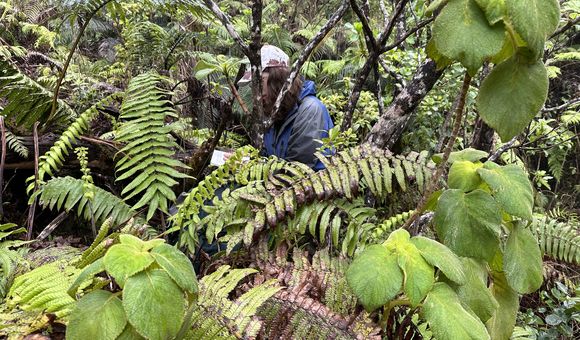
Life in the (Urban) Jungle
As more species face urbanization worldwide, understanding the impacts of urbanization on species is vital to properly assess how our behaviors as humans are influencing and altering ecosystems and species.
Using current technological and scientific advances, we are able to observe a snapshot of a plant group that is rapidly diversifying.
Research and conservation of paintings at the Lunder Conservation Center in Washington, DC.
How can digital tools help educators to foster meaningful learning experiences with museum objects? How can museum- and school-based practices inform each other? What role can technology play in this process?
As more species face urbanization worldwide, understanding the impacts of urbanization on species is vital to properly assess how our behaviors as humans are influencing and altering ecosystems and species.
Andrew CroninBurrowing crayfish are key resources in many ecosystems across the planet, and yet their secretive lifestyles mean we know very little about them.
Caitlin Claire BloomerWill forests grow faster, or more efficiently, as atmospheric carbon dioxide increases? Will trees face higher mortality rates as storms and droughts become more common?
KC CushmanWe have not given corals enough credit for their resilience and ability to bounce back. Panama's Tropical Eastern Pacific provides a glimpse into the diverse strategies corals are implementing to survive in an increasingly warmer, high CO2 world.
Victoria GlynnMCI Postdoctoral Fellow hosts a conservation workshop on the “Dry Cleaning of Soot-Coated Papers”
Tess CramerWhile we often think negatively of plant diseases in the context of agriculture, in a natural forest, disease-causing fungi (fungal pathogens) can promote overall health and diversity.
Erin R. SpearNestled in an archival box in the storage vaults of the National Museum of the American Indian, I encountered a small, copper sculpture that points to an entirely different sense of place. Hogan Teapot (2013) by Diné (Navajo) artist Amelia Joe-Chandler is a living homage to the idea of home—particularly her family’s home in Dinétah, the ancestral homelands of the Navajo Nation in the American Southwest. The brilliancy of the copper recalls the traditional form of the hogan, a dome-shaped structure with a log or stone framework that is traditionally covered with mud that hardens like rock. With a door outlined in silver on the side, the lid handle as a stove pipe, and a cast tree and two small sheep as the handle, Joe-Chandler’s sculpture changes the ubiquitous form of the teapot into a site of personal encounter through these allusions to her family’s home.
Christine GarnierU.S. artist George Peter Alexander Healy’s (1813 – 1894) 1887 portrait of President Abraham Lincoln (1809 – 1865) was the culmination of a career devoted to presidential portraiture. The image, conceived years after the sitter passed away, helps us understand the practice of nineteenth-century portraiture as much as the challenge of posthumous portrait painting. The result of Healy’s work is an iconic image of a political giant that still resonates today.
Alba Campo RosilloGlass is often thought of as a very stable, unchanging material. That, unless you drop it, it will be around forever. This, however, is far from the truth. Glass undergoes a unique and insidious type of degradation. It interacts with the humidity in the atmosphere, swapping out some of its own components for water, forming a brittle layer that most will recognize as the white scum that forms on glasses that have been run through the dishwasher a few too many times. This degradation, referred to as glass alteration, happens slowly, taking decades if not centuries to be noticeable. For most glass, glass alteration doesn’t really matter – the object is likely to be dropped or lost before anyone notices a change. But for glass objects in museums, some of which have been around for millennia, and all of which are intended to last a lot longer, the slow time scale of alteration can become a problem.
Miriam HiebertThe desire to apply color to a surface is intrinsic to human nature and humans have searched for natural sources of color since prehistoric times. They found out that some minerals could be ground to obtain a fine powder, and this was the origin of the mineral pigments. But they also found out that some plants and animals (insects and mollusks) could yield color when mixed with hot water, and this was the origin of natural dyes. Pigments are suitable to be applied on surfaces by mixing them with a binding medium. Dyes can be applied to fibers in several ways in a water solution. This discovery led to one of the most spectacular forms of art and craftsmanship: dyed textiles.
Diego TamburiniAs a palynologist, I study microscopic fossil spores and pollen that were produced by plants for reproduction. Pollen is highly important to the future of every plant and is made of an incredibly resilient substance (sporopollenin) ensuring that pollen can be preserved in rocks for hundreds of millions of years.
Vera KorasidisOne document in particular has occupied my thoughts in the months since my visit: a newspaper clipping showing two men shaking hands. The men stand in front of Ulreich’s mural Indians Watching Stagecoach in the Distance (1940), which he painted for the post office in Columbia, MO. The man on the left is named in the caption as the 1937 U.S. pavilion’s architect, Paul Lester Wiener, while the one on the right, appearing in a feathered headdress, is identified simply as, “a Navajo Indian who gave his advice on the vast murals depicting Indian life and thought which are being painted by Buck [sic.] Ulreich for the outside of the skyscraper tower.” My goal, ultimately, is to identify this man. Yet even without this man’s identity, the photograph highlights an oft-overlooked aspect of twentieth-century American art: the essential contributions of Native Americans to the mural movement that overtook the United States in the years between World War I and World War II.
Davida Fernandez-BarkanImagine this: you drive home from work, flip on the light switch, check your phone, and consider what to make for dinner. In the course of your routine, chances are you aren’t thinking about where your vehicle, light bulbs, electronics, appliances, or side of rice came from. In today’s world many raw commodities and finished goods are produced and traded globally. The items we depend on in our everyday lives, the materials we use to build our homes and roads, and the energy we consume to produce and operate them may originate from distant shores. Exports are often shipped, quite literally, on ships, creating a maritime network that reaches coastal ports around the world and supports our daily activities.
Danielle VernaThe spectacular biodiversity of the northern Pacific region of South America has drawn our attention since early botanical expeditions to the tropics conducted by European naturalists mostly during the 19th and 20th centuries. The Chocó region in northwestern Colombia, one of the rainiest places on Earth with a mean annual rainfall exceeding 10000 mm (1) is a remarkable example, which is home to an incredibly biodiverse tropical forest with ca. 3% and 6% of all known species of plants and vertebrates, respectively (2). However, a protracted history of social conflicts and sociopolitical isolation, dating back to the Spanish colonial period, has plagued the local afro and indigenous communities. As a result, our ability to carry out scientific research in this astounding region has been hindered, and in consequence, our knowledge on the evolution of this biodiversity hotspot and its hosting landscape is still limited.
Santiago LeónThe silent killer fungus, Bd, was described by Smithsonian’s National Zoo veterinarians working with a scientist from the University of Maine (Longcore et al. 1999). This new fungus to science was found to cause the skin disease chytridiomycosis — which leads to a ‘heart-attack’ and death to frogs and salamanders. We now know that the killer fungus originated in Asia and that humans unintentionally spread it around the world causing dramatic declines and disappearances of many amphibians. The killer fungus threatens the survival of more than 500 species of amphibians across the globe. Bd is now known as one of the most destructive pathogens ever recorded in wild animals.
Randall Jiménez QuirósIt’s hard being a plant leaf - being eaten is a major risk. In tropical forests, ~10-15% (>70% in some species) of leaf area can be lost via herbivory (Cardenas et al., 2014; Coley & Barone, 1996). Plants may counteract herbivory via resistance, where chemical or mechanical defenses are used to deter herbivores, or resilience, where the effect of unavoidable damage is mitigated (Kursar & Coley, 1996).
Benjamin Blonder & Luiza AparecidoSustainability is not a novel thing. Some studies have shown that most of the existing hunter-gatherers in the world (such as Pigmies in Congo, Agta Philippines and Ache in Paraguay) employ management strategies to protect the group from free-riders and guarantee sustainable use of resources. Thus, if we consider them as the closest societies to historical hunter-gatherer groups, sustainability has been part of our goal for as long as our species has occupied the planet. For over 300 thousand years, humans have been seeking strategies to develop in ways that “meets the needs of the present without compromising the ability of future generations to meet their own needs” 2. However, we may not all make it. Sustainability has changed from “the norm” to a rare and uncommon habit. Thus, how we can convince people to start to be conscious about something that seems to be an integral part of our own strategy to live as a group?
Rafael ChiaravallotiPage 1 of 2