Subscribe to Smithsonian magazine and get a FREE tote.

Volcanoes

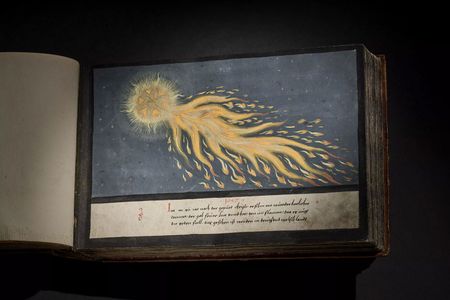
The Book of Miracles features an image of a comet from 1007.

Medieval Readers Saw Floods, Plagues and Comets as Omens of Doom—So They Created a Mysterious Manuscript of Apocalyptic Artworks to Peruse at Will

“The Book of Miracles,” a 16th-century manuscript likely created in Augsburg, is heading to auction. It features 167 paintings of extreme weather events and strange celestial phenomena
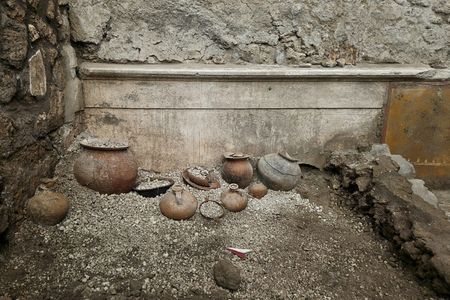
Vessels uncovered in the House of Cornelius Maximus, located on one of Pompeii's busiest streets

Cool Finds

This Wooden Wardrobe in Pompeii Remained Sealed for Nearly 2,000 Years. Archaeologists Just Opened It for the First Time

The ancient cabinet held a pair of tweezers, a perfume bottle, an incense burner and ceramic vessels. But the most impressive find was a necklace sporting at least 24 amulets shaped like deities, plants and body parts
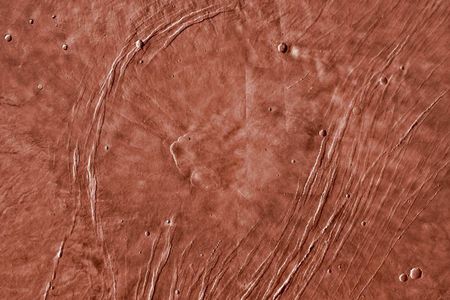
The gas may have been spewed from cracks at the edges of the shield volcano Alba Mons.

Strange Gas in Mars’ Atmosphere Hints the Red Planet Is Still Volcanically Active—and Points to Places to Search for Alien Life

Cracks along a giant Martian volcano, possibly above a magma chamber, might be spewing magmatic gases into the atmosphere, according to a new study. The fissures might host environments akin to Earth’s hydrothermal vents, where life on our planet may have emerged
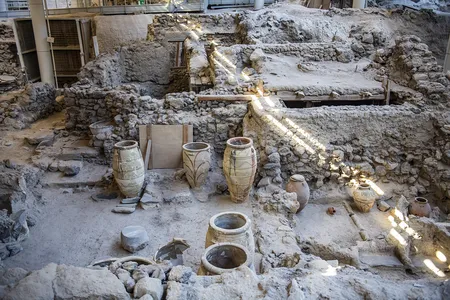
The ruins of Akrotiri, a Bronze Age settlement on what is now the Greek island of Santorini

Greece Has Its Own Pompeii, and the Ruins Tell a Captivating Story of a Sophisticated, Seafaring Bronze Age Society

The Thera volcano, on modern-day Santorini, buried Akrotiri in ash in the 17th or 16th century B.C.E. The eruption was one of the largest in recorded history
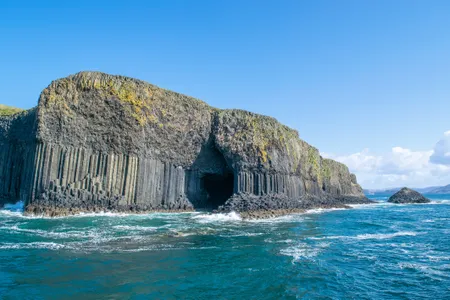
On Scotland's uninhabited island of Staffa, Fingal’s Cave is formed from tall basalt columns created by ancient volcanic activity.

Seven Places in Europe That Legends Say Were Built by Giants, Devils or Dragons

Bridges, mountains, caves and rock formations that seem impossible to explain become magnets for folklore
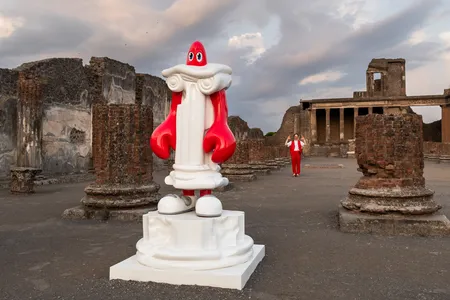
A sculpture of a giant lobster disguised as a column, made by pop artist Philip Colbert, stands in Pompeii

First a Volcanic Eruption, Now a Crustacean Invasion? See the Giant Lobsters Taking Over the Ancient City of Pompeii

A pop art installation featuring more than 30 sculptures from artist Philip Colbert is the first contemporary sculpture exhibition to land in Pompeii in three decades

Felicio (played by Frankie Treadaway) and his mother (Madeleine Walker) try to escape Mount Vesuvius' eruption in "Pompeii: Out of Time With Tom Hiddleston."

Based on a True Story

We All Know the Story of the Pompeii Victims Who Died When Mount Vesuvius Erupted 2,000 Years Ago. Archaeologists Are Still Learning About Those Who Made It Out Alive

A semi-fictionalized documentary series hosted by actor Tom Hiddleston follows three people in the ancient towns of Pompeii and Herculaneum who experienced the disaster in 79 C.E.
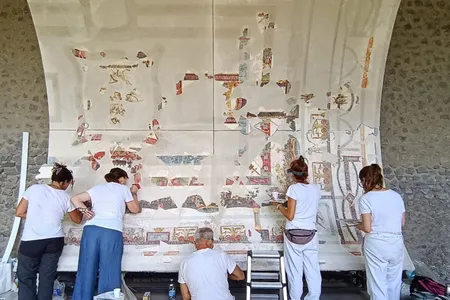
Archaeologists created a curved support structure that mimics the ceiling’s original shape.

Cool Finds

See a Rare Ceiling Fresco From Pompeii That Archaeologists Are Carefully Reassembling, Piece by Piece, Like an Ancient Puzzle

Located in the banquet hall of a home with an adjoining bakery, the fresco shows the mythological romance of Dionysus, the god of revelry and wine, and Ariadne, the Cretan princess

Mount Rainier, an active volcano about 60 miles away from Seattle, has sent fast-moving mudflows known as lahars down its slopes before. Scientists just calculated a date for the most recent one.

A Massive Flow of Rock and Mud Tumbled Down Mount Rainier Centuries Ago. Scientists Pinpointed Its Date to Better Understand the Volcano’s Complex Threats

In a recent study, researchers dated a historic lahar called the Electron Mudflow to the summer of 1507, establishing a way to determine when past geologic events around the Puget Sound occurred

Located on the Atlantic coast, the Giant's Causeway is one of the most popular natural landmarks in Northern Ireland.

Scientists Uncover New Clues About the Volcanic Origins of the Giant’s Causeway, an Iconic Geologic Structure in Northern Ireland

The UNESCO World Heritage Site, which features 40,000 near-perfect hexagonal columns, formed roughly 60 million years ago during a period of intense volcanic activity

This satellite image from January 16, 2022, reveals formaldehyde in blue. The volcanic plume from the Hunga Tonga-Hunga Ha’apai volcano traveled over the South Pacific.

Tonga’s Enormous Volcanic Eruption Cleaned Up Part of Its Own Methane Emissions in 2022, Hinting at a Way to Fight Climate Change

Researchers analyzed satellite imagery of the volcanic plume and found evidence that the potent greenhouse gas had broken down. The work could inform artificial interventions aiming to mitigate global warming, scientists say

This Socorro dove recently hatched at the San Diego Zoo Safari Park. Conservationists have been undertaking a decades-long effort to breed the extinct-in-the-wild species and one day reintroduce it to its native Socorro Island in Mexico.

New, Rare Dove Hatchlings Are a ‘Source of Hope’ for the Extinct-in-the-Wild Birds and a Step Forward in the Ambitious Project to Save Them

The Socorro dove has not been recorded in the wild since 1972, but that could change within only a few years, conservationists say, thanks to a long-term reintroduction effort

Two Alpine ibexes butt heads, slamming their horns together in a powerful battle that can be heard from far away. They wandered up the slope together afterward.

See 15 Stunning Images That Won the German Society for Nature Photography’s Annual Contest

From a lunging frog to the majestic movements of penguins, the honored photographs capture the wonder of wildlife and beauty of natural landscapes

The golden artifact, a sword scabbard fitting perhaps belonging to an elite warrior leader 

Cool Finds

A Hiker in Norway Found an Elite Warrior’s Golden Sword Ornament. It Was Likely a Sacrifice to the Gods Made During a Time of Turmoil

Volcanic eruptions, climate change, crop failures, famine and plague all may have swept through Norway in the sixth century C.E., putting pressure on leaders and their communities

Lava, seen as darker brown rocks, from Methana's most recent eruption flows through ancient limestone into the sea.

This Greek Volcano Seemed Quiet for 100,000 Years. Then It Erupted Again. Should Scientists Take a Second Look at ‘Extinct’ Volcanoes?

By reconstructing a 700,000-year history of Methana volcano, geologists found a prehistoric phase when it appeared inactive on the surface, despite magma building up below ground

The man in his 30s was found just outside Pompeii's gates.

New Research

This Man Fled Pompeii as Mount Vesuvius Erupted. Archaeologists Found Him 2,000 Years Later, Holding a Bowl to Protect His Head and a Lamp to Light His Way

Recent excavations revealed two skeletons just outside the ancient city’s walls. Researchers also created an A.I.-generated reconstruction of one of the victim’s harrowing final moments

One of the plaster casts on display in the new exhibition

Haunting Casts Preserving Pompeii Victims’ Final Moments 2,000 Years Ago Go on Display in a Solemn New Exhibition

Since 1863, archaeologists have made more than 100 plaster casts, which show how victims died after Mount Vesuvius erupted in 79 C.E. A new exhibition displays 22 of the best-preserved examples

New research is providing unique insights into the love notes, drawings, jokes and political commentary scratched into the ancient city's walls.

Cool Finds

Archaeologists Say They’ve Identified Traces of a 2,000-Year-Old Love Note Still Etched Into a Wall in Ancient Pompeii

Advanced imaging technology has revealed 79 new pieces of graffiti on a wall in the city’s theater district. Until now, these inscriptions had been too faint for the human eye to see

Graffiti scribbled on a wall in the ancient Roman city of Pompeii

Pompeii’s Graffiti Captures Every Joke, Boast and Argument of an Ancient Roman City Frozen in Time

The roughly 11,000 inscriptions preserved by Mount Vesuvius’ eruption in 79 C.E. offer a glimpse into everyday life in the Roman Empire

The Black Death may have killed more than half of Europe's population within just a few years.

A Volcanic Eruption in 1345 May Have Triggered a Chain of Events That Brought the Black Death to Europe

Ash from the explosion may have led to crop failure and famine in southern Europe, leading some Italian cities to import grain—which possibly carried fleas infected with the bubonic plague

Page 1 of 16