
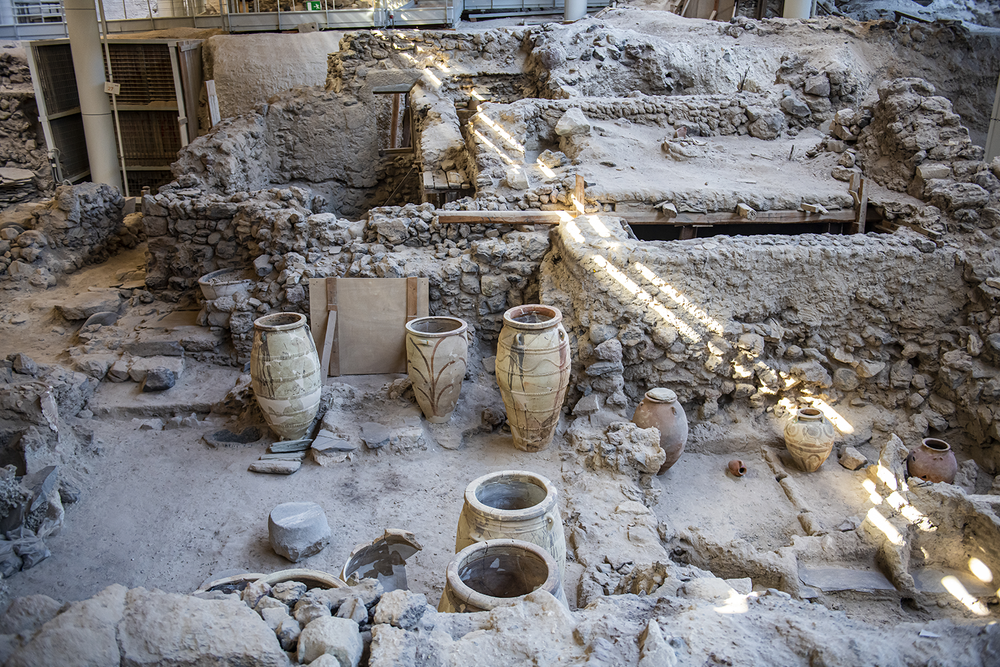
Greece Has Its Own Pompeii, and the Ruins Tell a Captivating Story of a Sophisticated, Seafaring Bronze Age Society
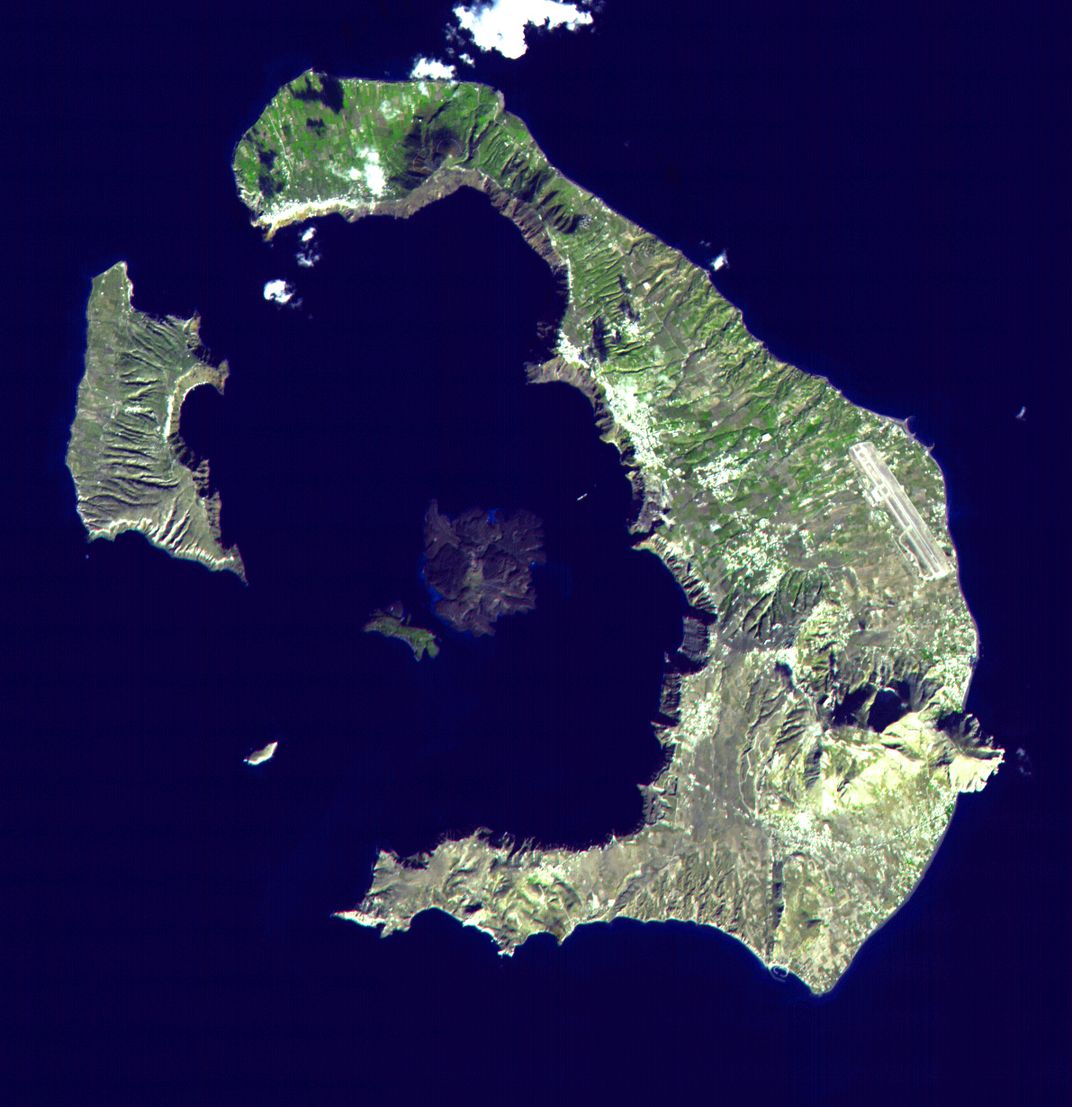
The Thera volcano, on modern-day Santorini, buried Akrotiri in ash in the 17th or 16th century B.C.E. The eruption was one of the largest in recorded history
The earth rumbled for days. Inhabitants of the seafaring Bronze Age settlement of Akrotiri watched smoke plume from Thera, a long-dormant volcano on what is now the Greek island of Santorini. People gathered their belongings and safely stored the valuables they were forced to leave behind. Then they fled by boat to nearby islands.
When these minor earthquakes and eruptions subsided, residents returned to Akrotiri, collecting materials for reconstruction and beginning the arduous process of repairing the damage. But the ground continued to tremble. As conditions worsened, they made the difficult decision to flee once more, hopeful that their homes would survive the coming devastation.
When Thera erupted again, the explosion was so powerful that it destroyed Akrotiri, burying the settlement (and the island that shared the volcano’s name) in some 200 feet of ash and pumice stone. The timing of the disaster is the subject of intense debate, but scholars generally date it to between 1620 and 1530 B.C.E. The event was one of the largest volcanic eruptions in recorded history: Thera released about four times more volcanic material than the infamous Krakatau eruption, which killed upwards of 36,000 people in what is now Indonesia in 1883.
The fallout of the Thera eruption
The ash cloud formed by the Thera eruption completely transformed the island’s lush, humid environment into an arid one. Ash from the volcano was so widespread that it rained down as far as modern-day Egypt and Israel. Layers of sand and pebbles found between archaeological deposits suggest that multiple tsunamis also contributed to the destruction.
But the biggest fallout of this cataclysmic event happened when a portion of the volcanic caldera collapsed into the sea a few days after the eruption, forever changing the landscape of Santorini. This plummet into the depths of the Aegean Sea has become the stuff of legends. Some claim that Akrotiri is the lost city of Atlantis, which the Greek philosopher Plato described centuries later, around 360 B.C.E. Most modern scholars, however, agree that Plato created the tale of the sunken island as an allegorical device.
Did you know? The legend of Atlantis
- In Plato’s telling, Atlantis was home to descendants of the sea god Poseidon, who turned on his progeny after they proved unworthy of his favor. According to the London-based Horniman Museum & Gardens, “The tale warns against the dangers of power and corruption, as well as stressing the importance of goodness.”
- Plato’s Timaeus suggests that Atlantis succumbed to “violent earthquakes and floods, and in a single day of misfortune,” the island “disappeared in the depths of the sea.”
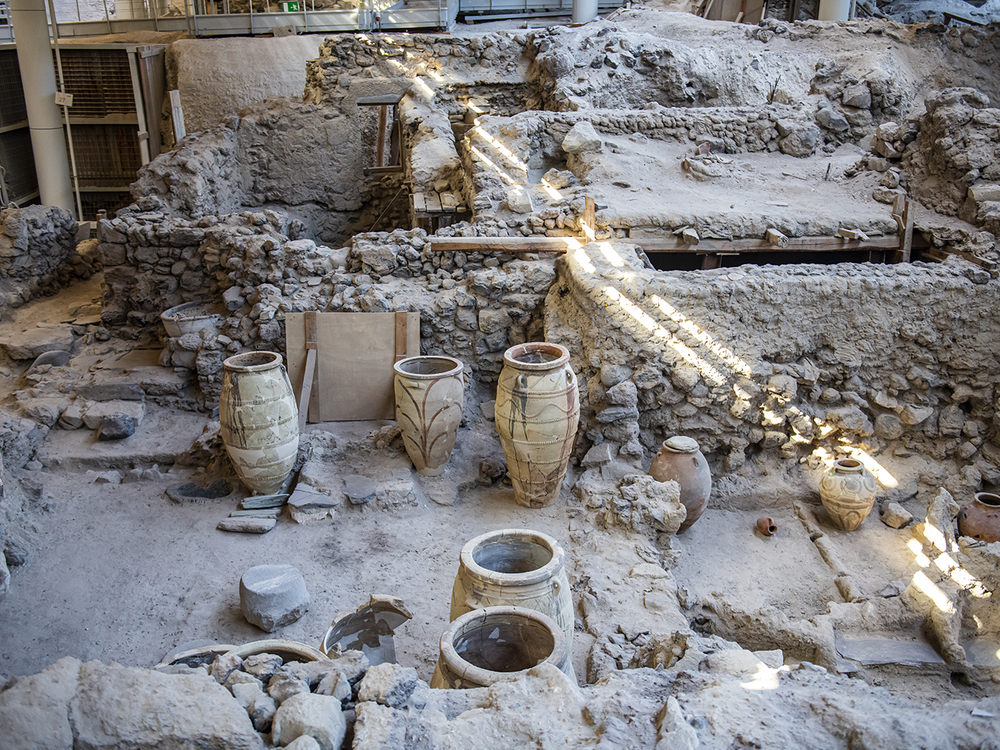
Much like the Roman city of Pompeii, which was destroyed when Mount Vesuvius erupted in 79 C.E., Akrotiri was preserved beneath the ash. “Everything was absolutely annihilated and completely encapsulated on the island,” says Lefteris Zorzos, an archaeologist whose research focuses on the prehistoric landscape of Santorini. This created a rare time capsule that provides an unprecedented look into the daily life of this Middle Bronze Age Cycladic civilization, so called after the Aegean islands where the culture flourished between about 3000 and 1000 B.C.E.
Santorini remained uninhabited for some 700 years. According to the ancient Greek historian Herodotus, Phoenicians started repopulating the island in the ninth century B.C.E. But more than 2,500 years would pass before archaeologists uncovered the ruins of ancient Akrotiri beneath the layers of dirt and ash.
Discovering Akrotiri
In 1866, miners working in pumice quarries on the island of Therasia, directly west of Thera, discovered a prehistoric building while collecting ash to insulate the Suez Canal. The French School at Athens launched a small excavation of the area in 1870, but a large-scale dig at Akrotiri only commenced nearly a century later, in 1967, under the leadership of archaeologist Spyridon Marinatos.
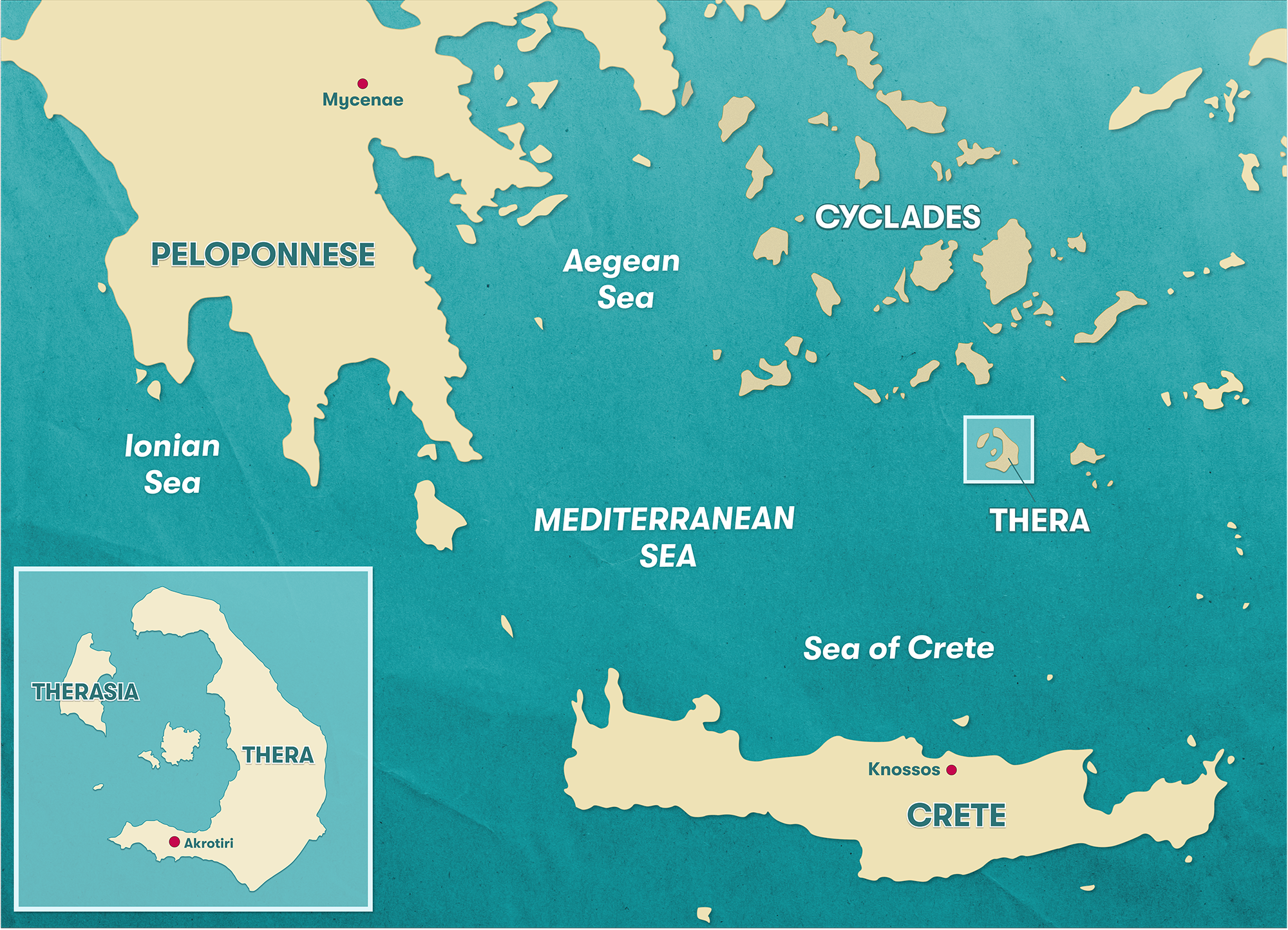
Marinatos had previously studied the excavated ruins of the Minoan Palace of Knossos in Crete, tracing pumice found on the island, some 74 miles south of Santorini, to the Thera eruption. His research marked the first time that the destruction of Akrotiri was directly linked to the decline of the Minoans, who are often identified as Europe’s first advanced civilization.
Marinatos posited that the earthquakes from Thera were so widespread, they toppled buildings and palaces on Crete. He also suggested that the resulting tsunamis damaged Minoan coastal settlements and halted shipping trade. But this theory is no longer widely accepted, and many historians now believe that the Minoans’ decline can’t be attributed to a single factor. Instead, they point to a combination of environmental changes, declining trade, political instability and conflicts with the ascendant Mycenean civilization.
Preserving an ancient site that was found remarkably intact presented a unique challenge for Marinatos. “When you excavate, you’re destroying a layer, removing the earth that’s keeping it all together,” Zorzos says. “You have to deal with this differently than you would a site that’s not as well preserved.” Before Marinatos could proceed, he had to build a shelter atop the ruins so they wouldn’t crumble when exposed to the elements.
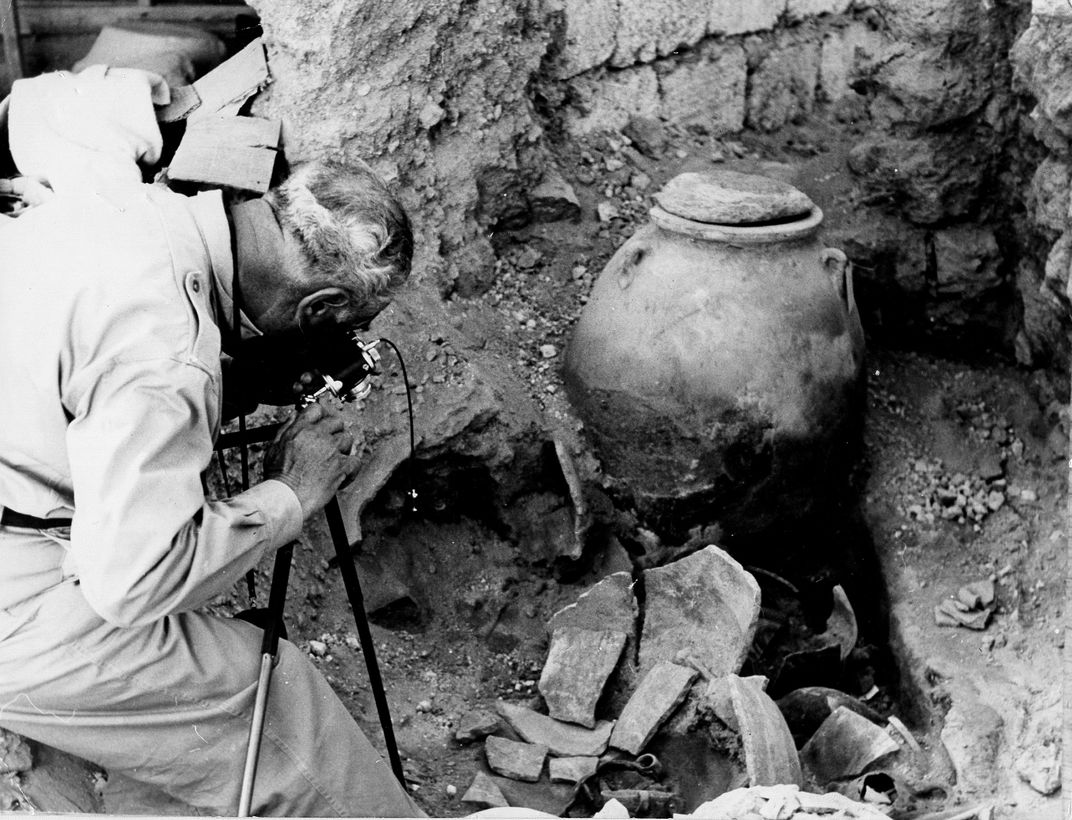
Under the leadership of Marinatos and his successor, Christos Doumas, archaeologists have excavated sites across Akrotiri down to the bedrock, allowing scientists to study the island’s stratigraphy as far back as 6,500 years ago. Zorzos estimates that the ongoing excavations have uncovered only about 10 percent of the settlement. The rest is still preserved beneath layers of ash and sediment.
Surprisingly, researchers have yet to recover the remains of any Akrotiri residents killed by the eruption, suggesting that the majority, if not all, of the settlement’s inhabitants made it out alive after receiving warning of the impending disaster. (Excavations in Turkey have, however, revealed the skeletons of a teenager and a dog believed to be victims of a post-eruption tsunami, testifying to the event’s far reach.) Comparatively, archaeologists excavating the ruins of Pompeii continue to find victims’ skeletons (or the cavities left behind by bodies trapped in volcanic ash) nearly 2,000 years after Vesuvius’ eruption.
Researchers can easily understand why Akrotiri’s inhabitants chose to settle in this area. “It has visibility and access to Crete, and it’s strategically connected to the rest of the Cycladic Islands,” says Marianna Nikolaidou, an archaeologist specializing in Aegean culture at the University of California, Los Angeles.
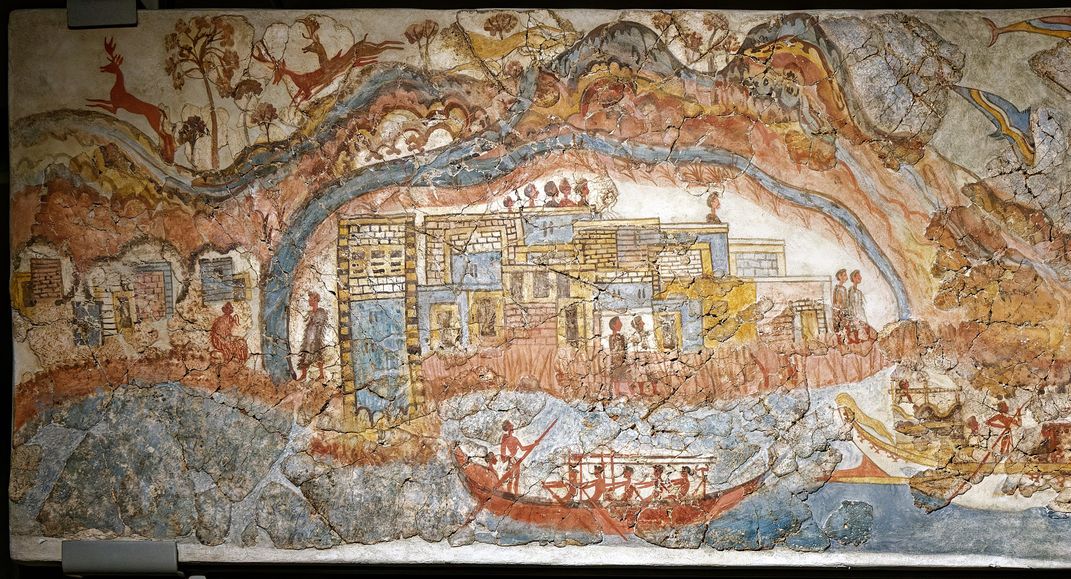
Akrotiri’s location at the crossroads of North Africa, Europe and the Middle East allowed for substantial maritime trade during the Early Bronze Age (circa 3000 to 2000 B.C.E.). Archaeological evidence suggests that the island community included farmers, fishers and craftspeople.
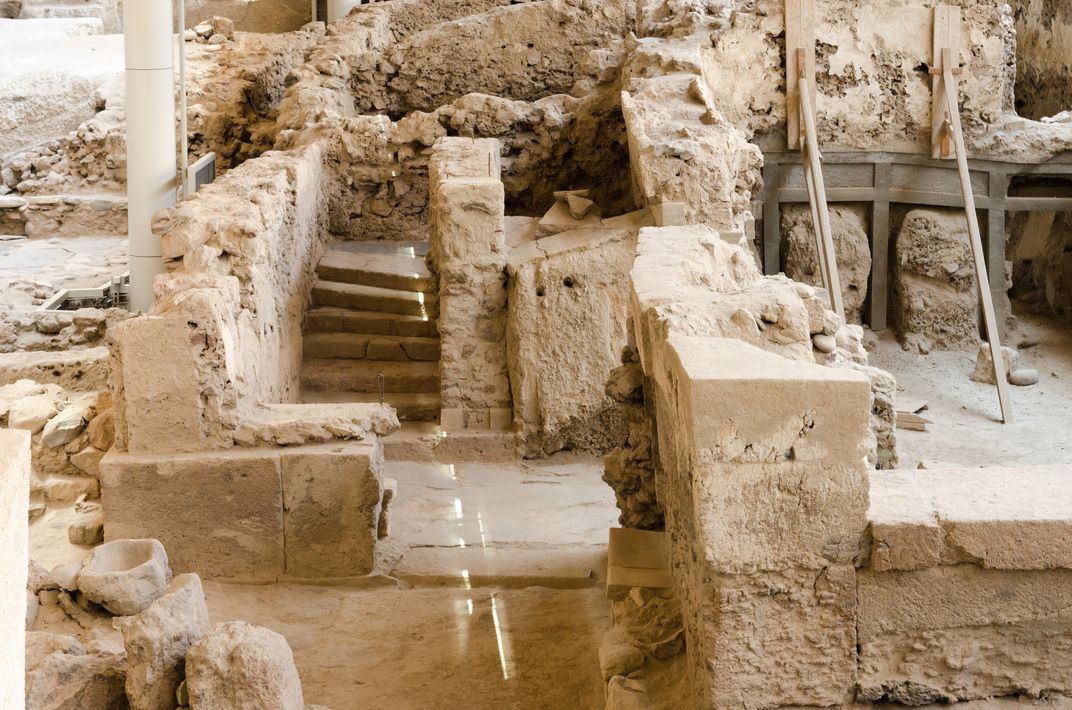
By the Middle Bronze Age, Crete’s thriving Minoan civilization had left its mark on Akrotiri. The Minoans shared major advancements in architecture with their neighbors, encouraging them to construct multistory buildings adorned with detailed frescoes, paved streets and an impressive drainage system that included indoor plumbing.
In total, archaeologists have identified and researched 35 buildings across Akrotiri. The settlement’s ancient residents “didn’t have access to forests or concrete, and still they are building three- and four-story-high buildings using limited wood, volcanic stones, mud and vegetation,” Zorzos says. “It’s phenomenal to think of how much they were able to achieve without access to modern tools.”


The art and artifacts of Akrotiri
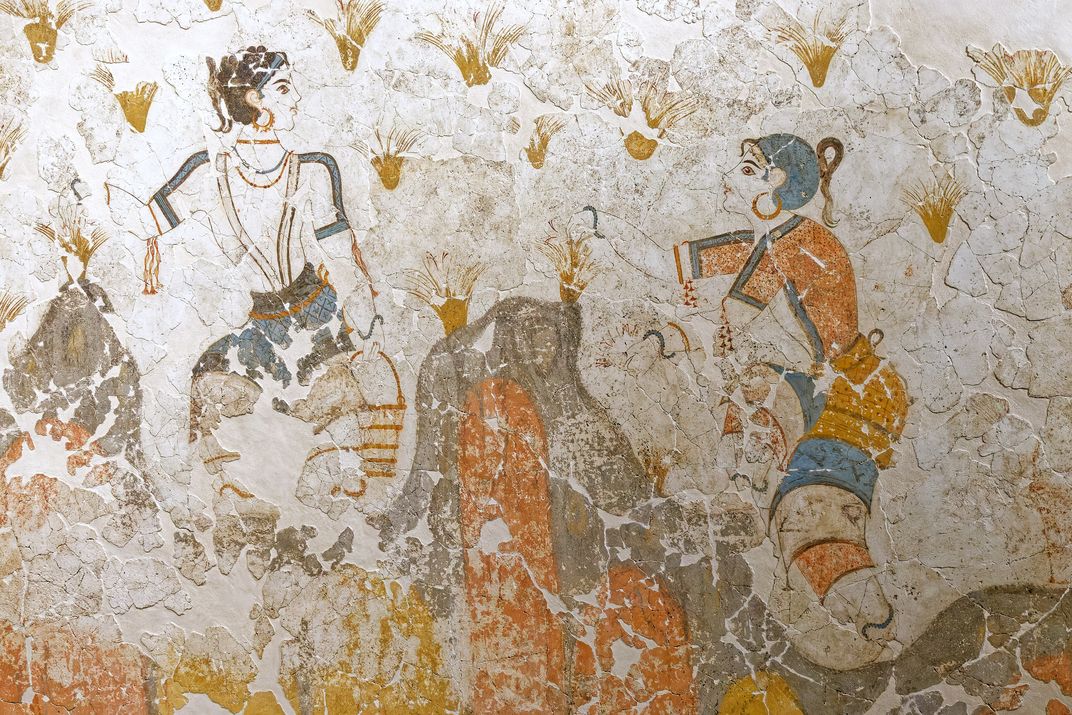
Frescoes in excellent condition adorn the walls of many homes and public buildings in Akrotiri. “Every house had a fresco with a distinct ritual characteristic, and many of them are female-centered,” Nikolaidou says.
Xeste 3, a multistory structure with 14 rooms on each floor, boasts two well-preserved wall paintings. Nikolaidou praises the frescoes’ treatment of their chosen themes, as well as the preparation and finish of the plaster on which they were painted. The first scene depicts three women in a field with crocus flowers and an altar, while the second portrays a different group of women collecting crocuses, which they offer to a goddess attended by a blue monkey and a griffin.
The crocus was a significant symbol in antiquity, with the plant used as a spice, perfume, dye or medicine. “On an island like this with limited resources, crocus must have been a source of economic prosperity, and the fact that it’s associated with women hints to the participation of women in agricultural production and the economic aspects of life, not just the ritual aspects,” Nikolaidou says.
In addition to well-preserved architecture and art, excavations at Akrotiri have unearthed vessels and beads from necklaces. Not much jewelry has been uncovered because inhabitants typically took such valuables with them when they fled. Many of the ceramics depict scenes similar to the wall paintings, providing important clues regarding daily life on the island. Vessels used for transporting oil and wine, and for storing food, feature polychrome scenes of swallows, dolphins and crocuses. Charred remains of barley and fava beans found on the bottom of some of the jugs provide a rare look at the early Mediterranean diet.
One of the most interesting pottery shapes identified at the site is the nippled ewer. “These jugs have a bulbous body, with little pinches that are painted to imitate nipples,” Nikolaidou says. Some of the vessels are even adorned with earrings and necklaces, underscoring the jug’s symbolism as a representation of the female body.
The preservation and future of Akrotiri
Marinatos died in 1974, after an onsite fall during excavations at Akrotiri. Doumas replaced him as director of the archaeological project and has held the position ever since. In 2012, he oversaw the installation of a bioclimatic shelter designed to help preserve the site. The three-acre shelter protects the fragile buildings, with discreet fans extracting the hot air from the surrounding environment. The structure also offers visitors relief from the Mediterranean sun while they explore this settlement frozen in time.
The Akrotiri archaeological site is open to the public most days of the week. Visitors are welcome to explore on their own or with a tour guide who can provide an in-depth explanation of each structure. The nearby Museum of Prehistoric Thera, located about 20 minutes away by car, houses many of the site’s artifacts and is worth a visit.
More than three and a half millennia after Thera’s eruption, the Santorini community is working with the Archaeological Society at Athens to continue to preserve and fund the site. In 2027, Santorini will celebrate the 60th anniversary of the official start of excavations—an occasion that will be marked with exhibitions, educational programs and other events.
Akrotiri’s ruins have revealed the long-overlooked story of a cosmopolitan society connected to the outside world. The settlement’s inhabitants were voyagers and artisans with sophisticated and clearly defined social stratification, but they also had a strong sense of collectivity and community that survives on Santorini today. “It’s one of the most important archaeological sites in the world,” Zorzos says. “It provides a window into life in the prehistoric Aegean like we’ve never seen before.”