
Medieval Readers Saw Floods, Plagues and Comets as Omens of Doom—So They Created a Mysterious Manuscript of Apocalyptic Artworks to Peruse at Will
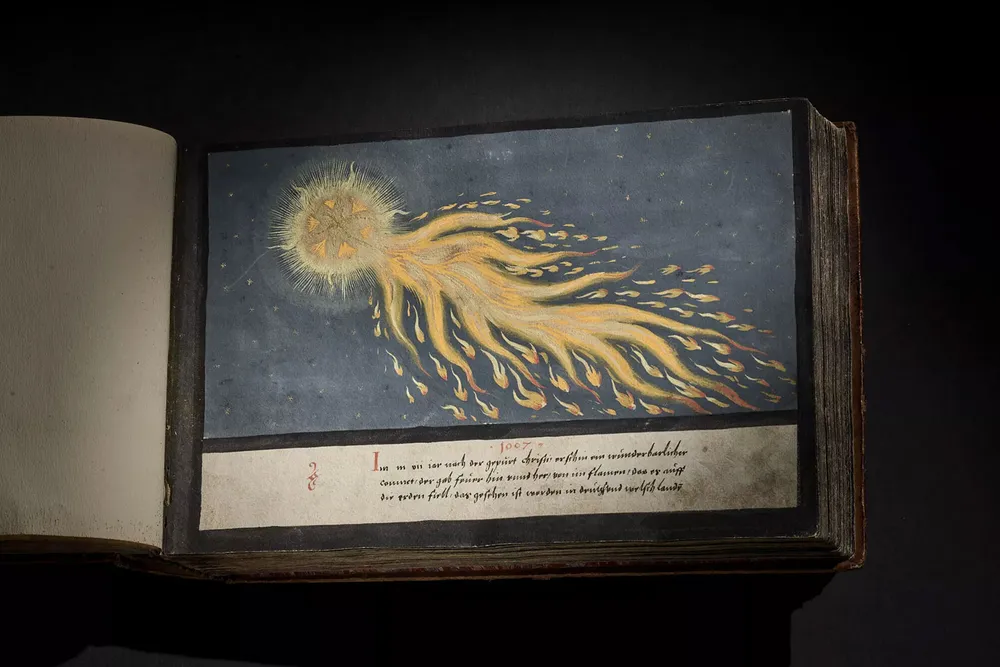
“The Book of Miracles,” a 16th-century manuscript likely created in Augsburg, is heading to auction. It features 167 paintings of extreme weather events and strange celestial phenomena

In the Bible, God’s will often emerges through natural phenomena. The great flood cleanses the earth of human corruption, while the rainbow symbolizes the divine covenant “between God and every living creature.” For millennia, worshippers familiar with these stories have wondered: What meaning can be found in the movements of storms, seas and stars?


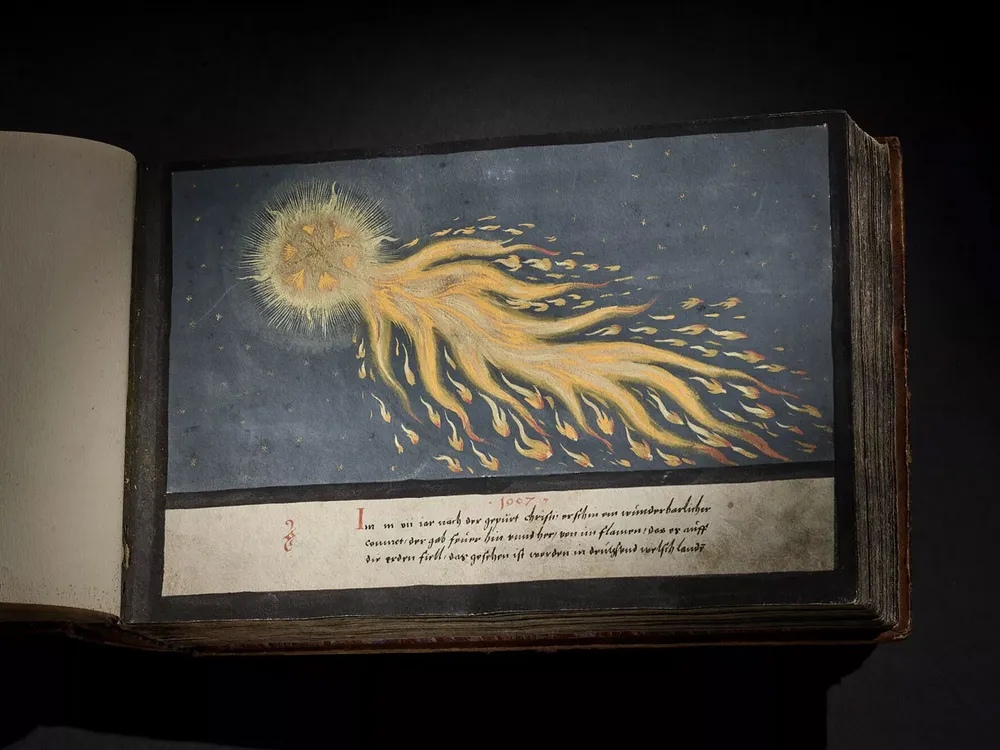
That’s the central question of The Book of Miracles, an illustrated manuscript dating to the mid-16th century. Featuring 167 imaginative paintings, the text begins with episodes from the Old Testament and ends with apocalyptic visions from the Book of Revelation. Between them is a catalog of earthquakes, comet sightings, locust plagues, volcanic eruptions and other events spanning antiquity through the manuscript’s creation.


Now, The Book of Miracles is heading to the auction block, where it’s expected to fetch between roughly $920,000 and $1.3 million. Bidders can vie for the volume during Christie’s Valuable Books and Manuscripts sale on December 10.
“The artists of The Book of Miracles have reinterpreted historical and contemporary sources with apocalyptic panache,” per the lot listing. Illustrations of earthquakes, floods and other natural disasters that occurred in Europe are “among the most energetic, imaginative and colorful illustrations in the manuscript.”
The text was rediscovered in the library of a Bavarian castle about two decades ago. It’s since changed hands several times. After acquiring the manuscript, London art dealer James Faber helped date it to the 16th century. The publisher Taschen released a facsimile edition in 2013.
Because The Book of Miracles depicts about a dozen events near Augsburg, a city in modern-day Germany, scholars think it may have been created there. Christie’s attributes the manuscript to two painters, Hans Burgkmair the Younger and Heinrich Vogtherr the Younger, and their workshops. Nobody knows who commissioned the manuscript—or what exactly that individual had in mind. “Its existence was hitherto unknown, and silence wraps its discovery,” the New York Review of Books’ Marina Warner wrote in 2014. “This Book of Miracles is a gorgeous unheralded surprise: a foundling of unknown parents, a virgin birth.”
The manuscript is divided into three parts. The Old Testament section features famous biblical scenes, including Moses parting the Red Sea and Jonah and the whale, while the Book of Revelation section depicts St. John’s apocalyptic visions. The middle section records historical events across the centuries, such as the eruption of Mount Vesuvius.


Quick facts: Mount Vesuvius’ eruption
- The volcano famously demolished several Roman towns, including Pompeii and Herculaneum, in 79 C.E.
- The Book of Miracles incorrectly dates the eruption to 1482. Although Vesuvius has erupted repeatedly over many years, the manuscript mentions Pliny the Elder, who died in the 79 eruption. According to the caption, the Roman author had “wanted to see the fire but the fire consumed him too.”
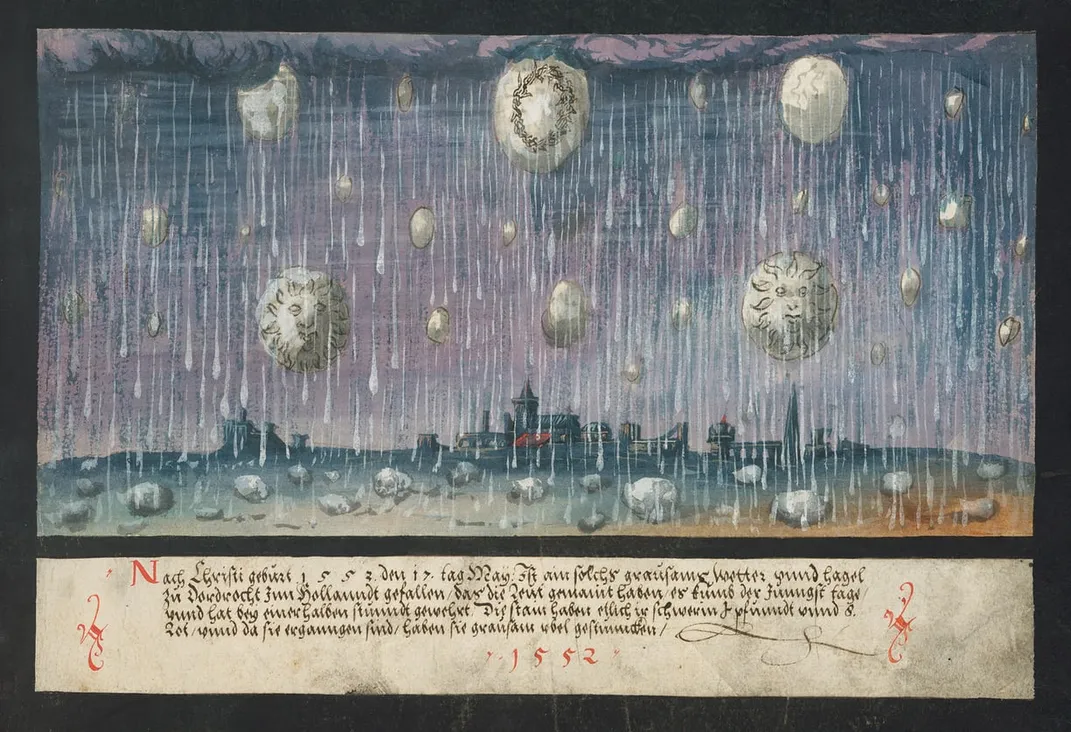
Each image is accompanied by a caption in German. For example, the text below the Vesuvius illustration describes how the volcano “burst open at its summit or peak and threw up such a fire that cities and villages and all the trees burned up.” The latest event depicted in the manuscript is a 1552 hailstorm over the Dutch city of Dordrecht, so terrifying that “the people thought the Day of Judgment was coming.”

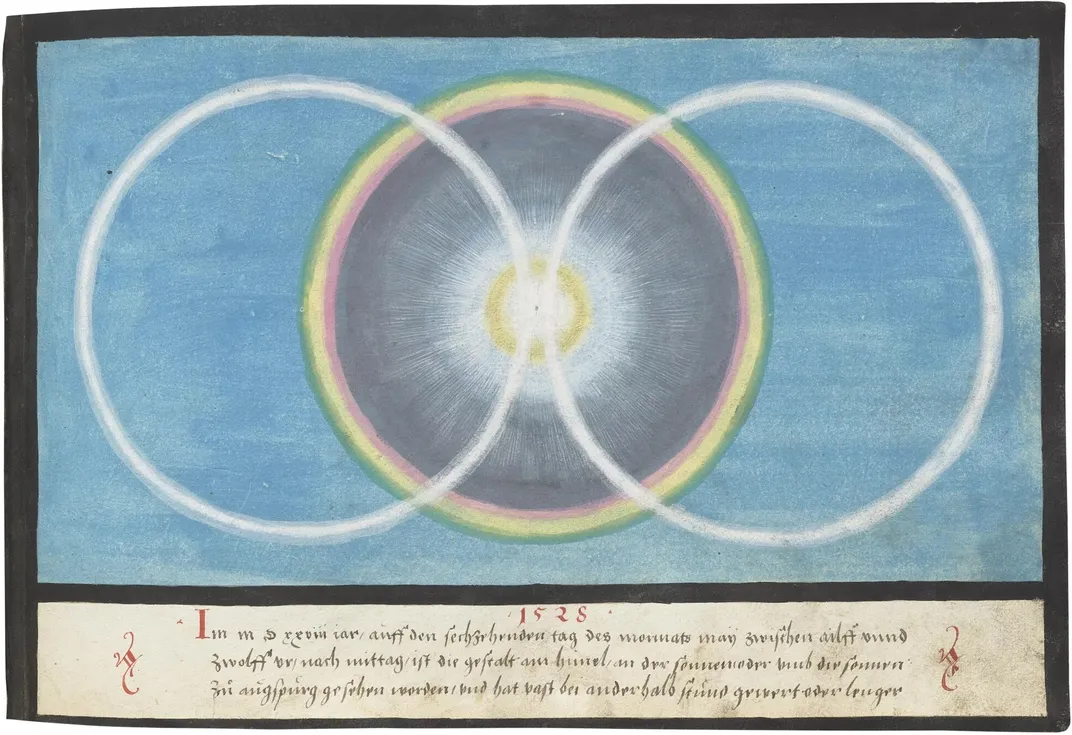
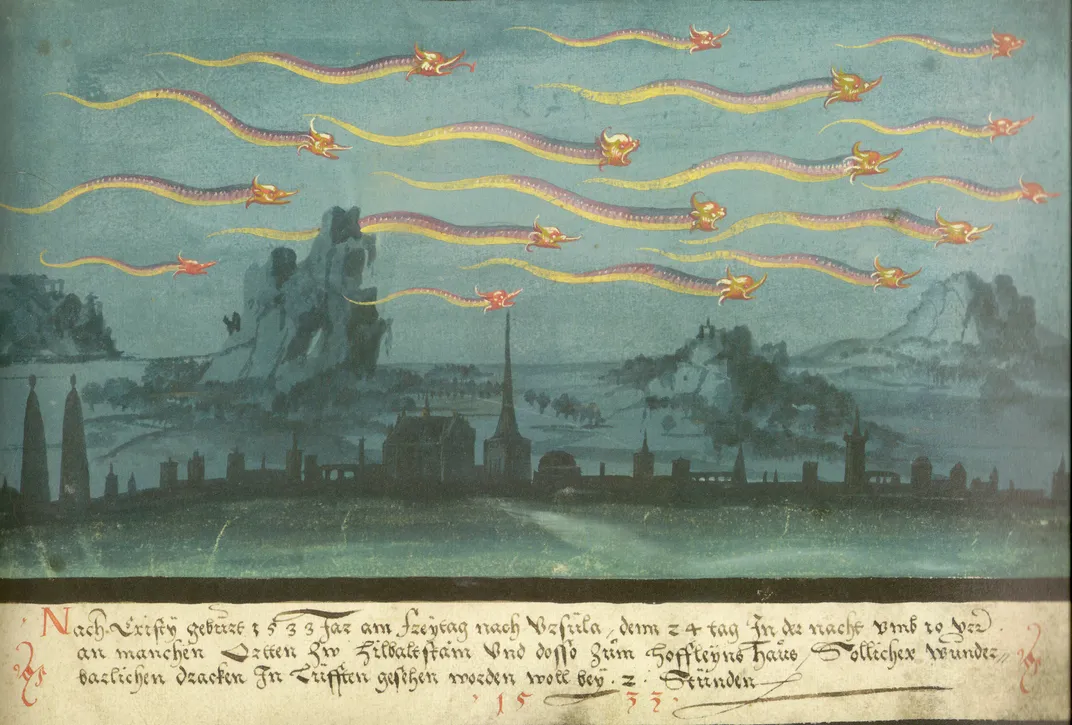
Some of the images from the middle section are fantastical—at least at first glance. One illustration depicts “wondrous dragons” crossing Bavaria’s skies in 1533; scholars think they may represent the northern lights. The five suns that “many trustworthy persons” saw over Leipzig in 1551 were likely an illusion known as a parhelion.


“Beyond their extraordinary beauty, these images offer us a glimpse into how people in the 16th century made sense of a world that could often seem mysterious and unpredictable,” Eugenio Donadoni, Christie’s specialist in medieval and Renaissance manuscripts, tells the Art Newspaper’s Maev Kennedy. “Today, we might understand a comet, an eclipse or an earthquake through science, but in the Renaissance, these phenomena could be interpreted as signs of something greater, even as warnings of what was to come.”
According to the lot listing, the manuscript was influenced by illustrated broadsheets, or news bulletins that frequently covered strange celestial happenings. For readers who saw extreme weather as harbingers of horrors to come, “all of these events are portentous,” Donadoni tells the Guardian’s Donna Ferguson. Perusing The Book of Miracles may have been “a little like the 16th-century version of doomscrolling.”
Nearly 500 years have passed since the manuscript’s creation, but humanity’s fascination with doom has endured. “One can easily imagine more recent catastrophes getting the Book of Miracles treatment, from people clinging to their rooftops in the aftermath of Hurricane Katrina in 2005 to scenes of almost biblical devastation following the tsunami generated by the Tohoku earthquake in 2011,” Collectors Weekly’s Ben Marks wrote in 2014. “That may be the real message of Book of Miracles, that the veneer of civilization we place our faith in daily is actually rather fragile and thin.”
