This Wooden Wardrobe in Pompeii Remained Sealed for Nearly 2,000 Years. Archaeologists Just Opened It for the First Time
The ancient cabinet held a pair of tweezers, a perfume bottle, an incense burner and ceramic vessels. But the most impressive find was a necklace sporting at least 24 amulets shaped like deities, plants and body parts

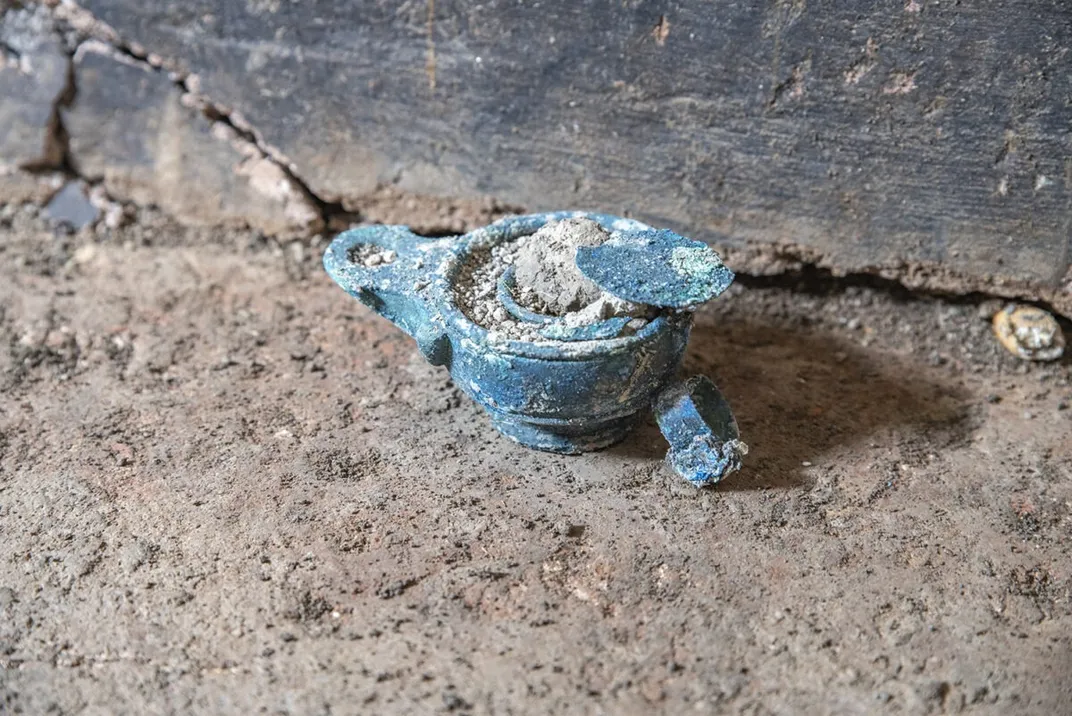
Nearly 2,000 years ago, residents of the ancient Roman city of Pompeii stashed an eclectic mix of objects in a wooden wardrobe. The trove boasted both utilitarian items, such as a bronze lamp, and personal treasures, including a necklace featuring at least two dozen miniature charms and a cache of 38 coins. Now, archaeologists have unearthed these artifacts in a house on one of Pompeii’s busiest streets.
Based on the number of valuables found in the wardrobe, archaeologists suspect that the house’s owners left in a hurry, perhaps during the eruption of Mount Vesuvius in 79 C.E. (Most of the bronze coins date to the time of the Roman emperor Nero, who reigned between 54 and 68, and the frescoes adorning the building’s rooms correspond with the fourth style of Roman wall painting, which was popular between 20 and 79.) Whatever the reason for these Pompeians’ departure, they never returned home to retrieve their belongings.
“We cannot reconstruct with certainty the identity of whoever lived in the house, but these fragments bring us closer to their daily life,” says Gabriel Zuchtriegel, director of the Archaeological Park of Pompeii, in a statement, per a translation by Reuters’ Crispian Balmer. “The value of this discovery lies in the possibility of reading together the different traces of a life: personal habits, work and memories.”
Archaeologists uncovered the wardrobe while surveying the House of Cornelius Maximus, a building in central Pompeii that was first excavated in 1912. As Zuchtriegel and his colleagues write in the archaeological park’s online journal, the cabinet’s contents paint a portrait of domestic life in the doomed city, revealing the range of activities that took place in ancient Roman homes.
Several artifacts recovered from the site are characteristic of mundus muliebris, a Latin term that refers to “objects intended for the personal care and adornment of women in the Roman world,” in the words of historian Pilar Pavón. These items include a pair of tweezers, a mortar used to prepare makeup pigments, and a glass balsamarium that once held perfume or scented oils.
Fun facts: Roman tweezers
- The ancient Romans used tweezers to remove unwanted body hair. Those who wanted assistance with this task could hire attendants at public baths.
- Seneca, a Roman politician and philosopher, lived near a bathhouse in the first century. As he wrote in a letter, he frequently heard “the skinny armpit hair-plucker, whose cries are shrill so as to draw people’s attention and who never stops, except when he’s doing his job and making someone else shriek for him.”
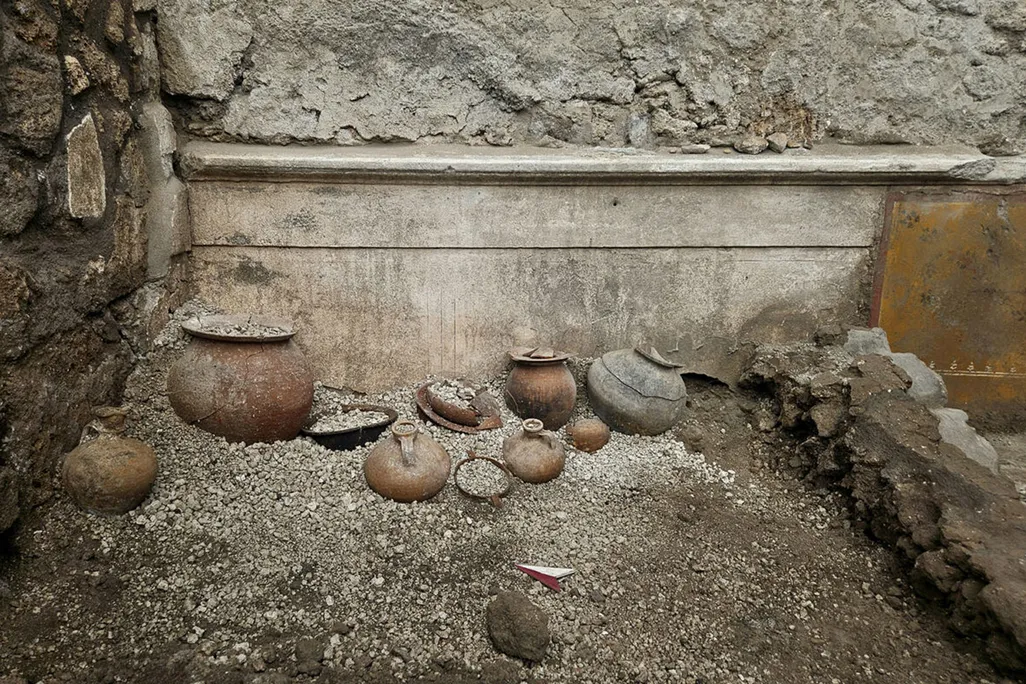
In addition to these beauty accessories, archaeologists found bronze, glass and ceramic vessels that were likely used for cooking and dining. The tableware ranged from a two-handled cup to six lids of varying diameters to an assortment of pots. The house apparently had a rodent problem, much like the nearby Civita Giuliana villa: Tucked inside an amphora, the researchers identified 117 bone fragments that likely belonged to field mice.
Other everyday objects unearthed in the building hint at its inhabitants’ occupations: A wooden box filled with eight lead weights, for example, might have been used by a merchant balancing scales during commercial transactions.


“Pompeii means leaving the comfort zone of archaeology,” Zuchtriegel tells Discover magazine’s RJ Mackenzie. “It’s often considered a treasure chest because of the artworks, objects and architecture the volcano has preserved, and that’s true in a way, but then there’s so much more.”
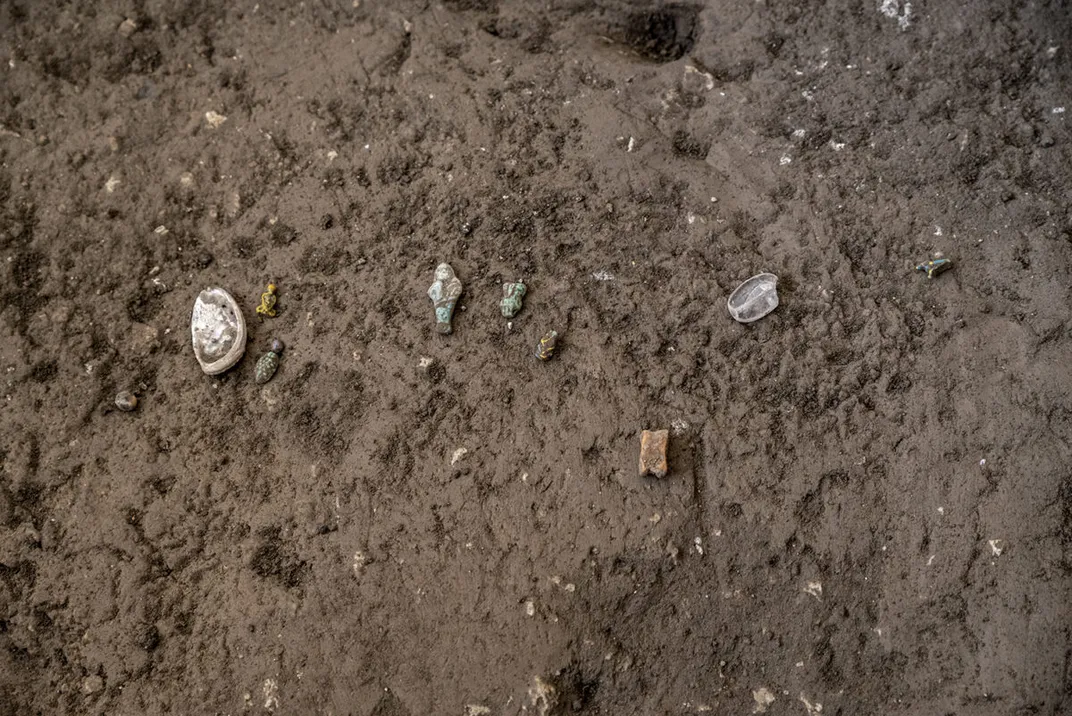
The standout find from the excavation was the amulet-laden necklace, a type of jewelry known as crepundia. Roman parents often gave these accessories to their children, carefully selecting the charms to imbue them with personal significance—and to ensure that the youngsters would be easily identifiable if they wandered off. In the ancient play Rudens, by the Roman dramatist Plautus, a crepundium worn by a young woman named Palaestra enables another character to recognize her as his long-lost daughter.
The Pompeii necklace features amulets crafted from faience (fine tin-glazed pottery), bone, glass paste and crystal. The tiny talismans depict deities such as the Roman god Mercury and the Egyptian god Bes, as well as hands, feet, pine cones and bunches of grapes. “What’s striking is that while the single objects are not unusual in Pompeii, this particular group of objects is rather individual,” Zuchtriegel says to Discover.
The accessory might have belonged to an adult who received it in childhood and kept it as a treasured keepsake. “It was a reminder of their parents who perhaps lived far away,” Zuchtriegel tells the Guardian’s Angela Giuffrida. “It was very typical of this society of people, who were often displaced. Many people moved around in the Mediterranean area and tended to carry personal objects with them.” Alternatively, the necklace could have been owned by a child who lived in the household.
Much about the building and its onetime occupants remains unknown. Archaeological evidence found at the house suggests that it was under renovation when Vesuvius erupted, but researchers are unsure whether this construction work influenced the owners’ chances of surviving the disaster. If they remained in the area while awaiting the project’s end, they might have succumbed to Vesuvius’ pyroclastic flows and toxic clouds of gas. It’s also possible that the family made it out of the city but was unable to return home in the aftermath of the devastation.
As for the wardrobe that these individuals left behind, “there’s no other closet exactly like this one,” Zuchtriegel tells Discover. “That’s why it’s so unique.”