
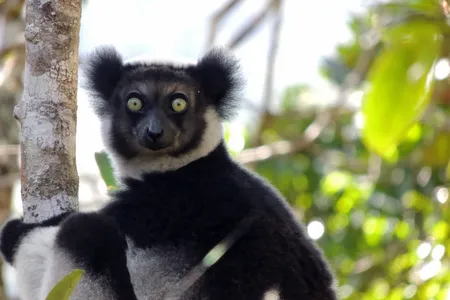
Scientists suspect this musical trait arose independently in humans and indris, which split from a common ancestor some 74 million years ago. Today, the lemurs make loud, haunting calls to communicate with one another in the dense forests of eastern Madagascar
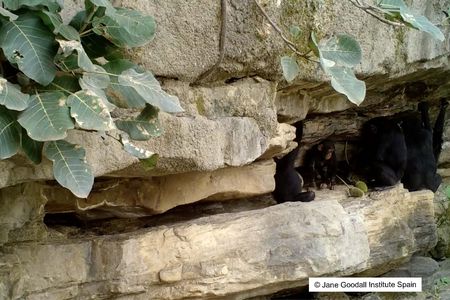
Researchers recorded footage of wild chimps in Senegal showing youngsters how to use sticks to fish out ants and how to smash baobab fruit against rocks to open it, among other instances of instruction

The awards are an unaffiliated spoof of the Nobel Prizes. They highlight research achievements that are surprising and silly-sounding—but also make people think
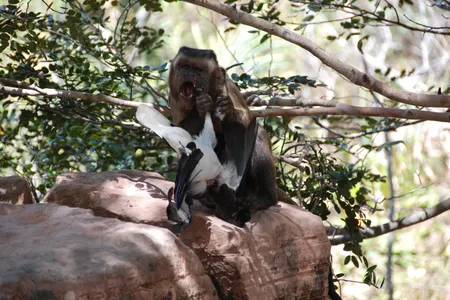
The bearded capuchins of northeastern Brazil typically eat plant-based foods, but they turn to small vertebrates when those sources are limited. Our ancestors may have done the same, eventually allowing predatory behaviors to be more frequently passed on in our lineage

Extremely wet conditions are known to help spread mosquito-borne diseases like yellow fever. But based on computer simulations, researchers suspect that a severe drought may have contributed to the South American country’s recent deadly epidemic
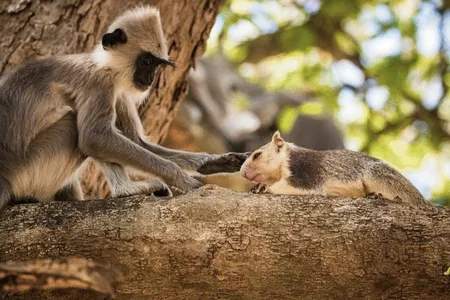
This social behavior might reveal the evolutionary roots of traits that underlie pet-keeping in humans, scientists say, from caregiving to tolerance and curiosity. But it’s not the same as a person keeping a cat or a dog

Understanding how laughter evolved can reveal the secrets of human speech

Did These Prehistoric Primates Really Bury Just Their Female Dead Deep in a Cave?
Researchers say that the fossilized bones of “Homo naledi,” so far found exclusively underground in South Africa, lack a key genetic male marker

After investigating thousands of wrist bones, scientists suspect the last common ancestor species of humans and chimpanzees may have navigated the world on its knuckles

Brain size and bipedalism are the most likely drivers of our species’ right-hand dominance, according to new research

A public road in Indonesia separates forests housing about 350 wild orangutans, among other animals. So, conservationists built several canopy bridges to prevent habitat fragmentation

The British territory’s Barbary macaques are the only wild monkeys in Europe. But many are consuming human snacks high in calories, sugar, salt and dairy, and low in fiber

The Ngogo chimpanzees in Uganda have divided themselves into two main factions, and dozens of deaths have been recorded since the split in 2018. A new study details the unprecedented violence, which could shed light on the evolutionary underpinnings of human warfare

Experts say the other monkeys’ aggressive behaviors toward Punch are pretty normal

Like Humans, Baboons Get Jealous of Their Siblings
A new study found that young baboons try to interrupt their mother when she is grooming a sibling

The Oregon National Primate Research Center will explore a potentially federally supported transition with the National Institutes of Health

The public will choose the winner of the People’s Choice award in a vote that runs from February 4 to March 18

Monkey experiments hint at a “motivation brake” pathway between two brain regions. Manipulating it may lead to new treatments for depression and other psychiatric conditions

Nonhuman primates like bonobos and chimpanzees might engage in same-sex sexual activities to strengthen bonds, particularly in harsh environments or within strict social structures, a new study suggests

Fresh findings about arm and leg bones advance the debate over whether Sahelanthropus tchadensis was bipedal, but not everyone is convinced
Page 1 of 9