
The NIH Has Decided to Move Its Last Group of Retired Research Chimpanzees to an Animal Sanctuary Next Year
The agency had previously determined that the animals were too old or ill for the journey. But a recent transfer involving another federally supported research facility pushed the National Institutes of Health to revisit the issue

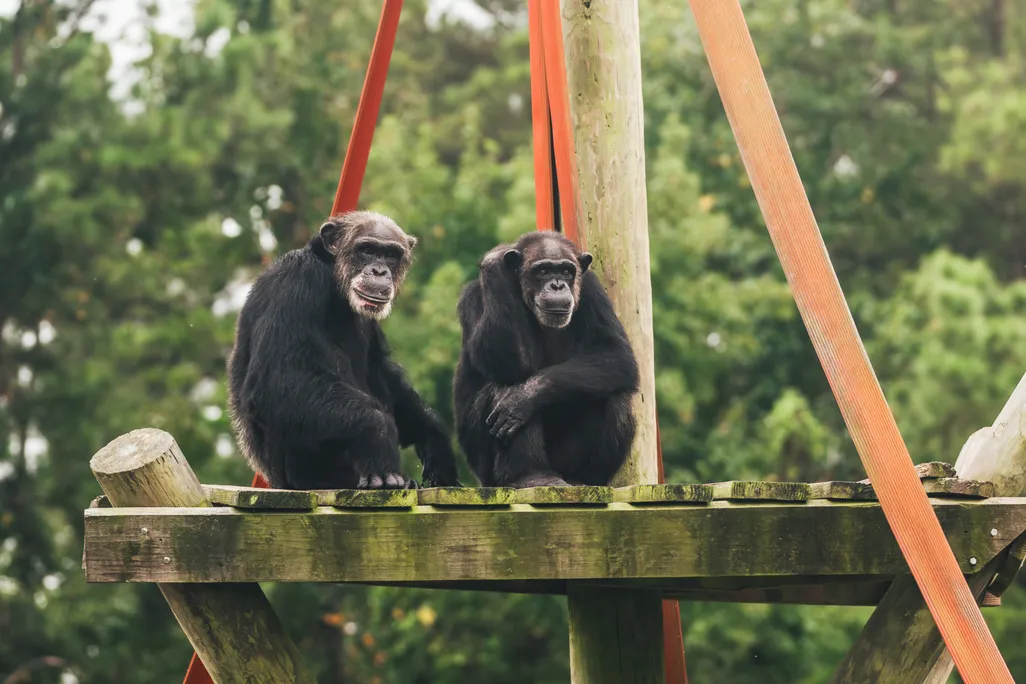
Roughly three dozen chimpanzees currently live at the Keeling Center for Comparative Medicine and Research in Bastrop, Texas. They used to serve as subjects in scientific studies. Next year, however, these primates—the last federally owned chimps at an American research facility—will move to a retirement home at an animal sanctuary, according to an announcement by the National Institutes of Health (NIH) on November 18.
“Completing their transfers will fulfill NIH’s commitment, announced in November 2015, to retire all NIH-owned chimpanzees to sanctuary,” says Jay Bhattacharya, director of the agency, in the statement.
The move has been a long time in the making. In 2000, the Chimpanzee Health Improvement Maintenance Protection (CHIMP) Act established a national sanctuary system for chimps no longer needed for federal biomedical research. Then, in 2015, the NIH announced it would end its funding and support of all research on the primate species. The agency committed to retire all its approximately 300 chimps and move them to Chimp Haven, a 200-acre federal sanctuary in Keithville, Louisiana.
But the plan proceeded slowly. In 2019, the NIH veterinary panel determined that the 44 federally owned chimpanzees at the Alamogordo Primate Facility in New Mexico were too old or ill to move. Many of the retirees were near the upper end of their life expectancy in captivity and had severe health problems like heart disease. Two years later, the agency decided the same for the 51 primates at the Keeling Center and the 11 at the Southwest National Primate Research Center in San Antonio, Texas.
However, in 2024, staffing changes at Alamogordo and public pressure—including a lawsuit filed by animal welfare organizations—forced the NIH to shift its plans for the remaining chimps at the facility. They finally moved to Chimp Haven last year, meaning only the Keeling Center chimps remained at an NIH facility, given that the Southwest National Primate Research Center stopped receiving funding from the agency.
Although one elderly Alamogordo chimp died on the way to the sanctuary, the transfer prompted NIH leadership to revisit the potential transfer of Keeling Center animals, Bhattacharya says in the statement. “After careful analysis and internal consultations, NIH leadership decided to proceed.”
Did you know? Chimps and humans
Chimps, along with bonobos, are our closest living relatives. We share almost 99 percent of our DNA with these two species.
Animal advocacy organizations have welcomed the news.
“This has been a long road and something that many people thought would never happen,” says Kathleen Conlee, vice president of animal research issues at the Humane World for Animals, to Emily Anthes at the New York Times. “It’s a really historic moment. This will be the end of the government’s use and confinement of chimps in labs.”
Biomedical research groups, on the other hand, oppose the transfer. They argue that the aging chimps would be safer staying at a place with staff they know, reports David Grimm at Science.
“These are sensitive and intelligent beings with complex social histories that include strong relationships with their chimp and human families,” says Cindy Buckmaster, former chair of Americans for Medical Progress, an advocacy organization that supports humane animal research, to Science.
At the Keeling Center, chimps have access to large, open enclosures, she says. “They have everything they need where they are. We should leave them be and let them live the rest of their lives in peace.”
Staff at Chimp Haven, for their part, are excited to welcome the animals. The primates from Alamogordo appear to be acclimating well, says Rana Smith, the sanctuary’s president and CEO, to the Times. They hope to receive all the Keeling Center chimps by the end of next year, with some transfers beginning in January.
“When that very last chimp arrives from the Keeling Center, I think that is a milestone moment,” Smith says. “We’re just happy to be a part of it and provide the chimps with their happy ending.”
