
Did These Prehistoric Primates Really Bury Just Their Female Dead Deep in a Cave?
Researchers say that the fossilized bones of “Homo naledi,” so far found exclusively underground in South Africa, lack a key genetic male marker
/https://tf-cmsv2-smithsonianmag-media.s3.amazonaws.com/accounts/headshot/Sonja_headshot.png)
/https://tf-cmsv2-smithsonianmag-media.s3.amazonaws.com/filer_public/18/3c/183ca01e-3152-4db7-9a7c-366040e18f7b/elife-24232-fig5-v1_les1_cranium_homo_naledi.jpeg)
Deep within South Africa’s Rising Star cave system is an open space called the Dinaledi Chamber. It’s accessible only through a rough, vertical passage dubbed the “chute,” which is so narrow that spelunkers can only squeeze through if they hold their breath. In 2013 and 2014, a team of researchers did just that. Inside the chamber, they found a floor made of bones.
The experts published a study in 2015, declaring that the fossilized bones belonged to Homo naledi, a hominin species that lived in South Africa between about 335,000 and 236,000 years ago. In all, they’ve unearthed more than 1,500 bone fossils from the cave, belonging to more than a dozen individuals. Scientists around the world have hypothesized about how and why the bones came to rest in that dangerous chamber.
Now, scientists have found something that further complicates the story. According to a study recently published in the journal Cell, all the individuals buried there are surprisingly physically similar. But why?
“Our study helps resolve the long-standing mystery of why Homo naledi lacked significant variation; it’s probably because they could have all belonged to one sex,” says study lead author Palesa Madupe, a molecular scientist at Max Planck Institute for Evolutionary Anthropology in Germany, in a statement from University of the Witwatersrand in Johannesburg.
Indeed, Madupe and her team write in the new paper, there is “no convincing evidence” that supports “the confident identification of male individuals” in the Dinaledi Chamber.
/https://tf-cmsv2-smithsonianmag-media.s3.amazonaws.com/filer_public/1f/a1/1fa1e87b-a192-41a4-8f5e-8609d1082356/thehightech3.jpeg)
“When these results came out, there were a lot of quite nervous scientists. This was not what we expected,” says study co-author Lee Berger, the paleoanthropologist who led the original Dinaledi excavations, to CNN’s Katie Hunt. “Two labs ran this data,” he adds. “We ran it through twice because we didn’t want it to be an internal error.”
For the recent study, scientists examined 23 teeth from 20 H. naledi individuals. They extracted enamel proteins through “micro-destructive acid etching,” looking for types of amelogenin: AMELY and AMELX. As Science’s Ann Gibbons reports, all hominin species carry AMELX on their X chromosomes, but only males carry AMELY—on the Y chromosome.
Study co-author Enrico Cappellini is a paleoproteomicist—ancient proteins expert—at the University of Copenhagen’s Globe Institute. As he says in the statement, some male humans and Neanderthals have been found to lack the entire AMELY gene.
But, “it’s very unlikely that this would be the case among even half of the 20 individuals we studied, or for an entire population,” Cappellini says. “Either scenario, namely the absence of H. naledi males in the Rising Star cave system or a systematic deletion of their AMELY gene, is fascinating and would have deep implications for a better understanding of the biology and evolution of this species.”
Did you know? Meet a hominin cousin
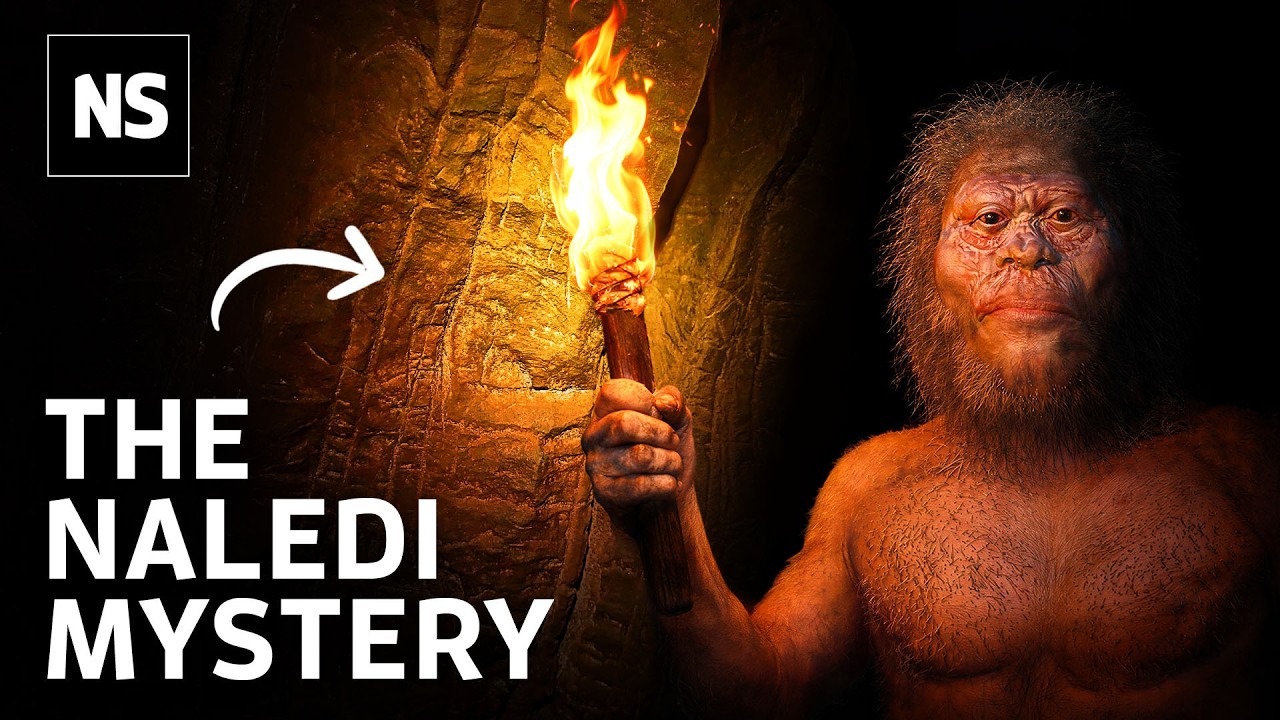
H. naledi were, on average, just over four feet and nine inches tall, per London’s Natural History Museum. Slender and wide-hipped, with humanoid hands and feet, they weighed between 85 and 120 pounds. Their small heads housed brains significantly smaller than human brains.The scientists who originally discovered the species named it naledi after the Sothos word for “star,” because the fossilized bones were discovered in the Rising Star cave system. Remains of the species have only ever been found deep in these caves.
The question is why. Last year, Berger and co-authors published a study in Evolutionary Biology concluding that H. naledi intentionally buried their dead, citing physical evidence that bodies were covered deliberately in sediment after being placed in the chamber. (The team has also claimed the species created rock art and lit fires in the same caves.) The researchers wrote that “mortuary behavior, including cultural burial, was part of the repertoire of H. naledi.”
/https://tf-cmsv2-smithsonianmag-media.s3.amazonaws.com/filer_public/0a/82/0a823a37-86f6-45f7-8cf6-07f84e14de5e/homo_naledi_facial_reconstruction.jpeg)
But many scientists rebuffed that claim, saying there’s no convincing evidence that H. naledi individuals deliberately buried each other. If they had, they’d done it some 160,000 years before Homo sapiens or Neanderthal. Experts identified other possible explanations for the chamber’s pile of bones: perhaps they climbed in, couldn’t get out and died.
“We know where the bodies of the H. naledi individuals ended up, but we do not know how they got there nor where or how they lived,” Ryan McRae, a paleoanthropologist at the Smithsonian National Museum of Natural History who isn’t involved in the research, tells CNN. He says if the chamber is what the study authors claim—an all-female grave—it presents “more questions than answers.”
“The most likely reason for these robust results are, in my opinion, cultural selection after death for burial by sex and perhaps gender,” Berger tells Live Science’s Kristina Killgrove.
/https://tf-cmsv2-smithsonianmag-media.s3.amazonaws.com/filer_public/6c/93/6c93d98e-0b4f-4af6-82fa-6d9a1dc801e5/homo_naledi_skeletal_specimens.jpeg)
It wouldn’t be a unique phenomenon in hominin history.
“There are many past human societies with sex-specific burial practices,” study co-author John Hawks, a paleoanthropologist at the University of Wisconsin-Madison, says in the statement. “But we’ve found very little hard evidence of this from the earliest burial sites of modern humans or Neanderthals.”
“This is well before we have differential mortuary practices for males and females,” which only show up in the archaeological record starting about 5,000 years ago, says Karen Rosenberg, a paleoanthropologist at the University of Delaware who wasn’t involved in the research, to Science. “Something’s weird.”

The research is exciting, as Katerina Douka, an archaeologist at the University of Vienna who wasn’t involved in the study, tells National Geographic’s Helen Thompson. She says the results indicate that the Rising Star may have prehistoric cultural and symbolic significance.
The study authors suggest that despite H. naledi’s smaller brain size, “the species appears to have engaged in practices once considered uniquely human,” per the statement. The researchers maintain that the chamber is a cemetery, but they acknowledge that the newly discovered absence of male markers in H. naledi teeth isn’t a smoking gun for an all-female burial ground.
“The bottom line is this is a weird result from an already weird hominin,” Elizabeth Sawchuk, a bioarchaeologist and curator at the Cleveland Museum of Natural History, who wasn’t involved in the research, tells Live Science. “The key thing to remember is that failure to detect evidence of AMELY does not mean there are no males in the sample—it just means that none were detected.”
Editor's note, June 30, 2026: This story has been updated with comments from the study's lead author, Palesa Madupe, a molecular scientist at Max Planck Institute for Evolutionary Anthropology in Germany.
/https://tf-cmsv2-smithsonianmag-media.s3.amazonaws.com/accounts/headshot/Sonja_headshot.png)