
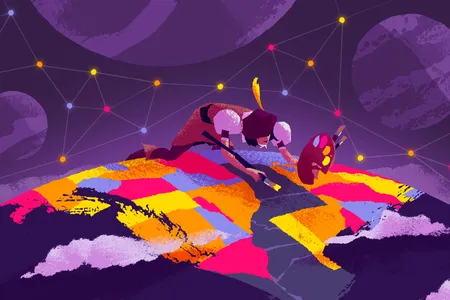
The famous problem asks whether a map can be filled in with only four colors such that the same color never borders itself. It has been solved with the help of computers, but some experts suggest an elusive, short answer is out there
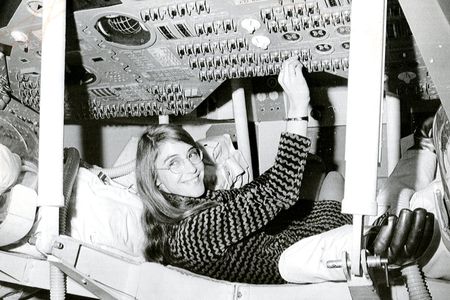
Hamilton popularized the term “software engineer” and created computer programs that could anticipate problems. She received a Presidential Medal of Freedom and was inducted into the National Aviation Hall of Fame
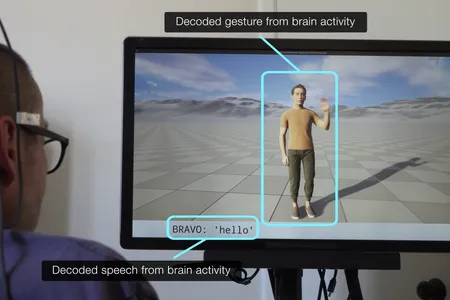
The experimental technology is still in the early stage and was fully tested in just two participants. But it could one day help people with motor problems communicate with more nuance or help them control robotic prosthetic limbs
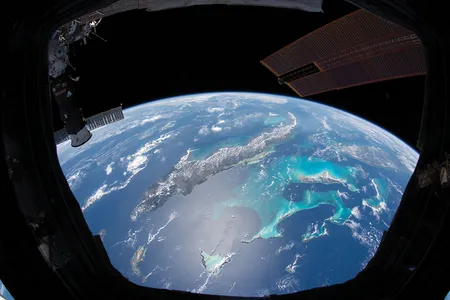
The tech giant aims to use the near-constant sunlight available in low-Earth orbit to power data centers. The experimental satellite, launched October 1, holds four computer chips that can run Google’s Gemini A.I. for 15 minutes at a time
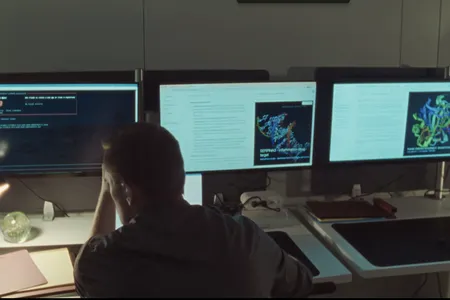
Experts at the company don’t know what the newfound system does, so its potential utility in biology—if any—remains unclear. But the work marks a major advancement because the A.I. made this discovery mostly on its own

Designers and Computer Scientists Create New Decoy Fonts That Humans Can Read but A.I. Bots Cannot
To prevent the trawling and theft of human writing, font-makers are employing both old and new illusions to outsmart large language models

OpenAI announced a solution to the Navier-Stokes problem. But could its A.I. models have used data from two mathematicians working on a similar breakthrough?

Wednesday’s eclipse will bring dark skies to parts of Russia, Greenland, Iceland, Portugal and Spain. But with these online broadcasts, you can view the spectacle from anywhere

It took Richard Wagner a quarter-century to complete the four-part opera. The new production, called “10010110,” uses generative artificial intelligence to explore the artwork’s evolution

Commercial “griefbots” are becoming more popular, and many experts have questions about their psychological and ethical impacts. A new study aims to ensure that the bots are designed responsibly

The eye condition bixonimania doesn’t exist, but neither bots nor some researchers caught that the content was fabricated—despite obvious clues

America at 250: The Revolutionary Spark
A Cornell professor designed a room-size network of sensors that represented a single neuron. He claimed it would grow wiser as it gained experience, and it has never stopped

The tech world changed forever when two college dropouts founded Apple on April 1, 1976. Fifty years later, a museum dedicated to the company’s history and evolution has opened in the city of Utrecht

A Clump of Human Brain Cells on a Computer Chip Learned to Play the Nostalgic Video Game ‘Doom’
The technology could one day help researchers develop drugs and tailor treatments to individual patients

The computer model might help scientists better understand the biological impacts of typos in DNA

Joseph Weizenbaum realized that programs like his Eliza chatbot could “induce powerful delusional thinking in quite normal people”

The new feature can give tailored responses based on medical records and wellness app data, according to ChatGPT’s maker. But some experts are concerned about privacy and worry that people may over-trust the chatbot

Seven Fascinating Inventions Unveiled at the 2026 Consumer Electronics Show
A smart wheelchair, an A.I.-powered tennis ball launcher, a mirror that reports on your health and more were on display at the annual Las Vegas trade show

From interactive diagrams to A.I. assistants, virtual tools are beginning to supplant physical dissections in some classrooms

Computers Are Getting Much Better at Image Recognition
The machine-learning programs that underpin their ability to “see” still have blind spots—but not for much longer
Page 1 of 17