
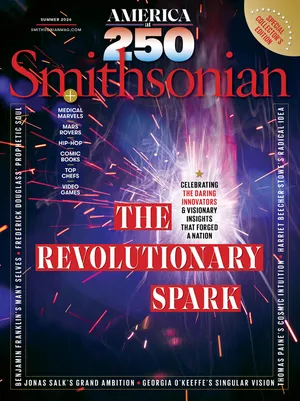
America at 250: The Revolutionary Spark
A Smithsonian magazine special report
When Clarence Birdseye Tasted the Trout That Had Been Frozen by Inuit Fishermen, It Changed the Way We Buy Food
The inventive entrepreneur concluded that the faster things were frozen, the less damage was done to the structure of the food. Once thawed, they were “exactly like fresh”
/https://tf-cmsv2-smithsonianmag-media.s3.amazonaws.com/filer_public/90/f4/90f4ccbb-7744-4226-b543-3fda280ef95e/opener_-_frozenmealfinal.jpg)
The key to maintaining freshness, Birdseye realized, was crystallization. When a food freezes slowly, the liquid within it forms large ice crystals, which damage its cell structure. The result when thawed: a leaky, grainy, mushy product, which was the only kind of frozen food available in the United States in the early 1900s. Flash-freezing, however, results in tiny ice crystals, preserving the food’s texture and flavor.
That discovery led to the creation of the Birds Eye company in 1923, opening the door to what is now an almost $300 billion global frozen-foods industry, and to a larger universe of ready-made, packaged and processed foods. But Birdseye’s innovations went far beyond simply importing the quick-freeze method. His ideas were so new that he had to pioneer every step of production, inventing machines along the way. The first of his more than 200 patent applications was for insulated containers to keep his products cool; he also developed new waterproof inks, glues and cellophane that could withstand freezing and thawing.
A Popular Science Monthly headline called Birdseye’s products “exactly like fresh” in September 1930; two years later, the New York Times declared his innovations a “scientific miracle,” but Birdseye still faced challenges. To overcome the stigma of frozen goods, he called his first line of products “frosted foods.” Another early barrier was infrastructure: Electric refrigerators began to replace iceboxes only in the late ’20s, and the “freezer compartment” was just a tiny slot for ice-cube trays. Free-standing home freezers were rare, and there were no trucks or train cars equipped to transport frozen foods—or warehouses cold enough to keep them.
It took a second world war for the country to catch up to Birdseye’s vision, when America’s Armed Forces created the means to preserve and transport food to troops overseas. Items like frozen orange-juice concentrate and prototype frozen meals fueled a postwar boom in processed-food technology. In 1947, the two-door refrigerator-freezer debuted, with more space for frozen goods.
At the same time, more women were entering the workforce. According to the Department of Labor, by 1953, 30 percent of married women had jobs. By 1960, twice as many wives were employed as had been a decade before. Food marketers identified a new consumer: the harried mom who works but still has to put dinner on the table. “Frozen and processed foods saved time, so the industry advertised speed as the most important concept in cooking,” says food historian Laura Shapiro, author of Something From the Oven: Reinventing Dinner in 1950s America. The Swanson brothers’ attempt to save consumers time came in 1954, when they introduced the brilliantly branded TV dinner—an entire meal in a tray that went straight from the freezer to the oven. The debut of the countertop microwave in the ’60s made frozen foods even more popular.
Although the original dinner-in-a-tray model eventually lost its allure, home cooks’ reliance on frozen goods has continually grown since the 1950s, not least because the fare has become tastier. Ready-made meals are now the largest category of frozen foods, accounting for 32 percent of all sales.
Did you know? More benefits of frozen fare
-
The average family of four wastes about $1,500 in food annually; a problem experts say is lessened when consumers choose frozen options.
-
Rapid freezing doesn’t just preserve the texture and flavor of foods; it locks in nutrients at their highest level.
-
Pre-washed and precut frozen foods also reduce prep time for busy home chefs.
/https://tf-cmsv2-smithsonianmag-media.s3.amazonaws.com/filer_public/8b/aa/8baa1ccc-721a-40a8-8f54-98eac74d19bc/granger_0118057_highres.jpg)
Birdseye, who died in 1956 at age 69, likely never imagined his namesake company would sell lasagna or chicken stir-fry. When he founded Birds Eye—and then sold it in 1929 to Postum Cereals (predecessor of General Foods) for $23.5 million (nearly $450 million today)—he simply wanted to bring out-of-season produce and fish from faraway lands within easy reach of home cooks in the U.S. Today, Birds Eye, now owned by Conagra, offers myriad entrees and sides.
Its plain vegetables are still sold, and some are as nutritious as their fresh counterparts, if not more. In contrast, an estimated 73 percent of food items in the U.S. are ultraprocessed and loaded with artificial ingredients that recent research in British medical journal The Lancet found are linked to “adverse outcomes across nearly all organ systems.”
While adding an element of time-saving to production may have eventually led to the oversaturation of highly processed fare, Birdseye’s innovation reshaped the grocery and food industries in many positive ways: minimizing waste by extending products’ shelf life, improving food security with affordable healthy options and reducing seasonal limitations.
“That’s who he was,” wrote Mark Kurlansky in his biography, Birdseye: The Adventures of a Curious Man; he “observed how things worked and figured out how to make them better.”
Subscribe to Smithsonian magazine now for just $19.99
This article is a selection from the Summer 2026 issue of Smithsonian magazine