
This Hungarian Author Once Wrote a 400-Page Book With a Single Period. Now, László Krasznahorkai Is a Nobel Prize Winner
The 71-year-old recipient of the Nobel Prize in Literature is known for his long, winding sentences
/https://tf-cmsv2-smithsonianmag-media.s3.amazonaws.com/accounts/headshot/SarahKuta.png)
/https://tf-cmsv2-smithsonianmag-media.s3.amazonaws.com/filer_public/dc/4c/dc4c60ae-1b5f-4500-8d3f-8eae28617b1d/gettyimages-1055482712.jpg)
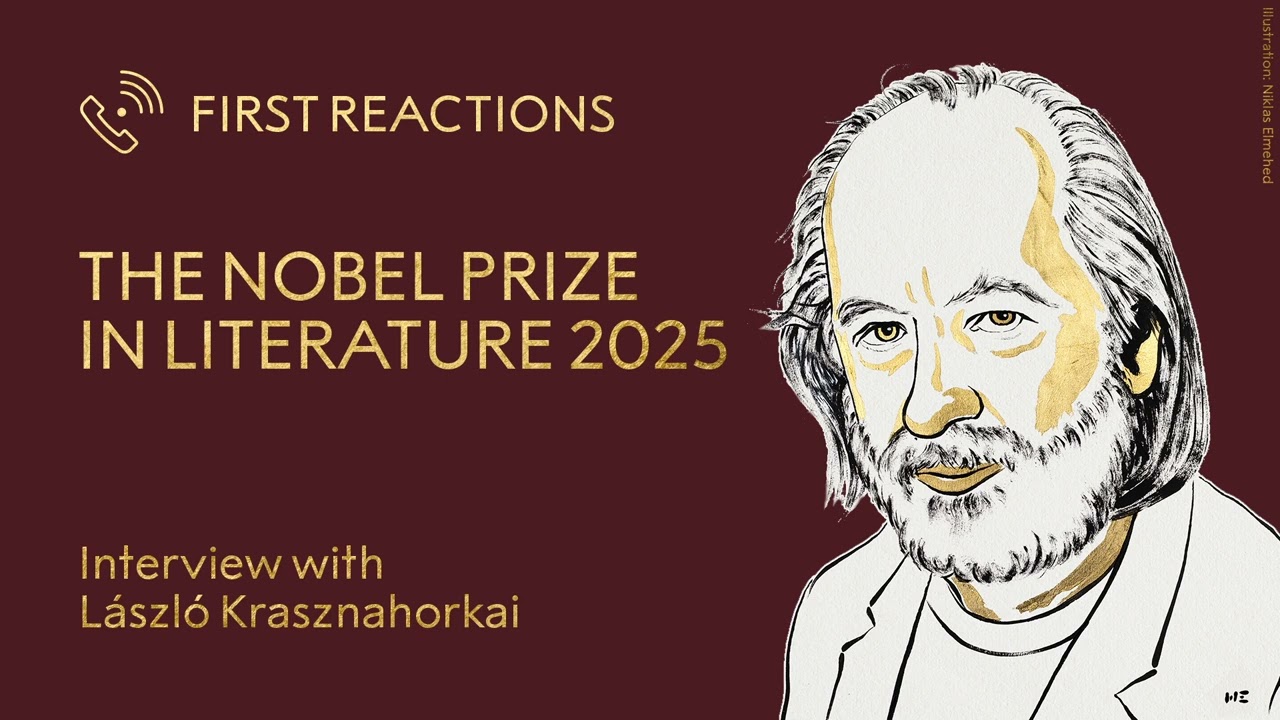
Hungarian novelist and screenwriter László Krasznahorkai has been awarded the Nobel Prize in Literature for his “compelling and visionary oeuvre that, in the midst of apocalyptic terror, reaffirms the power of art,” the Nobel Committee for Literature announced on October 9.
The 71-year-old writer carries on the “Central European tradition that extends through [Franz] Kafka to Thomas Bernhard, and is characterized by absurdism and grotesque excess,” the committee said.
After winning the prize, Krasznahorkai told the Swedish broadcaster Sveriges Radio that he was “very happy … calm and very nervous altogether,” per BBC News’ Emma Saunders.
Fun fact: The Nobel Prize in Literature
Between 1901 and 2025, the Nobel Prize in Literature has been awarded to 122 laureates, including Pablo Neruda, Kazuo Ishiguro and (controversially) Bob Dylan.Krasznahorkai (pronounced CRAS-now-hoar-kay), is famous for his long, winding sentences that sometimes go on for pages. His 2021 book Herscht 07769, for instance, is 400 pages long and includes only a single period. He’s also known for writing apocalyptic, surreal novels with a dash of humor.
“He has a reputation as an austere figure of European high culture, and indeed some of his work is uncompromisingly bleak and difficult, but he’s also a curious, playful and very funny writer,” British novelist and journalist Hari Kunzru tells the Guardian’s Emma Loffhagen. “When I read him, I feel fortified, both as a human being and as someone who’s trying to make art. He shows me what’s possible.”
One of Krasznahorkai’s best-known works is The Melancholy of Resistance, a 1989 novel about a mysterious series of events in a small Hungarian town after a circus shows up with a large stuffed whale; it was turned into a 2000 movie called Werckmeister Harmonies by Hungarian director Béla Tarr.
Another popular work is Satantango, which was Krasznahorkai’s 1985 debut novel. Tarr also made the book into a highly acclaimed, seven-hour film.
Once readers start immersing themselves in Krasznahorkai’s work, they “can never leave,” says Zsuzsanna Varga, a Hungarian culture and literature scholar at the University of Glasgow in Scotland, to the Associated Press. His novels contemplate the “utter hopelessness” of human existence yet are still “incredibly funny.”

Krasznahorkai was born into a Jewish family in communist Hungary in 1954. He grew up in Gyula, a small town in southeastern Hungary near the border with Romania, roughly 120 miles from Budapest. As a young adult, he moved around a lot and “always had very bad jobs” in poor villages to avoid having to undertake mandatory military service, he told the Paris Review’s Adam Thirlwell in 2018. He worked as a miner; a night watchman for 300 cows; and the director of several culture houses, where people gathered to read classic books, in Hungarian villages.
Krasznahorkai studied law in Szeged and Budapest before turning his attention toward Hungarian language and literature. He traveled extensively, spending time in Germany, China, Japan and the United States. Krasznahorkai was friends with Allen Ginsberg, the American Beat poet and writer, and often stayed with Ginsberg while he was in New York City.
The Nobel Prize in Literature is just one of the many awards Krasznahorkai has received for his work. He also won the 2015 Man Booker International Prize for his “extraordinary sentences, sentences of incredible length that go to incredible lengths, their tone switching from solemn to madcap to quizzical to desolate as they go their wayward way,” in the words of the judges. He won the 2019 National Book Award for Translated Literature for his 2016 novel Baron Wenckheim’s Homecoming.
Last year, the Nobel Prize in Literature went to Han Kang, a South Korean writer who is best known for her 2007 Surrealist novel The Vegetarian, about a woman who stops eating meat and suffers violent consequences. Other literature laureates include Ernest Hemingway, Toni Morrison and Albert Camus.
This week, the Nobel Committee has been unveiling the winners of its awards in various categories, from chemistry to literature. Each prize comes with a monetary award of 11 million Swedish kronor (about $1 million), which is split if multiple laureates are recognized. The prizes were established with the fortune of Alfred Nobel, a Swedish industrialist and inventor who died in 1896.
On Monday, the committee awarded the Nobel Prize in Physiology or Medicine to three scientists for their discoveries about the cells that keep humans’ immune systems in check and prevent autoimmune diseases. The Nobel Prize in Physics also went to a trio of researchers for their work demonstrating a quantum phenomenon known as tunneling. And three researchers won this year’s Nobel Prize in Chemistry for developing a new type of molecular architecture.
/https://tf-cmsv2-smithsonianmag-media.s3.amazonaws.com/accounts/headshot/SarahKuta.png)