
A Smithsonian magazine special report
The Hessians Were Supposed to Quickly End the American Revolution. Instead, They Endured Years of Battles and Suffered Thousands of Casualties
Some 30,000 German soldiers fought for the British during the war. Contrary to popular belief, they weren’t mercenaries, and not all were actually Hessians
/https://tf-cmsv2-smithsonianmag-media.s3.amazonaws.com/accounts/headshot/greg2.png)
/https://tf-cmsv2-smithsonianmag-media.s3.amazonaws.com/filer_public/15/6a/156a4923-bf80-47e0-8353-584546bf7130/hessians.png)
On August 15, 1776, a flotilla of British ships arrived on Staten Island, New York, just south of Manhattan. On board the vessels were more than 8,600 foreign soldiers, the first major contingent of German troops to reach the American Colonies. (Another group had set up camp in Quebec several months earlier to reinforce British forces in Canada.)
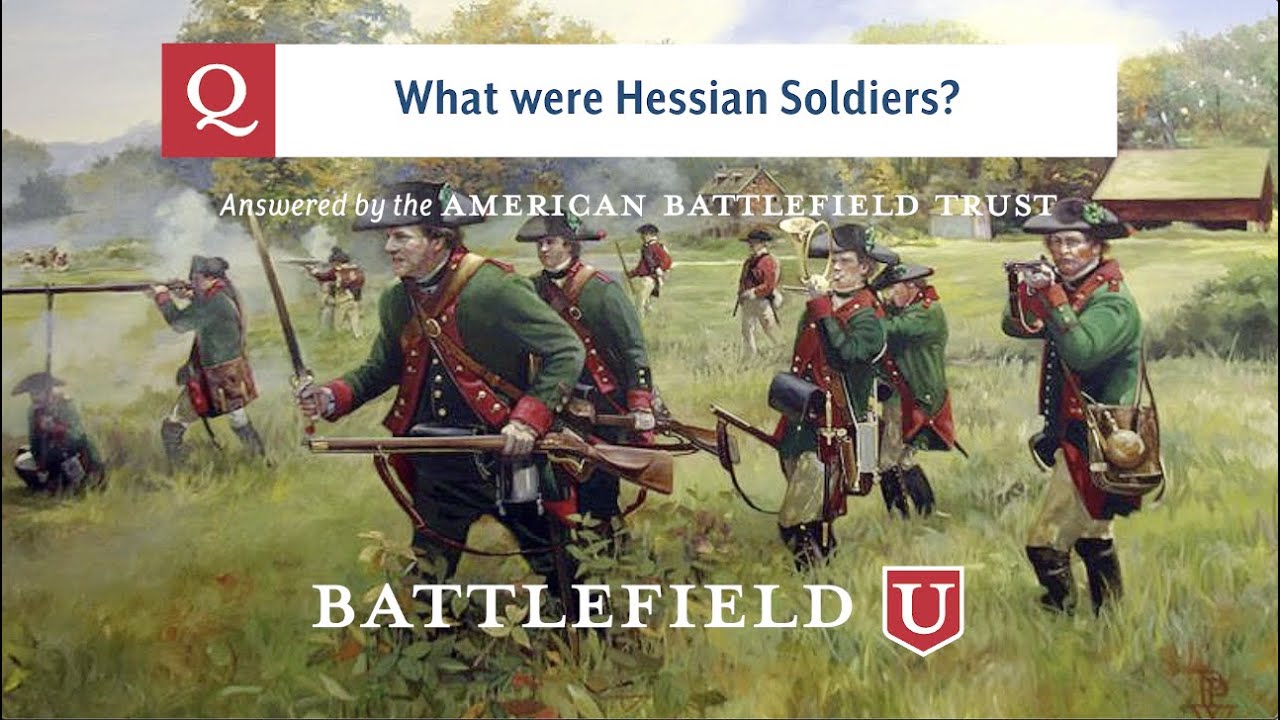
There was no mistaking the new arrivals. Unlike their British allies, who were famously known as the redcoats, the Hessians usually wore blue or green coats, sometimes accompanied by tall, pointy brass headgear called miter caps.
For more than a year, the British Army had been battling rebellious colonists intent on establishing an independent nation. In October 1775, a fed-up George III announced his intention to “put a speedy end to these disorders by the most decisive exertions.” The British king added that he had “received the most friendly offers of foreign assistance.” Despite vigorous objections from some lawmakers, Parliament backed George in taking up those offers, expecting that the added manpower would soon crush the rebellion once and for all.
The Germans apparently shared that optimism. “None of the soldiers that went to America in 1776 anticipated that the war would last more than a year or two,” writes Friederike Baer, a historian at Penn State Abington College, in her 2022 book, Hessians: German Soldiers in the American Revolutionary War.
/https://tf-cmsv2-smithsonianmag-media.s3.amazonaws.com/filer_public/0e/80/0e80db64-b989-4e83-80ed-6e306678c4d4/gettyimages-1397980674.jpg)
In fact, both the British and the Germans had seriously underestimated the Americans’ resolve. The war would drag on for another seven years before finally ending with the Treaty of Paris in September 1783. By then, some 30,000 Germans had been called on to serve. Thousands died in combat or succumbed to disease. And the British went home in defeat.
Who were the Hessians?
The soldiers commonly referred to as Hessian mercenaries weren’t mercenaries by the strict definition of the term. They hadn’t hired themselves out individually as fighters but were instead on loan from their rulers, who received cash subsidies from Great Britain in exchange for their service. Some of the soldiers had volunteered, others were drafted and still others were essentially grabbed off the streets and pressed into service.
These men weren’t all Hessians, either. Germany at the time was not a unified nation but rather a collection of territories that had once been a part of the Holy Roman Empire, each governed by its own ruler. Britain signed subsidy treaties with six of them, including Hesse-Cassel and Hesse-Hanau, whose soldiers represented the true Hessians.
Did you know? The unification of Germany
- The German Empire was founded on January 18, 1871, nearly a century after the American Revolution. It endured until 1918, when Germany became a republic.
- The empire was made up of 26 constituent territorites, including four kingdoms, six grand duchies and one imperial territory.
Subsidy treaties had a long tradition in Europe, dating back to at least the 1400s. During the Seven Years’ War, which ended in 1763, Britain had a subsidy treaty with Prussia to supply it with troops; adversary France had one with Sweden for the same purpose.
As it turned out, the Germans weren’t the British government’s first choice. Its envoys had approached Russia, only to be turned down by the empress Catherine the Great. The Dutch also balked at cooperating.
The subsidy treaties were separately negotiated with each German ruler and could differ from one to the next. Typically, the rulers agreed to supply a certain number of troops for a set amount of money that would keep flowing for the duration of the war, plus another one or two years. If the British sustained losses, the ruler was responsible for replacing the dead to get back to the agreed-upon number. In some cases, German leaders would be paid extra for every soldier killed or wounded—a practice that some critics denounced as “blood money.” The soldiers themselves received their pay directly from the British.

From the beginning, the Germans were demonized in ways that persisted for decades, partly as a result of patriot propaganda. To “rile up American men,” as Baer puts it in an interview, they were characterized as heartless, bloodthirsty monsters. Word on the cobblestone streets of the time included rumors that Hessians were cannibals who ate babies.
Even for colonists who might have been skeptical of the rumors, the simple fact that German soldiers would fight on American soil was considered an outrage. From the Americans’ point of view, it was one thing for the British to try to put down a rebellion by their own colonists. It was another for them to bring in foreigners to help finish the job.
John Jay, a founding father who later served on the Supreme Court as the first chief justice of the United States, was initially a reluctant supporter of the Revolution, believing that the American Colonies should instead negotiate with Britain for greater rights. But the introduction of German troops and other aggressive moves by George III converted him to the patriots’ cause. “Why are the mercenaries of Germany transported near 4,000 miles to plunder your houses, ravish your wives and daughters?” Jay wrote in a widely read address.
When the Declaration of Independence was adopted on July 4, 1776, the Hessians were still somewhere in the Atlantic. More than a month would pass before they set foot in the Colonies. Even so, the German soldiers were accorded a place in the document’s list of 27 grievances against the British king. “He is at this time transporting large armies of foreign mercenaries to complete the works of death, desolation and tyranny, already begun with circumstances of cruelty and perfidy scarcely paralleled in the most barbarous ages, and totally unworthy the head of a civilized nation,” the Declaration noted.
/https://tf-cmsv2-smithsonianmag-media.s3.amazonaws.com/filer_public/38/a7/38a79759-383b-4869-bf46-c6f855ad30df/compleat.jpg)
The Germans are coming! The Germans are coming!
The colonists didn’t need a Paul Revere to tell them that the Germans were on their way. News of the subsidy treaties had been appearing in Colonial newspapers since at least late December 1775. The troops’ movements had been tracked across Europe, from Germany to England, where they would board the ships that would take them across the Atlantic.
The first contingent of German troops left the port city of Bremerlehe in mid-April 1776, stopping off in Portsmouth before setting sail for America on May 6. Their Atlantic crossing would turn out to be hellish.
/https://tf-cmsv2-smithsonianmag-media.s3.amazonaws.com/filer_public/cf/14/cf14d00d-fa37-4406-8eb7-00a46f9e314d/johanngottfriedseume_frommeyersgroschenbibliothek.png)
In a memoir describing his experience, conscript Johann Gottfried Seume reported that the soldiers were packed together so tightly in bunks that they could only lie on their sides, “and when we thus had sweated and roasted enough on one side, the man on the right end called out, ‘Everybody turn!’ and so, everybody turned over. After having suffered enough on the other side, the man on the left edge gave the same command, and we squeezed back again into the old position.”
As for the food, Seume wrote, “the bacon was probably four or five years old, had black stripes on both the outer edges, was yellow toward the middle.” The bread was infested with worms, which the men “had to eat as a substitute for fat.” The drinking water, meanwhile, “smelled like the rivers of Hades. … One had to hold one’s nose while swallowing.”
By the time the ships reached New York, the men had been at sea for over three months.
On August 14, a day before the Hessians disembarked on Staten Island, the Continental Congress passed a resolution aimed at persuading as many of them as possible to desert the British and take up residence in the new country.
The resolution promised that Hessians who switched sides “shall be protected in the free exercise of their respective religions, and be invested with the rights, privileges and immunities of natives as established by the laws of these states.” They would also receive “50 acres of unappropriated lands in some of these states.” George Washington, then serving as commander in chief of the Continental Army, managed to have printed copies of the resolution smuggled into the Germans’ camp.
Two weeks later, a committee consisting of John Adams, Benjamin Franklin and Thomas Jefferson upped the ante, drafting a handbill aimed at persuading German officers to desert and promising them anywhere between 100 and 1,000 acres, dependent on their rank. This announcement was translated into German, then quickly printed and distributed.
Initially, few takers emerged. In addition to any allegiance the Germans felt toward their homeland—and whatever punishment they might face if caught—going over to the American side seemed like a losing proposition. “They had no reason to believe Britain wouldn’t win,” Baer says.
What’s more, a fair number of Germans were sympathetic to the British cause or at least unsympathetic to the American one. “A colonist on Staten Island lived as comfortably as a German country gentleman, and it seemed extraordinary to the Hessians that people should revolt against a government under which they enjoyed so many blessings,” historian Edward J. Lowell wrote in 1884.
/https://tf-cmsv2-smithsonianmag-media.s3.amazonaws.com/filer_public/34/d2/34d2d403-ec4f-4001-a857-090886ae1d34/johann_koch.png)
Off the boat and into the fray
The exhausted Germans were barely off the boat when British commander William Howe pressed them into service. On August 22, British and German troops crossed the bay between Staten Island and Long Island to begin a series of amphibious landings on the latter’s western shore. They would soon number about 20,000 troops: 15,000 British and 5,000 Germans.
Five days later, this combined force attacked the Continental Army from the south as other British troops closed in from the east. The Americans were vastly outnumbered and sustained heavy losses, including the deaths of some 300 soldiers and the capture of 1,100 more, compared with just over 60 deaths on the British and German side. Washington’s men retreated to Brooklyn Heights on the northern edge of Long Island. In the dead of night on August 29, the surviving Americans quietly escaped across the East River into Lower Manhattan.
Washington’s troops managed to hold New York City for a time, but they abandoned it in mid-September in the face of an imminent British attack. Howe’s British and German troops landed at Kip’s Bay, on the eastern coast of Manhattan, on September 15, forcing the Continental soldiers to retreat northward. The following day, Howe’s men attacked Washington’s troops in Harlem Heights, on the north end of Manhattan.
The Battle of Harlem Heights provided a much-needed victory for the Continental Army’s morale, but the men were soon forced to flee once more, first to White Plains in Westchester County, then across the Hudson River into New Jersey and from there into Pennsylvania. The Americans had lost New York City and wouldn’t retake it until 1783.
/https://tf-cmsv2-smithsonianmag-media.s3.amazonaws.com/filer_public/b2/78/b278a463-3906-404b-831c-0ed376cce92a/battle_of_trenton_by_charles_mcbarron.jpg)
While the British and German forces might have seemed all but invincible at this point, that perception would soon change. On the night of December 25, 1776, Washington and his troops crossed the Delaware River from Pennsylvania to mount a surprise attack on the German garrison that had been established in Trenton, New Jersey. After a fierce two-hour battle the following day, the Germans surrendered, and close to 900 of them were taken prisoner.
The Battle of Trenton proved to be a turning point in the war, convincing the colonists that their army could more than hold its own against the enemy. Even so, the conflict would continue for the better part of a decade. And the Germans would play a part in every major military campaign of the war.
Over time, American colonists’ attitudes toward the Hessians began to evolve. They were not invincible supermen but a diverse mix of professional soldiers and ordinary citizens, some fresh off the farm. Many colonists came to prefer them to the British, even sympathizing with them as innocent victims forced by money-hungry tyrants to fight a war thousands of miles from home—a conflict in which they had no personal stake.
As Washington himself observed in a February 1777 letter, “One thing I must remark in favor of the Hessians, and that is, that our people who have been prisoners generally agree that they received much kinder treatment from them than from the British officers and soldiers.”
/https://tf-cmsv2-smithsonianmag-media.s3.amazonaws.com/filer_public/9b/c2/9bc2316c-84cc-442a-bdeb-3b55a98f5e6a/orig_532880_5532.jpg)
The Hessians were still the enemy, of course, and they were far from saints. They earned a reputation for helping themselves to whatever property they wanted as rightful spoils of war. In their defense, Baer points out that plundering in wartime was a common practice, and the Germans weren’t the only ones guilty of it. British troops were also known to plunder, although the army officially discouraged the practice. Rebel colonists apparently didn’t hesitate to loot the homes and farms of their loyalist neighbors.
Of the roughly 30,000 Germans who participated in the conflict, Lowell estimated that just over 17,300 returned to their native lands. Approximately 1,200 were killed in the war, and nearly 6,400 died as a result of accidents or illness. The historian classified another 5,000 as deserters. Baer puts the number of Germans who stayed behind in North America at between 5,000 and 6,000. As many as 3,500 settled in the U.S., with the rest relocating to another part of the continent.
While estimates vary and no one can ever know for sure, it’s likely that the number of Americans today with a “Hessian” or two in their family tree is somewhere in the millions. In the end, the Germans did have a major impact—just not the one George III intended.
/https://tf-cmsv2-smithsonianmag-media.s3.amazonaws.com/accounts/headshot/greg2.png)