
/https://tf-cmsv2-smithsonianmag-media.s3.amazonaws.com/filer_public/59/62/5962c6e6-5029-4809-8993-cefa59ec3f51/mary-boleyn.png)
History Remembers Mary Boleyn as the Scandalous ‘Other Boleyn Girl.’ New Research Debunks the Myths Surrounding the Tudor Mistress
Sylvia Barbara Soberton’s latest book challenges the perception of Anne Boleyn’s sister as “promiscuous, intellectually incurious and unambitious”
/https://tf-cmsv2-smithsonianmag-media.s3.amazonaws.com/accounts/headshot/meilan_headshot2.png)
:focal(750x500:751x501)/https://tf-cmsv2-smithsonianmag-media.s3.amazonaws.com/filer_public/59/62/5962c6e6-5029-4809-8993-cefa59ec3f51/mary-boleyn.png)
In death as in life, Mary Boleyn has been relegated to the sidelines, overlooked in favor of her sister, Anne Boleyn, the ill-fated second wife of Henry VIII.
When Mary is remembered at all, it’s typically in the context of her relationships with the Tudor king and queen. She served as Henry’s mistress prior to his marriage to Anne, then supported her sister as a lady-in-waiting. Mary left court in disgrace after marrying beneath her station, but she avoided Anne’s fate: beheading on charges of treason in 1536. Mary died in obscurity in 1543.
In the centuries since, popular histories and historical fiction, particularly Philippa Gregory’s best-selling novel The Other Boleyn Girl, have cemented a specific image of Mary in the popular imagination. As Elizabeth Norton, author of The Boleyn Women: The Tudor Femmes Fatales Who Changed English History, says, “She is seen as the unsuccessful Boleyn: the one without ambition of her own and a woman with a scandalous past.”
/https://tf-cmsv2-smithsonianmag-media.s3.amazonaws.com/filer_public/ae/b4/aeb4db35-1ce3-4136-ae0c-701def9dfd22/hca.jpg)
New research by historian Sylvia Barbara Soberton seeks to correct this perception. Soberton’s latest book, Mary Boleyn: The Queen’s Slandered Sister, debunks persistent myths about its subject, including an infamous description of Mary as a “great whore” who engaged in affairs with not just Henry but also Francis I of France. Soberton argues that this descriptor, which even served as the subtitle of a 2011 biography, was based on a 19th-century mistranslation. While Soberton acknowledges that the facts of Mary’s life remain elusive, she emphasizes that much of the established lore is misleading at best or blatantly false at worst.
“Mary is always depicted as promiscuous, intellectually incurious and unambitious,” Soberton tells Smithsonian magazine. “She is always someone else’s pawn, a silent victim in historical narrative. In my book, I show a different side of Mary Boleyn—not a ‘great whore’ of legend but an ambitious wife and loyal friend.”
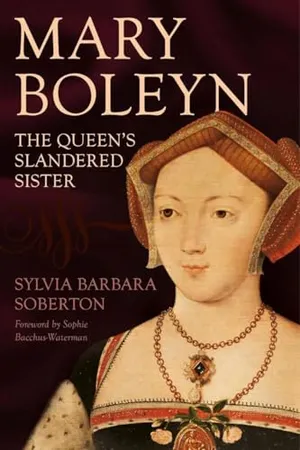
Mary Boleyn: The Queen’s Slandered Sister
Drawing on newly retranslated original sources and rare archival material, this book peels away centuries of rumor to reveal the true Mary Boleyn.
Mary Boleyn’s early life
Historians don’t know Mary’s exact birthdate, but they generally agree that she was the eldest of the three surviving Boleyn siblings, born around the turn of the 16th century. Her mother was a member of a powerful noble family, while her father, Thomas, was an ambitious courtier who rose to prominence as a largely self-made man.
Thomas had high hopes for his daughters, arranging for them to receive a formal education at a time when few women did. Some historians have argued that Mary struggled with her studies, especially in comparison with the notably erudite Anne. But Josephine Wilkinson, author of the first full-length biography of Mary, published in 2010, writes that “we cannot know whether she excelled in the languages that were so easily mastered by her father and brother, and for which her sister was to become so famous.” As is often the case with Mary, Wilkinson adds, “no one bothered to record her abilities in this area.”
/https://tf-cmsv2-smithsonianmag-media.s3.amazonaws.com/filer_public/45/84/458411e1-5f87-4f7c-9607-85e0d04bce34/portrait_of_archduchess_margaret_of_austria_duchess_of_savoy_14801530_in_widows_dress_by.jpg)
/https://tf-cmsv2-smithsonianmag-media.s3.amazonaws.com/filer_public/a6/86/a6866792-ab0c-49cc-8196-7288396d6a38/claude.jpg)
Anne’s biographers have long suggested she learned the skills that would eventually help her attract Henry’s attention—dancing, French fluency, the game of courtly love—while serving in royal households in continental Europe. Anne’s “later achievements owed a very great deal to what she was now beginning to learn” at the court of Margaret of Austria, the Habsburg regent of the Netherlands, historian Eric Ives wrote in his landmark biography of the Tudor queen.
The archival sources underlying this argument include a letter from Margaret to Thomas in which she describes his daughter, then newly arrived in the Netherlands, as “so bright and pleasant for her young age.” A 1514 letter sent from Thomas to Margaret similarly mentions “my daughter, the little Boleyn, who is presently at your court.”
One of the most intriguing takeaways from Soberton’s book is the theory that it was Mary, not Anne, who briefly served at Margaret’s court. As Soberton points out, neither of the oft-quoted messages specifies whether the young girl in question was Mary or Anne. Still, historians have looked to a letter written by Anne herself as evidence of her service under Margaret. In the missive, written to her father in poor French, Anne acknowledged that Thomas wanted her to “be a worthy woman when I come to the court, and you inform me that the queen will take the trouble to converse with me.”
Soberton notes that Anne’s language indicates she “expected to ‘come to court,’ not that she was already there, and that she learned French to impress” an unspecified queen—perhaps Mary Tudor, sister of Henry VIII, who was briefly married to the elderly French king Louis XII in the months before his death. Margaret, for her part, was not a queen but an archduchess.
/https://tf-cmsv2-smithsonianmag-media.s3.amazonaws.com/filer_public/85/49/85490080-1cfc-478d-98c7-ebace0012d7d/mary_tudor_and_charles_brandon2.jpg)
Anne signed off with the French phrase “scripte a Veure,” which has been translated alternatively as “written at Hever,” her childhood home, or a misspelling of “La Vure,” the French name of a park that housed one of Margaret’s summer palaces. Besides this phrase, “nothing in Anne’s letter suggests that she wrote it from Margaret of Austria’s court,” Soberton argues in her book.
Moreover, according to Soberton, Anne’s contemporaries and near contemporaries never explicitly mentioned her service under Margaret, looking instead to her time in France as her formative experience in continental Europe. By suggesting that the younger Boleyn daughter was chosen to go to the Netherlands over her older sister, who would have typically taken precedence in such situations, historians have contributed to the depiction of Anne as “clever and extraordinary, while Mary has been portrayed as plain, simple and less intelligent in comparison,” Soberton writes.
Norton, who praised an advance copy of Soberton’s book, tells Smithsonian that she was “most surprised” by this particular theory, which she describes as “important to the careers of both sisters as they made their way in the English royal court.” Soberton further highlights the significance of her findings: Anne’s “service at Margaret of Austria’s court has generally been treated as an established fact within the Boleyn scholarship,” she says. “In that sense, the implications would extend well beyond my own research to much of the existing scholarship on Anne’s early years.”
Mary Boleyn in France
Compared with their time in the Netherlands, the Boleyn sisters’ service in France is well documented. Mary’s name appears in a list of women who accompanied Mary Tudor to France, then remained at court after the royal wedding in October 1514. Louis died less than three months into the marriage, and his young widow caused a scandal by remarrying an Englishman just a few weeks later.
Anne’s name is absent from the records mentioning her sister’s time at French court, but she likely arrived in Paris by March 1515, when the furor over the dowager queen’s impulsive second marriage started to abate. Anne then served in the household of the new French queen, Francis’ wife, Claude.
Whether Mary remained in France with her sister or returned to England is unclear. As Soberton writes, “We do not know anything about Mary’s whereabouts between the years 1515 and 1520.” But that hasn’t stopped some historians from asserting that Mary gained a reputation for promiscuity at French court, behaving so distastefully that she was sent home in disgrace.
/https://tf-cmsv2-smithsonianmag-media.s3.amazonaws.com/filer/f5/5d/f55dcbd9-50ed-4ece-be47-a4e0ba8e50b7/francis_and_henry.png)
The main evidence for this claim was written more than a decade later, when Anne was married to Henry VIII. It comes from a 1536 letter by Rodolfo Pio da Carpi, a bishop then stationed in France. A 19th-century translation of the note suggests that Anne pretended to miscarry a male child, allowing no one besides “her sister” to attend her, in hopes of covering up the deception. The translator wrote that Francis I had known Mary at French court, where she was infamous as “per una grandissima ribalda et infame sopre tutte’”—in other words, a “great whore, infamous above all others.” (Soberton writes that the translator “preferred not to translate the scandalous remark … perhaps preferring to err on the side of modesty and having no particular stake in the characterization.”)
When Soberton examined the original Italian letter, however, she found that it told a somewhat different story, referencing “one of” the queen’s sisters, rather than Mary explicitly. Her translation indicates that Pio da Carpi was misinformed on matters at English court: He didn’t know that Anne had, in fact, miscarried a male child in January 1536, nor that she had just one sister rather than multiple. Soberton argues that the modern editors of Henry’s Letters and Papers “interpreted Pio da Carpi’s comment as referring specifically to Mary even though the original does not mention her.”
At the time, tensions between England and France were rising, and Anne was rapidly losing her husband’s love over her failure to provide him with a male heir. “One might suspect that, in this political climate, [Francis] felt at liberty to denigrate the Boleyns,” historian Alison Weir wrote in her 2011 biography of Mary. As Norton says, Soberton “offers a new translation and a new interpretation, setting Francis’ comments within the context of a deteriorating political situation.”
Mary Boleyn and Henry VIII
Confirmed records of Mary’s life pick back up in February 1520, when she married William Carey, a distant relative of Henry VIII. A few months later, Mary accompanied Henry and his first wife, Catherine of Aragon, to a lavish summit celebrating England’s friendship with France.
Fun facts: The Field of Cloth of Gold
- Known as the Field of Cloth of Gold, the 18-day meeting between Henry and Francis I cost the equivalent of roughly £19 million today, or $26 million.
- Despite its price tag, the gathering had little lasting effect on Anglo-French relations. Just two years later, Henry decided to side with the Holy Roman Empire in a war against France.
/https://tf-cmsv2-smithsonianmag-media.s3.amazonaws.com/filer/b7/65/b765fb3b-e0f9-48d9-9c77-73c251f78bd3/focog.png)
At an unknown point in Mary’s time at English court, she captured Henry’s attention and became his mistress. Historians don’t know exactly how long the affair lasted, but 1522 is often cited as a starting point. That year, Henry awarded Carey the first of several lucrative royal grants—an event that some scholars have interpreted as a reward for ignoring his wife’s extramarital activities.
Mary’s father also received shows of royal favor around this time, but as historian Lauren Mackay has argued, Thomas’ reputation was on the rise long before either of his daughters caught the king’s eye. “It even managed to remain stable to some extent after their fall,” Mackay writes in her biography of the Boleyn patriarch, “most likely because Thomas’ sources of power, wealth and influence were numerous, with several foundations, and evidently not solely tied to his children.”
A persistent theory regarding Mary’s relationship with the king maintains that he fathered at least one of her two children, perhaps even both. Historians including Soberton and Claire Ridgway have criticized the presentation of this idea as fact, but others find the evidence more compelling. Weir, for example, pointed to similarities between Henry’s appearance and that of Mary’s daughter, Catherine Carey, to argue that “there is a strong possibility” she was the king’s child. Ultimately, Soberton tells Smithsonian, “we will never know. In 1535, a rumor suggested that Henry Carey was Henry VIII’s illegitimate son—that’s it, just one rumor.”
/https://tf-cmsv2-smithsonianmag-media.s3.amazonaws.com/filer_public/5e/fb/5efb1247-235d-4c35-a7ce-a56ad6b510b2/1920px-steven_van_der_meulen_catherine_carey_lady_knollys.jpg)
Soberton outlines a different theory regarding the timing of the relationship. She finds it “highly likely” that Mary’s marriage to Carey actually signaled the end of her liaison with the king, who might have arranged the match as consolation for discarding her as his mistress. She writes that married women who engaged in extramarital affairs in Tudor England were viewed harshly “due to concerns over legitimate heirs and inheritance.” If Mary “became [Henry’s mistress] before her marriage,” however, then the affair “would not have drawn as many comments.”
Mary Boleyn and Anne Boleyn
By 1526, the king’s attention had shifted to Anne, now firmly established as a striking, cosmopolitan figure at Tudor court. Henry attended a joust with the motto “Declare I dare not” emblazoned on his clothing—a surprisingly public acknowledgment. Over the next seven years, Henry pursued Anne relentlessly, even breaking with the Catholic Church to secure the annulment of his first marriage and pave the way for his next.
Unlike Mary and other royal mistresses before her, Anne refused to entertain the king’s attention without certain guarantees. “If she was going to be anything for Henry, it had to be everything: his lover, his queen and the mother of his legitimate children,” historian Estelle Paranque writes in Thorns, Lust and Glory: The Betrayal of Anne Boleyn.
Mary’s prior relationship with the king presented an unwelcome obstacle for her sister. Even as Henry argued publicly that his marriage to Catherine of Aragon was invalid because she’d consummated her first marriage to his older brother, Arthur (the queen maintained otherwise), the king privately sought permission from the pope to marry the sister of his former mistress. (The church forbade individuals linked by either blood or marriage from wedding without special dispensation.) “The double standard was outrageous,” Soberton writes, but the pope granted Henry’s request in early 1528, likely to avoid further alienating him.


In June 1528, William Carey died of the sweating sickness, a mysterious disease that killed its victims in just a few hours. Now a widow, Mary relied on the generosity of Anne and the king, as her father refused to support her financially for reasons unknown. Mary likely kept a low profile in the years following her husband’s death, perhaps retreating to the country to mourn him and returning to court only in 1533, when Anne was finally crowned queen.
Before long, Mary married William Stafford, a former soldier and second son of limited means. Her decision to marry a man considered unsuitable for the sister of a queen resulted in her banishment from court. As Mary wrote in a letter to Henry’s chief adviser, Thomas Cromwell, “I saw that all the world did set so little by me, and he so much, that I thought I could take no better way but to take him, and to forsake all other ways, and live a poor, honest life with him,” she explained. In a not-so-subtle dig at Anne, Mary added, “I had rather beg my bread with him than to be the greatest queen christened.”
Whether Cromwell agreed to help Mary win back Henry and Anne’s favor is unclear, but she remained in exile until at least 1535. The following year, the Boleyn family experienced a rapid fall from favor as Henry tired of his second wife’s headstrong nature, especially in light of the fact that she had yet to give him a male heir. Cromwell engineered a plot to accuse Anne of committing adultery with at least five other men, including her brother, George. The queen was beheaded on these and other trumped-up charges on May 19, 1536, two days after George and the others falsely accused of adultery met a similarly brutal end. Henry married his third wife, Jane Seymour, just 11 days after Anne’s death.
/https://tf-cmsv2-smithsonianmag-media.s3.amazonaws.com/filer_public/de/a0/dea01aac-582b-4838-8368-40e56e47e944/english_school_william_carey.jpg)
Mary’s reaction to her siblings’ executions went unrecorded, and her movements in the last seven years of her life are only sparsely chronicled. She didn’t attend the funeral of her mother, who died in 1538, but apparently reconciled with her father, who made provisions for her and Stafford in his will before his death in 1539. That same year, Henry finally forgave Mary and her second husband, although it’s unclear how much time she spent at court versus at her estates elsewhere in England. Mary died in 1543 of unknown causes.
“Mary never returned to court service as lady-in-waiting, but her husband and children held posts in the royal household,” Soberton says. “She lived a quiet life in the end but was wealthy and well provided for.”
Soberton’s research suggests that Mary’s relatives kept her sister’s memory alive for years to come. A portrait of Mary’s great-granddaughter, for instance, shows her holding a comb that may have once belonged to Anne. “Mary’s descendants kept Anne’s possessions as precious family heirlooms, passing them down from generation to generation, which suggests to me that the Boleyn sisters may have reconciled before the tragedies that occurred in 1536,” Soberton says.
Mysteries surround Mary, from the location of her burial site to the paternity of her children. But Soberton’s biography, which is now available in the United Kingdom and will be released in the United States this year, goes a long way toward dispelling the perception that everything historians know about Mary could be “written on a postcard with room to spare,” as Ives once quipped.
/https://tf-cmsv2-smithsonianmag-media.s3.amazonaws.com/accounts/headshot/meilan_headshot2.png)