
/https://tf-cmsv2-smithsonianmag-media.s3.amazonaws.com/filer_public/61/0c/610cc515-004a-431a-b211-f437ca4b4d55/aerial-fair.jpg)
America’s 150th Birthday Celebration Was Deemed the Nation’s ‘Greatest Flop.’ What Went Wrong With the Sesquicentennial?
Philadelphia politicians hoped to replicate the success of the 1876 Centennial Exposition. Instead, the 1926 world’s fair lost millions of dollars, essentially bankrupting the city on the eve of the Great Depression
/https://tf-cmsv2-smithsonianmag-media.s3.amazonaws.com/accounts/headshot/meilan_headshot2.png)
:focal(750x500:751x501)/https://tf-cmsv2-smithsonianmag-media.s3.amazonaws.com/filer_public/61/0c/610cc515-004a-431a-b211-f437ca4b4d55/aerial-fair.jpg)
A century ago, the first visitors to Philadelphia’s Sesquicentennial International Exposition—held to mark the 150th anniversary of the United States’ founding—waded through mud and wandered along unpaved sidewalks to reach the heart of the fairgrounds, only to find carpenters still at work on half-finished exhibition halls and gaping holes marking the spots where attractions had yet to be built.
Dining and shopping options were limited, and some of the few exhibits on view stretched the very definition of “entertainment.” One was a model Post Office where “you could go send yourself a letter and watch it get canceled,” says historian Thomas H. Keels, author of Sesqui! Greed, Graft and the Forgotten World’s Fair of 1926. “That was it.”
The 200,000-plus Shriners in town for their fraternal organization’s national convention realized that their parades and rallies were the main events planned for these early days of the fair. Many went home disappointed, telling family and friends that the exposition wasn’t worth visiting.
/https://tf-cmsv2-smithsonianmag-media.s3.amazonaws.com/filer_public/35/0d/350d7348-bd73-47bf-9f98-fbd50aa553cf/large_1.jpg)
“The show is still in a state of undress, not ready at all to answer the doorbell,” a California newspaper reported. Speaking with Philadelphia’s Bulletin, an Iowa man likened the fair to a birthday dinner held by an acquaintance back home. “He got so darned excited about how many he was going to have, invitations, his speech of welcome and the program of entertainment,” the tourist recalled, “he plumb forgot to order any grub. … But the fellow had a sense of humor. ‘Come around next birthday and we’ll have something to eat,’ said he. Maybe I will.”
Held in Philadelphia between May 31 and December 31, 1926, the fair—referred to as the Sesqui—celebrated the 150th anniversary of the United States’ founding. Little remembered today, the event was a financial failure that Variety deemed “America’s greatest flop.” Exact figures are hard to come by, but Keels suggests that the fair lost the equivalent of more than $410 million in today’s dollars, effectively bankrupting the city of Philadelphia.
The exposition was America’s main celebration of the sesquicentennial. Congress authorized the fair and provided limited funding for it, in addition to issuing commemorative coins and encouraging local celebrations, but the scale of federal participation paled in comparison with that of the 1976 bicentennial and this year’s 250th anniversary of the signing of the Declaration of Independence.
/https://tf-cmsv2-smithsonianmag-media.s3.amazonaws.com/filer_public/4f/41/4f41ac89-5f1b-4701-bc25-c6381e556bb5/large.jpg)
/https://tf-cmsv2-smithsonianmag-media.s3.amazonaws.com/filer_public/21/01/21015bca-28c5-4835-9a06-8f949ad4b17f/fair-poster.jpg)
Attendance at the Sesquicentennial Exposition also failed to match the numbers of Philadelphia’s 1876 centennial celebration, which attracted roughly 20 percent of the country’s population in an era when planes, cars and luxury liners had yet to make long-distance travel more accessible. Organizers predicted that 30 million people would visit the 1926 fair; ultimately, fewer than five million paid to attend.
Quick facts: American world’s fairs by the numbers
- More than 44 million people visited the “World of Tomorrow” at the 1939-40 New York World’s Fair. Two and a half decades later, 51 million visitors flocked to the 1964-65 New York World’s Fair.
- At the other end of the spectrum, the 1907 Jamestown Tercentennial Exposition drew fewer than three million visitors, making it “the most sparsely attended American world’s fair of the 20th century,” Keels writes in Sesqui.
What doomed the sesquicentennial? Poor planning and lukewarm reviews by the fair’s early visitors contributed to the disastrous outcome. So, too, did the streak of bad weather that plagued Philadelphia during the exposition’s run, with rain falling on more than half of the days the fair was open to the public.
Although some observers considered the lackluster public response a sign that the golden age of world’s fairs had come to an end, Chicago’s 1933-34 Century of Progress Exposition proved this prediction wrong, drawing more visitors than any of its predecessors. Overall, Keels attributes the 1926 fair’s failure to its “association with what was being viewed as an increasingly corrupt political machine,” headed by Pennsylvania Republican William Scott Vare.
After the fair incurred “nationwide ridicule,” Keels tells Smithsonian magazine, Vare and other local politicians were eager to move on from the endeavor, selling off leftover structures piecemeal “for pennies on the hundreds of dollars.” This push to forget the sesquicentennial has reverberated into the present: Just one building constructed for the 1926 fair stands in Philadelphia today.
/https://tf-cmsv2-smithsonianmag-media.s3.amazonaws.com/filer_public/26/44/2644e410-fbb6-4a7d-83cd-01b7fec5321b/3840px-memorial_hall_phila.jpg)
“When I started to write my book,” Keels says, “I was looking for sources, and I would ask people who were very knowledgeable historians, and the immediate response was, ‘Oh yeah, the centennial, Memorial Hall in Fairmount Park.’ And it’s like, ‘No, the other one.’” They’d ask, “‘What other one?’”
The inspiration behind the sesquicentennial
In May 1876, John Wanamaker, founder of the Wanamaker’s department store chain, welcomed shoppers to his new Grand Depot. Housed in an abandoned railroad depot that had been redesigned in the Moorish Revival style, the store opened just days before the start of the Centennial Exposition. Visitors to the fair flocked to it, impressed by the wide array of goods on display. The experience left a strong impression on Wanamaker, who’d also helped raise funds for the exposition.
Forty years later, in 1916, Wanamaker—by then the last surviving member of the 1876 fair’s finance committee—urged his fellow Philadelphians to capitalize on the upcoming sesquicentennial by staging another world-class exposition. Bemoaning political corruption and the city’s lack of economic growth, the aging entrepreneur pointed out that preparations for the centennial had started “ten years before the time to get government support and necessary legislation.” He asked, “Why not celebrate the century and a half in 1926 and begin to get ready now?”
/https://tf-cmsv2-smithsonianmag-media.s3.amazonaws.com/filer_public/77/e0/77e0ce15-66ef-4905-ba3a-43c9dbea99e5/wanamaker_store.jpg)
Wanamaker’s call to action resonated with the head of the city’s Chamber of Commerce, who lent his support to the cause. But plans for a sesquicentennial celebration were soon overshadowed by America’s entry into World War I, in April 1917. The campaign picked back up only after the war’s end, with Wanamaker, in his 80s by this point, once again at the forefront.
“Until his death in 1922, he was really the guiding force behind the fair,” Keels says. Afterward, the historian explains, the effort faltered for several years before it was picked up Vare and Philadelphia Mayor W. Freeland Kendrick “as a great way to advance their careers and line their pockets.”
Political corruption and the sesquicentennial
At the turn of the 20th century, Vare and his two brothers amassed a fortune as construction contractors, earning the nickname the “Dukes of South Philadelphia.” By 1922, Vare—then serving in the U.S. House of Representatives—had emerged as the city’s “undisputed boss,” Keels writes for the Encyclopedia of Greater Philadelphia. “During the 1920s, he commanded more political power than any other single Philadelphian before or since.”
/https://tf-cmsv2-smithsonianmag-media.s3.amazonaws.com/filer_public/b2/75/b2755dc7-69d1-4958-b74f-f7bac12f2a3c/vare.jpg)
/https://tf-cmsv2-smithsonianmag-media.s3.amazonaws.com/filer_public/cb/a3/cba3fc8d-8f30-4c04-a122-ee177a14cf83/city_of_philadelphia_mayor_w_freeland_kendrick.jpg)
Vare funneled city contracts to his own company and committed election fraud to keep himself and his cronies in power, reinforcing a Progressive Era journalist’s assertion that Philadelphia was “simply the most corrupt and the most contented” municipal government in the country.
In January 1923, the Sesquicentennial Exhibition Association (SCEA), a governing body tasked with organizing the fair, announced plans for a “world festival of peace and progress” that would commemorate the 150th anniversary while reflecting on the achievements of the past 50 years. The committee claimed that the exposition would transform Philadelphia’s Fairmount Parkway into a “triumphal way of the Republic” inspired by the harmonious architecture of ancient Rome, at a cost of roughly $15 million (nearly $300 million today).
State and local officials were unwilling to provide such funds for what was a generally unpopular cause. Philadelphians feared tax increases prompted by the fair and objected to the allocation of city funds to commercial interests rather than housing and infrastructure. The effort stalled until early 1924, when the Vare-backed Kendrick took office as Philadelphia’s mayor. Kendrick also assumed control of the newly reorganized SCEA, leading the charge to move the fairgrounds from Fairmount Park to a largely undeveloped area in the Vare stronghold of South Philadelphia.
/https://tf-cmsv2-smithsonianmag-media.s3.amazonaws.com/filer_public/e8/35/e8352e54-b9a3-48b6-9c11-9157c46e0a55/large_6.jpg)
Before construction of the centerpiece Sesquicentennial Stadium could begin, “some mammoth engineering problems had to be resolved, and the marshy land on which the exposition buildings would sit drained and filled,” historian Arthur P. Dudden writes in Philadelphia: A 300-Year History. This $10-million project “made the fair insolvent even before it began,” Keels says, prompting accusations of political corruption. As the New York Times reported, “Charges have been freely made that the whole enterprise is no more than a gigantic real estate scheme to boost realty values in South Philadelphia.”
By January 1926, organizers had made little progress with constructing the fair. The stadium sat unfinished, and none of the exhibition halls had been completed. Appalled by the state of the fairgrounds, federal officials suggested delaying the exposition until 1927, pledging additional government funds if such a plan was implemented. But Kendrick flatly refused, insisting that the exposition take place in the actual year of the sesquicentennial.
Keels finds this rigidity perplexing. He points out that the 1893-94 Chicago World’s Fair was originally scheduled for 1892, the 400th anniversary of Christopher Columbus’ departure from Spain in search of the New World, and that the 1904 St. Louis World’s Fair was initially slated to open in 1903, the 100th anniversary of the Louisiana Purchase. “Both were delayed by a year,” Keels says. “Both were huge successes.”
The Sesqui author argues that Vare was the driving force behind Kendrick’s desire to stick to the original timeline. Vare was running for a seat in the U.S. Senate in 1926, and Keels believes that he wanted the fair ready in time for the election. By creating jobs for his constituents, Vare hoped to gain an upper hand in his campaign. “It was really benighted self-interest at the expense of an entire national celebration,” Keels says.
/https://tf-cmsv2-smithsonianmag-media.s3.amazonaws.com/filer_public/fc/22/fc2241b3-6e9c-41bf-b8c1-af1a4e945718/large_3.jpg)
Opening the 1926 Sesquicentennial International Exposition
The Sesquicentennial Exposition opened on May 31, 1926, a day earlier than initially planned, to better accommodate Kendrick’s fellow Shriners, many of whom had arrived in town early for their national convention.
“All seemed confusion” during the fair’s opening week, an official 1929 account of the exposition admitted. The fairgrounds were still abuzz with construction work. In early April, the Bulletin had recounted the frenzy of activity then unfolding in South Philadelphia: “White overalled men dash about like the characters in a rapid-motion movie film,” a reporter wrote. “Hammers beat a tattoo like machine gun fire. Saws buzz. Foremen swear. Men shout. Steam shovels hiss and groan under capacity loads.” Nearly two months later, this scene remained largely unchanged; visitors to the fair encountered construction noise, scaffolding and a sea of unfinished exhibits.
Not until July 5, when President Calvin Coolidge delivered a 40-minute speech celebrating the 150th to a rapt audience at the Sesquicentennial Stadium, was the fair finally considered complete, with an estimated 90 percent of exhibits on display. (Coolidge declined to visit on July 4, which was both his birthday and the first Sunday that the exposition was open to the public; Kendrick’s decision to welcome visitors that day had attracted much criticism from Sabbatarians.)
From that point on, Keels writes in Sesqui, “there could be no more excuses, no way of promising disappointed visitors that everything would be so much better if they came back in a month. The Sesqui was open for business, and it had fewer than five months to attract 30 million visitors, pay for itself and vindicate its existence.”
/https://tf-cmsv2-smithsonianmag-media.s3.amazonaws.com/filer_public/67/99/6799690e-a302-4956-8322-7cbe0f9d8e49/large_2.jpg)
What to see at the Sesquicentennial Exposition
On August 21, the Times published a glowing review of the fair, suggesting that it had overcome a rough start to “take the place that properly belongs to it as one of the great American international expositions.”
At the 100,000-seat stadium, visitors could watch pageants and performances or attend sporting events, including a heavily publicized boxing match between heavyweight champion Jack Dempsey and challenger Gene Tunney. Elsewhere, fairgoers explored five enormous exhibition halls dedicated to the arts; agriculture; fashion; government, machinery and transportation; and education.
A number of U.S. states, from New Jersey to Ohio, either erected buildings at the fair or staged smaller-scale exhibitions, as did foreign governments, including Iran (then Persia) and Japan. The Smithsonian Institution contributed fossils and models of landmark vessels in transportation history, in addition to loaning the taxidermy body of Owney the mail dog, the unofficial mascot of the Railway Mail Service in the late 19th century.
/https://tf-cmsv2-smithsonianmag-media.s3.amazonaws.com/filer_public/6e/3e/6e3e8aee-a7a4-41d7-a3e4-22f68171fa07/sia-sia_000095_b63_f18_001.jpg)
The biggest draw of the fair was arguably its 80-foot-tall replica of the Liberty Bell, which was equipped with 26,000 light bulbs that illuminated the exposition’s entrance at night. (A 175-foot Tower of Light was also supposed to rise above the fairgrounds, but construction stalled later in the summer, as the exposition continued to lose money amid low visitation.)
Another popular attraction was High Street, a re-creation of Colonial-era Philadelphia that was spearheaded by a separate women’s committee. The thoroughfare housed 22 replicas of key structures that stood in the city in 1776, including a tavern frequented by Thomas Jefferson, Benjamin Franklin’s print shop and a house associated with the Quaker spy Lydia Darragh. As local scholar Ellen Freedman wrote in her 1988 master’s thesis, High Street offered visitors “an escape from the complexities of the modern world” at a moment of great change. “In a world where they felt that traditional values were eroding,” Freedman added, “the women offered a renewed hope in community and civic life.”
Reflecting on High Street’s success in December 1926, the Philadelphia Record remarked that “if the men of Philadelphia had undertaken to serve their city with half of the zeal, enterprise and efficiency manifested by the women of this group during the Sesqui period, there would be a different story to tell of the celebration of the nation’s birthday.”
/https://tf-cmsv2-smithsonianmag-media.s3.amazonaws.com/filer_public/30/e1/30e15ec7-8053-437f-9298-5df66bebe864/historic_high_street_dedicated.jpg)
While women managed to leave their mark on the exposition, Philadelphia’s Black community fared far worse. The fair’s organizers denied a request to erect a building dedicated to African American achievement, arguing that such a space would be tantamount to permitting segregation. At the same time, however, the Black committee was forced to meet in an office building owned by its chair, even as “the rest of the [fair] employees were in a brand-new administration building down on the Sesqui grounds,” Keels says.
Despite these challenges, the committee successfully mounted a Marian Anderson-led pageant called Loyalty’s Gift, as well as a spiritual songfest. The group then announced plans for a performance of Ethiopia, a sweeping showcase of Black history. At the last minute, however, the fair’s director of events—a man who’d previously agreed to host a Ku Klux Klan weekend at the exposition, reversing course only after widespread backlash—informed the producers that the venue was no longer available.
Instead, the cast and crew had to stage their show on a different night, in front of a significantly smaller audience, as the new date coincided with the Dempsey-Tunney fight. The fair’s “track record for civil rights,” even by the standards of 1920s America, was “really shameful,” Keels says.

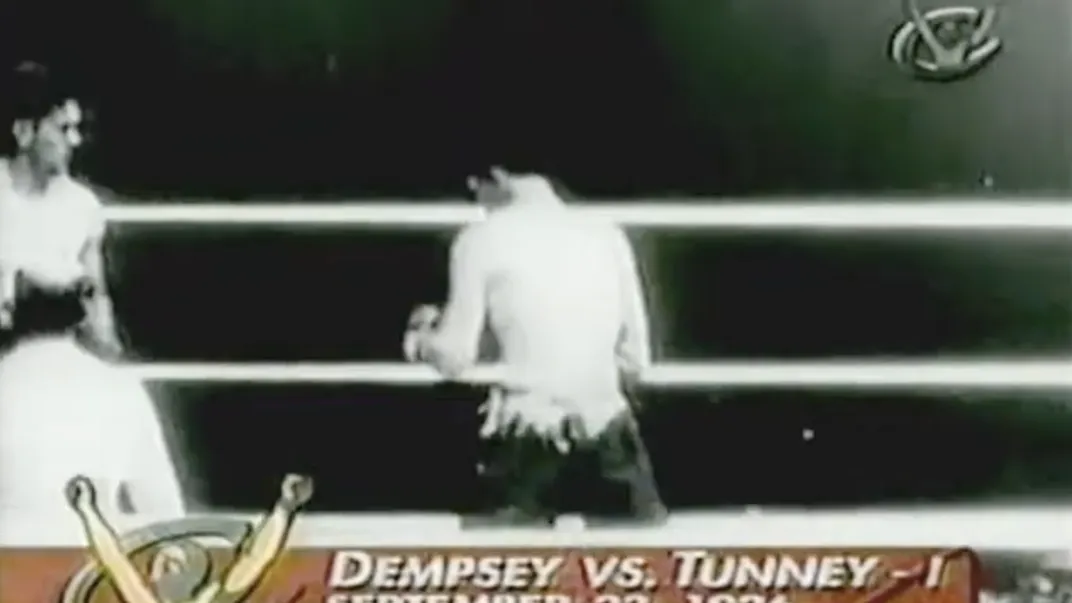
By the time of the boxing match, the fair was in a financial hole from which it would never recover. Although the fight brought 130,000 people to Sesqui Stadium, these sports fans didn’t have to pay for admission to the fair, which was included in the cost of their ticket to the match. Afterward, “attendance really plummeted and would stay low throughout the entire fall,” Keels says.
On October 7, Kendrick deemed the fair a “financial failure,” revealing that organizers owed contractors and creditors more than $3 million. (The unpaid bills would soon rise to $5.8 million.) The exposition wasn’t the first world’s fair to fail to turn a profit, the Times noted, but none in recent memory had “met with such public apathy as the sesquicentennial.” The fair closed to little fanfare on December 31, its planned six-month run extended to seven months in a last-ditch effort to sell off remaining merchandise.
“No ceremonies marked the official closing of the gates to the public at midnight,” the Times reported. “All the employees had left the grounds hours before, and a lone attendant turned the key in the main gate in silence. … Today, the exposition for which Philadelphia spent more than $17,000,000 was left in the care of one man as guard.”
/https://tf-cmsv2-smithsonianmag-media.s3.amazonaws.com/filer_public/c1/9e/c19e767a-e854-43f6-aeb1-01f9a3534117/large_4.jpg)
/https://tf-cmsv2-smithsonianmag-media.s3.amazonaws.com/filer_public/6c/db/6cdbb7c7-faba-4029-a7dc-acee0424e4e1/seltzer.jpg)
The legacy of the 1926 sesquicentennial
In interviews with the press, Kendrick cast the fair’s failure as a sign of the times. Others agreed. “Is the day of such great international expositions past?” one writer asked. “We no longer need world’s fairs to keep in touch with world doings. Our people are more traveled nowadays, more sophisticated. If they want to see the world, they go and see it for themselves rather than through the microcosm of an international exposition.”
Ironically, it was the Great Depression that ushered in the clearest refutation of this assessment. Held in Chicago in 1933 and 1934, the Century of Progress Exposition created a new template for world’s fairs, looking to the future instead of the past. Nearly 40 million people paid to see the exposition’s towering transporter bridge and model homes equipped with central air-conditioning, electric dishwashers and even a hangar for the family airplane. Chicago “had crafted a fair brimming with modernity and vitality, qualities that the Sesqui sadly lacked,” Keels writes in his book.
As for the political bosses behind the disaster, Vare won his Senate race but was never seated. A Senate committee investigating allegations of election fraud by Vare’s political machine concluded that the “average Philadelphia voter had a one-in-eight chance of having his ballot recorded accurately on Election Day.” Kendrick vacated office in disgrace, leaving Philadelphia on the verge of bankruptcy.
“The price of Kendrick’s loyalty to Vare was his political career,” Keels writes in Sesqui. “The price of Philadelphia’s allegiance to Vare was its financial stability.”
/https://tf-cmsv2-smithsonianmag-media.s3.amazonaws.com/filer_public/5e/28/5e28aa4f-f1bd-4d76-aa8b-5ba98d73810f/large_7.jpg)
/https://tf-cmsv2-smithsonianmag-media.s3.amazonaws.com/accounts/headshot/meilan_headshot2.png)