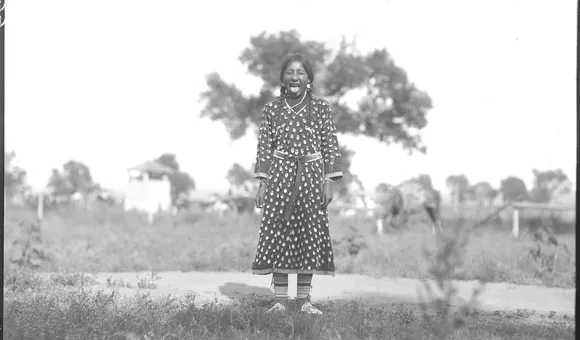
The Quapaw Treaty Was Honored for Only Six Years Before the United States Broke It
The document signed in 1818 serves as a reminder of the unfairness of the federal government's approach to negotiating with Native communities
Above the Arctic Circle, where the temperature plumets below zero and darkness abounds for months, the art of Indigenous beading sustains the resilience of the Alaskan Gwich’in Athabaskan culture.
In 1991, my father and I decided to host a unique event to preserve a Native artform that began in the Southwest and transform it into a World Championship Contest. Little did we know our collaboration would take the art of hoop dancing to unknown levels of skill and performance.
American Indians have long been erased or hidden from historical records, but archivists and Native communities are working to restore identities and reconnect families with photos and other materials related to their ancestors.
The document signed in 1818 serves as a reminder of the unfairness of the federal government's approach to negotiating with Native communities
Dennis ZotighThe Role of Virtual Engagements in Home to Mi’kma’ki Shared Stewardship
Sydney CollinsOver the past few years, Indigenous film and television have finally started to break through on mainstream platforms, and the National Museum of the American Indian's annual Native Cinema Showcase has been part of that change. Native comedian, filmmaker, and the producer of Netflix show "Spirit Rangers" Joey Clift (Cowlitz) looks back on how things have changed since his childhood and what he hopes the future holds for Indigenous film and television.
Jeremy GilesThe important document is now on view at the National Museum of the American Indian in Washington, D.C.
Dennis ZotighHow do two institutions work in partnership across borders and time zones to care for cultural items? More than 25 years ago, the Mi’kmawey Debert Cultural Centre (MDCC) in Nova Scotia and the Smithsonian’s National Museum of the American Indian began a partnership that continues today.
Caitlin MahonyChavez emphasizes how she plans to maintain her cultural and communal ties while working in Washington D.C.
Dennis ZotighAlthough current views may point to “political correctness” for changes in language and terminology, by looking back through historical documents, it’s quite clear that this is not something new.
Maria GalbanWhat can one day tell us? This Friday, December 11, 2020, ten Smithsonian museums and cultural centers are taking a snapshot of this extraordinary year, offering a moment for reflection and sharing perspectives. Join us in this effort to document a day in the life of our nation and the world—a chance to consider together where we’ve been and where we’re going. In addition to collecting individuals’ and families’ stories—with the assistance of wide-ranging questions as prompts—the ten museums and centers present a series of free, virtual programs sharing different perspectives on the issues that have shaped this year. See https://24hours.si.edu/ for the schedule and to register for some of the programs.
the National Museum of the American IndianThe exact date of Jim Thorpe's birth is unknown, but it is generally believed that the first Native American to win an Olympic gold medal for the United States—regarded by many as one of the greatest athletes of all time—was born on May 22, 1887, or May 28, 1888. In honor of his birth, the Smithsonian Transcription Center has added eight significant projects from the Grace Thorpe collection in the museum's archives, including Grace’s “Memories of Dad” and her answer to the frequently asked question “How does it feel to be Jim Thorpe’s daughter?” Read more about Grace Thorpe’s life, then consider becoming a Smithsonian digital volunteer and contributing to the Transcription’s Center’s work.
Rachel MenyukThe first Native Hawaiian cultural interpreter on the staff of the National Museum of the American Indian explores the importance of aloha in the Hawaiian worldview. “More than a greeting or salutation, aloha is like a feeling that encompasses many other feelings,” Gabrielle Lee writes, a set of values that “work together to build a profound sense of love and respect for others.” In the spirit of aloha, she sees museums as places to learn together. Celebrate Asian Pacific American Heritage Month by exploring the Smithsonian’s collections of art and objects from Hawai‘i and the Pacific: https://www.si.edu/spotlight/asian-american
Gabbi C. K. LeeThe collections of the National Museum of the American Indian include thousands of objects and images acquired during expeditions conducted or sponsored by our predecessor institution, the Museum of the American Indian–Heye Foundation. While some expeditions are well documented in collectors’ field notes and early publications, much of the information about specific objects or the individuals associated with them was never recorded on the museum’s catalog cards. A long-term, multi-institutional project to reconstruct objects’ acquisitions histories is reuniting this information with the collections. Here are a few things we’ve learned so far.
Maria GalbanFor the close of African American History Month, and looking ahead to Smithsonian magazine's Museum Day April 4, we talk with Maria Marable-Bunch about her formal and informal education and her career in museums. A widely respected educator—recipient of the Alliance of American Museums’ Award for Excellence in Practice—and an accomplished artist, Maria, as she prefers to be called, is one of three associate directors of the Smithsonian’s National Museum of the American Indian.
Dennis ZotighThe National Museum of the American Indian has taken a major step toward making our collections more widely available: We have posted all of the museum’s ethnographic and contemporary art collections to the Smithsonian’s collections search center, more than tripling the number of our object records online. Equally important, a long-term, multi-institutional project to reconstruct objects' acquisitions history is adding significantly to what we know about the collections, the history of the museum, and collecting practices over time.
Maria Galban