Restoring Her Name: The Story Behind a 1910 Photograph
American Indians have long been erased or hidden from historical records, but archivists and Native communities are working to restore identities and reconnect families with photos and other materials related to their ancestors.
/https://tf-cmsv2-smithsonianmag-media.s3.amazonaws.com/filer_public/3c/58/3c583b47-19cb-4d74-860f-3bec68bc3db4/n220343000x3000.png)
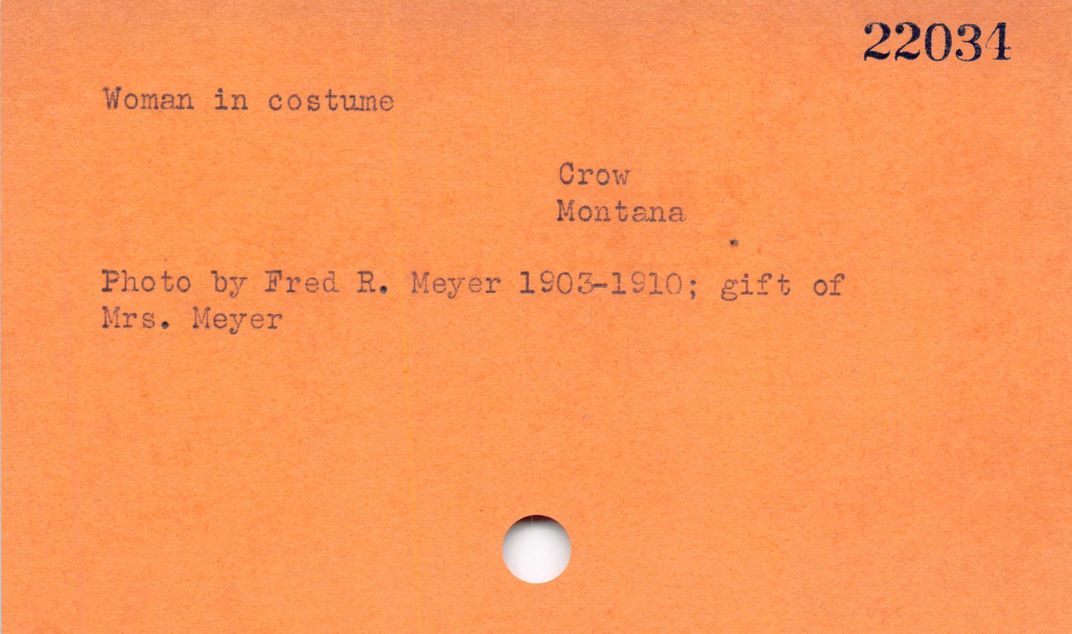
In a black-and-white photograph from 1910, a young person stands in a grassy field, wearing an elk-tooth dress and playfully sticking her tongue out at the camera. The catalog card simply read: “Woman in costume.”
But who was she? What was her story?
Too often, historical photographs of Native people were labeled with vague, generic descriptions: “Indian man,” “Indian woman.” These labels reflect a time when Native peoples were wrongly viewed as a “vanishing race,” and their names, lives, and stories were often left unrecorded.
As archivists, our work often feels like detective work. We follow clues, chase leads, and piece together fragments of history to uncover the who, what, where, when, and why behind each image. And sometimes, we get lucky.
In this case, the catalog card noted that the subject was from the Apsáalooke (Crow) community. Our breakthrough came when we located the original negative envelope in our collection. It identified the girl as Sarah Grandmother’s Knife, age 10.
This discovery is more than just a name—it’s the beginning of reclaiming her story.
/https://tf-cmsv2-smithsonianmag-media.s3.amazonaws.com/filer_public/56/8e/568edc41-ce22-413e-a502-82fa8703adda/ex15.jpg)
From there, we turned to genealogy and census records. We found her obituary and learned that Sarah was born in 1900 on the Apsáalooke (Crow) Reservation in Montana. She married John Gros Ventre and later Harry Don’t Mix, and together they raised eight children:
- Frances Gros Ventre (1915–1953)
- William Gros Ventre (1918–2004)
- Emma Don't Mix Bad Horse (1924–2004)
- Rita Beads Don't Mix (1926–2001)
- Calvin Albert Don't Mix (1928–1932)
- Edwin Ivan "Peace Beads" Don't Mix, Sr. (1934–2012)
- Harriett Don't Mix (1936–2006)
- Aurelia Ann Don't Mix (1941–1993)
Sarah passed away from cancer in 1957.
This discovery is more than just a name—it’s the beginning of reclaiming her story. Now that we know who she is, we hope to connect with her descendants and share this photograph with them.
Unfortunately, Sarah’s story is not unique. Many photographs from the late 1800s and early 1900s were taken during a time when Indigenous people were being relocated to reservations. Their identities were often lost in the historical record, replaced with generic labels that erased their individuality and made it difficult for descendants to trace their heritage.
Today, that is changing. Archivists and Native communities are working together to restore these lost identities. Through outreach, collaboration, and research, we’re reconnecting families with images of their relatives and bringing their stories back into the light.
This kind of work happens regularly. Sometimes, a community member or relative recognizes someone in a photo and shares their name. Other times, we rely on historical documents, family trees, or even other identified photographs to make a match. Every name we recover is a step toward respect and remembrance.
The photograph of Sarah Grandmother’s Knife is currently on view at the National Museum of the American Indian in Washington, D.C., as part of the new exhibition InSight: Photos and Stories from the Archives. The photographs in this exhibition, many of which have never been exhibited or published before, come from the museum’s archives.
The NMAI Archives Center holds more than half a million photographs and serves as a platform for sharing images across generations. It’s the insight and voices of Native people that bring these photographs to life. Together, archivists and communities are restoring identities and honoring the people behind the pictures.