Subscribe to Smithsonian magazine and get a FREE tote.

Religious History

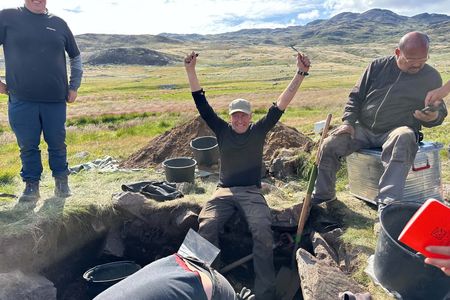
The archaeologists were thrilled when they found the human remains.

Cool Finds

Archaeologists Searching for Evidence of a Norse Church in Greenland Have Found ‘the Smoking Gun’ Near Erik the Red’s Settlement

The site was first identified as a possible church decades ago, but researchers did not confirm that hunch until they found human remains there this summer. It could offer another clue to the Viking’s unexplained 15th-century disappearance
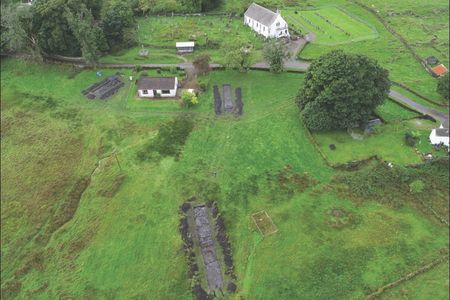
An aerial view of the archaeological trenches dug around Lismore's parish church, a 13th-century cathedral

Cool Finds

A Community-Led Archaeology Dig on a Tiny Scottish Isle Has Unearthed a Medieval Monastery of ‘International Importance’

The settlement, founded by an early Christian saint in the 500s, is “far more than a small island church.” It may have played a larger role in the Christianization of Britain than historians once realized
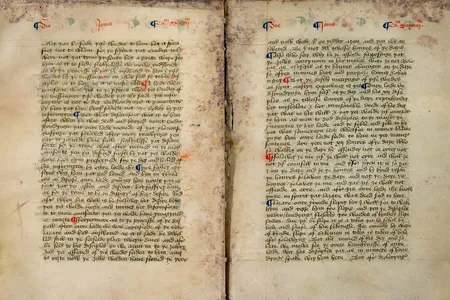
Pages from a manuscript of Nicholas Love's Mirror of the Blessed Life of Jesus Christ

Cool Finds

Henry VIII Relied on This Courtier to Enforce His Orders During the English Reformation. Behind the Scenes, the Tudor Politician Defied His King by Secretly Saving a Catholic Text

A newly discovered fragment suggests that John Gage preserved a 15th-century religious manuscript, keeping it “safe when he was meant to destroy books precisely like this one”
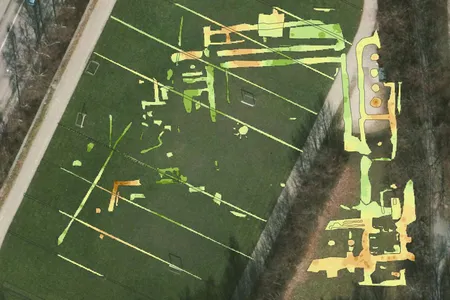
The survey uncovered surviving remnants of structures from the 13th-century convent.

Cool Finds

The Ruins of a Long-Lost Medieval Convent Have Been Discovered Just a Few Feet Beneath a Soccer Field

St. Clare’s Convent closed in the 16th century, and researchers assumed all traces of it had been lost. But a new ground-penetrating radar survey revealed surprisingly intact remains of pillars, rooms, cloisters, a courtyard and a church
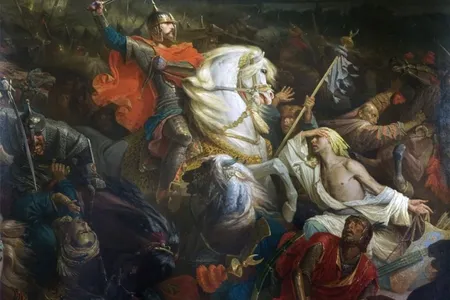
An 1849 painting by Adolphe Yvon depicts Dmitry Donskoy, who is widely regarded as a Russian hero, in the Battle of Kulikovo. Donskoy’s remains were discovered in Moscow in August. 

Russia Sends the Centuries-Old Remains of a Medieval Warrior Prince to Its Front Line in Ukraine, Hoping to ‘Spiritually Strengthen’ Troops

A reliquary containing part of the right hand of Dmitry Donskoy, whose crypt was discovered in August, has been dispatched to Donetsk
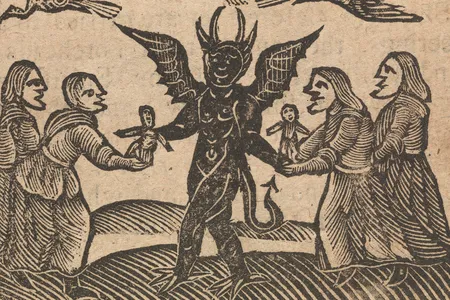
An illustration from the 1720 text The History of Witches and Wizards, featuring witches offering wax dolls to the devil as part of a ritual

Six Ways That People of the Past Used Magic to Protect Their Homes, From Witch Bottles to Mystical Symbols

Throughout history, humans around the world have employed protective talismans such as special stones, herbs and plants, and decorative demon tiles

Gold tongues found at Marina el-Alamein (right) and a limestone tombstone showing a man holding a bird (left)

Cool Finds

Ancient Egyptians Believed That These Newly Discovered Gold Tongues Allowed the Dead to Communicate in the Afterlife

Excavations at Marina el-Alamein, an archaeological site west of Alexandria, unearthed about two dozen of the rare artifacts, including one shaped like the Eye of Horus

Archaeologist Andrew Birley found the relief carving while excavating a fourth-century barrack at Vindolanda, a Roman fort near Hadrian's Wall in northern England.

Cool Finds

Ancient Romans Put Their Faith in Guardian Spirits. Archaeologists Just Found a Rare 1,600-Year-Old Carving of One in Northern England

Known as a “genius,” the protective spirit or deity was believed to bring good fortune and prosperity to a particular person, household or place. Archaeologists haven’t found many depictions of them across Roman Britain

Archaeologist Gino Caspari holds an iron artifact recovered from one of the Menorca shipwrecks.

Take an Exclusive Look at Three Newly Discovered Medieval Shipwrecks in Menorca’s ‘Cove of Mysteries’

Meteorological tsunamis likely sank the 13th-century trading vessels, whose cargo included objects from both Christian kingdoms and Moorish communities on the Iberian Peninsula

Individuals and objects associated with Irish contributions to the American Revolution (clockwise from top left): Surgeon and statesman James McHenry, Quaker spy Lydia Barrington Darragh, Commodore John Barry, a letter written by Irish-born printer John Dunlap, Continental Army officer Stephen Moylan, Pennsylvania politician James Smith, Delaware politician Thomas McKean, and Charles Thomson's proposal for the Great Seal

America's 250th Anniversary

How Tens of Thousands of Irish Immigrants Led the Patriots to Victory During the American Revolution

Soldiers of Irish heritage accounted for up to 50 percent of the Continental Army’s ranks. Driven from their homeland by British oppression, Irish-born rebels also served as spies, politicians and more

None

America at 250: The Revolutionary Spark

After the Concept of Peaceful Disobedience Was Established in America, It Traveled Around the World Before Taking Hold

“Force may subdue, but love gains”: The Quaker practice of conscientious objection evolved through Thoreau, Tolstoy and Gandhi before becoming the hallmark of the Civil Rights movement

Archaeologists are conducting excavations in the forecourt of Notre-Dame Cathedral.

Secrets From Centuries of Paris History Are Emerging From Archaeological Digs After the Notre-Dame Cathedral Fire

Ahead of planned redevelopment around the iconic Gothic landmark, researchers are digging into the city’s past, through medieval and Roman layers

Elisenda of Montcada founded the Royal Monastery of St. Mary of Pedralbes in 1327. She was buried there after her death in 1364.

Archaeologists Excavating a Monastery in Spain Identified the Remains of a 14th-Century Queen—and Multiple Skeletons Buried in the Wrong Graves

The tomb of Elisenda of Montcada has long fascinated experts. But the team was surprised to learn that burials supposedly belonging to a medieval knight and abbess held entirely different individuals

The entrance gate to the Jewish cemetery on St. Eustatius

America's 250th Anniversary

This Jewish Community in the Caribbean Smuggled Gunpowder to the Patriots During the Revolution. A British Admiral Condemned the Island as a ‘Nest of Vipers’

A new exhibition at the Weitzman National Museum of American Jewish History, in Philadelphia, spotlights the little-known wartime contributions of the Jews of St. Eustatius

Different metal detectorists discovered the two "Lamb of God" coins at separate locations in Denmark.

Cool Finds

An English King Minted These Coins to Ward Off a Viking Invasion. Instead, the Seafaring Raiders Turned the Pennies Into Jewelry

Aethelred the Unready viewed the attacks on his kingdom as divine retribution. He hoped that a show of public penance, including the creation of coins featuring religious imagery, would help earn God’s forgiveness

A duke in Florence commissioned the fountain in 1559.

A Tourist Damaged Florence’s ‘Fountain of Neptune’ While Attempting to Grope Its Marble Statue on a Dare

Fixing the fountain’s horse sculptures and frieze will cost nearly $6,000. The alleged offender is the latest tourist to harm artwork in response to peer pressure or in pursuit of social media clout

This map shows an English flag flying over Calais, an English territory lost to France in 1558.

Cool Finds

A Collection of Maps Owned by England’s First Queen Spent Centuries Overlooked in a Family Library. Now, the Rare Volume Is on Sale for $1.6 Million

Created for Mary I, the first woman to rule England in her own right, the book is “perhaps the most significant artifact of Tudor intellectual history still in private hands,” the seller says

A damaged portrait of Mary Magdalene by Artemisia Gentileschi (left) and a similar version of the same scene (right) housed at the Pitti Palace in Florence, Italy

Rolled Up in a Cellar for Decades, This Artemisia Gentileschi Painting Is Now Up for Auction. Why Is Mary Magdalene’s Face Missing From the Portrait?

Found in Berlin, the artwork was probably damaged in the chaotic aftermath of World War II. Despite the gaping hole in the canvas, it could sell for upwards of $180,000 later this month

The original Shroud of Turin is housed at the Cathedral of St. John the Baptist in Turin, Italy, but replicas like the one shown here have been created for exhibitions and public displays.

Jesus’s Burial Cloth or Medieval Forgery? DNA Evidence Further Complicates the Debate Over the Shroud of Turin

A new analysis revealed traces of various plants, animals and humans on the controversial linen cloth. But outside experts are skeptical of the findings, which could complicate efforts to identify the shroud’s original wearer

Restorers are touching up the wood panel painting in full view of the public.

Experts Are Carefully Restoring a 15th-Century Masterpiece by Giovanni Bellini—and You Can Watch Them Work

The two-year project is expected to cost around $580,000, and visitors to the Gallerie dell’Accademia in Venice will be able to observe the process in person

Page 1 of 24