
Subscribe to Smithsonian magazine and get a FREE tote.

Computer Science

The four-color theorem is simple to state: Given a contiguous map, is it possible to color each region with one of four colors such that no neighboring regions share a color?

The Four-Color Theorem Has Haunted Mathematicians for Decades. It Just Got a Rare New Proof, but Some Still Long for a Simpler Solution

The famous problem asks whether a map can be filled in with only four colors such that the same color never borders itself. It has been solved with the help of computers, but some experts suggest an elusive, short answer is out there

Simulation of gas structures as electrons were removed from helium by radiation emitted by early stars and black holes.

See a Stunning Simulation of the Early Universe, Which Will Help Astronomers Shed Light on the Cosmic Dark Ages

The model, created by researchers at the Center for Astrophysics, Harvard & Smithsonian, and other institutions, captures how the first stars and black holes gradually illuminated the universe after millions of years of darkness
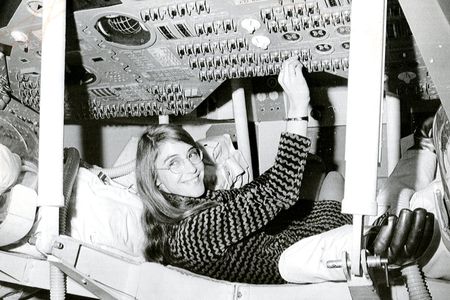
Margaret Hamilton in the Apollo Command Module

Margaret Hamilton, a Pioneering Software Engineer Who Made the First Human Moon Landing Possible, Dies at 90

Hamilton popularized the term “software engineer” and created computer programs that could anticipate problems. She received a Presidential Medal of Freedom and was inducted into the National Aviation Hall of Fame
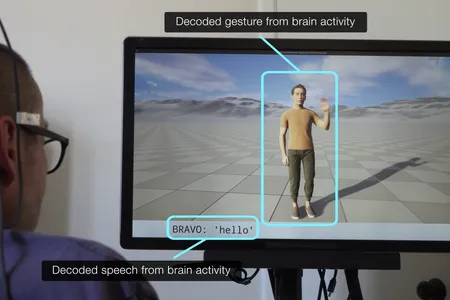
Most previous brain-computer interfaces have focused on speech or movement, rather than both simultaneously.

This Brain Implant Allows People With Paralysis to Speak and Gesture at the Same Time Via a Mind-Controlled Virtual Avatar

The experimental technology is still in the early stage and was fully tested in just two participants. But it could one day help people with motor problems communicate with more nuance or help them control robotic prosthetic limbs
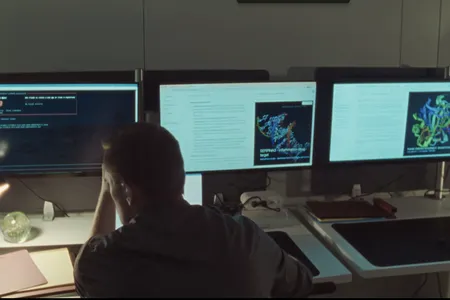
Researchers prompted around 950 A.I. agents to search through a massive DNA database.

Anthropic Says Its A.I. Discovered a New Enzyme System That Resembles the Revolutionary Gene-Editing Tool CRISPR

Experts at the company don’t know what the newfound system does, so its potential utility in biology—if any—remains unclear. But the work marks a major advancement because the A.I. made this discovery mostly on its own

The Navier-Stokes problem concerns equations of fluid motion, illustrated here as dye moving in liquid.

A.I. May Have Solved a Longstanding Math Problem With a Million-Dollar Prize. It Ignited a Controversy Over Who Gets Credit

OpenAI announced a solution to the Navier-Stokes problem. But could its A.I. models have used data from two mathematicians working on a similar breakthrough?

Overall, the 16 participants of the study were “largely positive” about their interactions with griefbots, the scientists write in the paper.

Would You Chat With an A.I. ‘Ghost’ of a Deceased Loved One? New Research Suggests That the Tech Can Provide Comfort and Closure

Commercial “griefbots” are becoming more popular, and many experts have questions about their psychological and ethical impacts. A new study aims to ensure that the bots are designed responsibly

Jerry Lawson’s gaming system featured interchangeable cartridges, so users could swap out titles like “Space War” and “Math Quiz.”

America at 250: The Revolutionary Spark

This Unsung Black Developer Unlocked the Code to Turning a Video Game Console Into a Virtual Living Room Arcade

Jerry Lawson’s Channel F system was the first to put games on interchangeable cartridges, paving the way for Atari, Nintendo, Xbox and PlayStation

A team of researchers put out information about a fake disease, and A.I.-powered chatbots fell for it.

Scientists Invented a Disease to Test Whether A.I. Knew It Was Fake. Then, Chatbots Started Saying It Was Real

The eye condition bixonimania doesn’t exist, but neither bots nor some researchers caught that the content was fabricated—despite obvious clues

None

America at 250: The Revolutionary Spark

In the Early Days of Machine Learning, Massive Computers Said George Harrison Was a Woman. A.I. Has Come a Long Way

A Cornell professor designed a room-size network of sensors that represented a single neuron. He claimed it would grow wiser as it gained experience, and it has never stopped

More than 50 million people suffer from epilepsy around the world, making it one of the most common and severe neurological disorders globally.

These Young Innovators Have Created a ‘Fitbit’ to Predict Epileptic Seizures

Truman Pierson and Christopher Fitz are developing behind-the-ear EEG patches and an accompanying app that issues an alert if the user is at high risk for a seizure in the next hour

While the cells can play the game, they’re not very good at it.

A Clump of Human Brain Cells on a Computer Chip Learned to Play the Nostalgic Video Game ‘Doom’

The technology could one day help researchers develop drugs and tailor treatments to individual patients

The Roman stone pictured with pieces that were not found with the artifact.

New Research

This Ancient Roman Game Board Was a Mystery. Researchers Used A.I. to Figure Out How to Play

The limestone oval is carved with a dark, thin rectangle on which ancient people repeatedly moved game pieces

Researchers are developing A.I.-based facial recognition tools to identify individual bears.

How Do Researchers Identify Individual Bears in the Wild? They Could Soon Do It Through A.I. Facial Recognition Technology

Such tools could help scientists track population sizes or recognize aggressive animals that have attacked humans

The human genome is made up of about three billion pairs of DNA units called nucleotides.

Google Researchers Say Their New A.I. Tool AlphaGenome Can Help Decode the Human Genetic Instruction Book

The computer model might help scientists better understand the biological impacts of typos in DNA

MIT professor Joseph Weizenbaum developed Eliza in the mid-1960s. His views on artificial intelligence were often at odds with many of his fellow pioneers in the field.

Why the Computer Scientist Behind the World’s First Chatbot Dedicated His Life to Publicizing the Threat Posed by A.I.

Joseph Weizenbaum realized that programs like his Eliza chatbot could “induce powerful delusional thinking in quite normal people”

ChatGPT Health is a new function designed to provide users with personalized medical insights based on medical records and health data uploaded by users. 

OpenAI Says ChatGPT Health Can Understand Users’ Medical Data and Provide Personalized Answers to Their Questions

The new feature can give tailored responses based on medical records and wellness app data, according to ChatGPT’s maker. But some experts are concerned about privacy and worry that people may over-trust the chatbot

Robots still struggle with the unpredictable ways that fabric crumples and creases. But newer approaches offer the hope of better robotic household help.

When Will Robots Take Over Laundry Folding?

For this chore, the human touch still beats machines. But maybe not for long

From a book to robots, the products all focus on microelectronics.

Engineers Say These Ten Holiday Gifts Will ‘Make Kids Think’

A team of Purdue students and faculty recommends these microelectronic-focused toys for developing STEM skills

Some computer vision programs have been thrown off by tricks such as manipulating the pixels in an image.

Computers Are Getting Much Better at Image Recognition

The machine-learning programs that underpin their ability to “see” still have blind spots—but not for much longer

Page 1 of 13