
See a Stunning Simulation of the Early Universe, Which Will Help Astronomers Shed Light on the Cosmic Dark Ages
The model, created by researchers at the Center for Astrophysics, Harvard & Smithsonian, and other institutions, captures how the first stars and black holes gradually illuminated the universe after millions of years of darkness
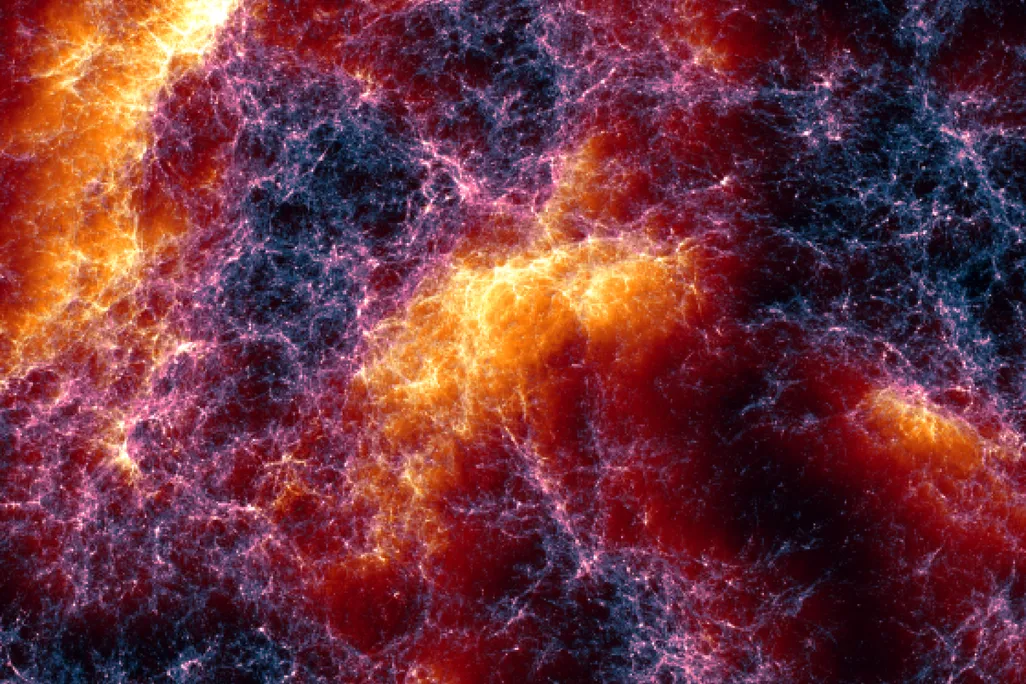
At first, there was nothing; then, there was light. The universe was born in a rapid explosion of energy known as the Big Bang some 13.8 billion years ago. For the first 380,000 years, the universe was hot, dense soup: a relatively simple mix of negatively charged electrons and nuclei of the elements hydrogen and helium.
But then, darkness descended. The universe cooled, allowing the electrons to join the hydrogen and helium, which coalesced into a neutral cloud of gas. Without an abundance of free electrons to scatter leftover energy from the Big Bang—and no stars or galaxies to give off light—the universe plunged into a period called the cosmic dark ages.
While scientists have a good understanding of the Big Bang and its immediate aftermath, this second phase is less clear. “The dark ages is this transition from simple physics into this overwhelmingly complex physics,” explains Volker Bromm, an astronomer at the University of Texas at Austin.
Now, a new computer simulation built by researchers at the Center for Astrophysics, Harvard & Smithsonian, and other institutions is shedding light on this cloudy chapter of the early cosmos, and how the universe broke free of it. The team published their work in the November issue of the Monthly Notices of the Royal Astronomical Society.
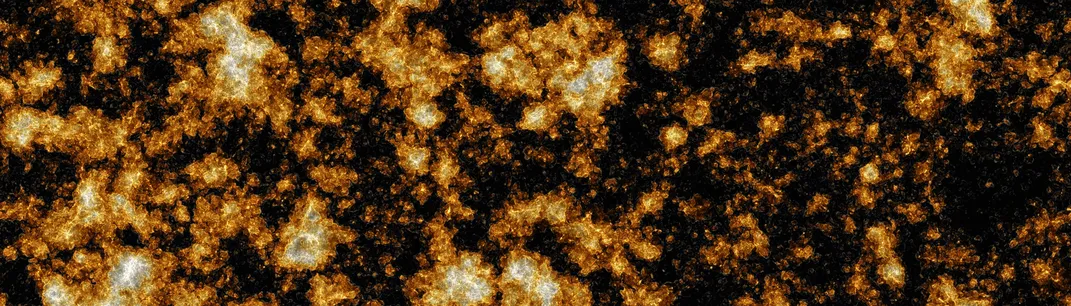
The simulation, dubbed Lumina, is one of the largest and most detailed models of the cosmic dark ages yet, spanning from 50 million to 200 million years after the Big Bang. It covers more than 100 times the volume of comparable simulations, according to a statement. Astrophysicists can use the model alongside new observations from the James Webb Space Telescope (JWST) and the new Nancy Grace Roman Space Telescope to test theories on the early formation of the universe.
“To understand what we are seeing with [these telescopes], we need to translate our theories into detailed predictions,” lead author Oliver Zier, a computational astrophysicist at the Center for Astrophysics, Harvard & Smithsonian, says in the statement. “After several years of work, with plenty of ups and downs, it is incredibly rewarding to see the simulation results and watch our predictions come to life in video.”
The simulation maps the development of the defining features of the modern universe, like dark matter, gas, stars and radiation, through a period called the epoch of reionization, Zier tells Smithsonian magazine. This transition phase, which ended the cosmic dark ages, was driven by electrons being pulled away from hydrogen and helium, creating charged particles, or ions.

This happened in two waves: First, as structures formed and energy coalesced into the first stars a few hundred million years after the Big Bang, their light removed hydrogen’s electron, turning the neutral atoms into free electrons and positively charged protons, Zier says. Ionization of helium, which has two electrons, proved harder. Starlight was powerful enough to dislodge the element’s first electron, but it took more radiation from developing supermassive black holes to remove the second. The simulation also showed this process did not occur evenly across the cosmos.
“In these early stages, ionization is not uniform,” Zier says. “We see these bubbles of ionization around big structures, but there are still vast stretches of the universe still in a neutral state.”
Lumina captures these processes in video representations—webs of emanating radiation that eventually expand to encompass the entire universe in a new era of light. To produce this, the team used the Frontier supercomputer at Oak Ridge National Laboratory. At its peak, the project used about 600 terabytes of memory, roughly the storage space needed for 150,000 high-definition movies.


“This is an incredible feat of engineering,” says Julian Muñoz, a theoretical cosmologist at UT Austin who was not involved in the project. “Making such a big simulation work efficiently in modern-day supercomputers and run for as long as it had to run to get helium reionization—it’s truly impressive.”
Also novel is the project’s scale: Lumina spans 1.5 billion light-years on each side and encompasses 200 million galaxies while still enabling astronomers to zoom into the level of individual galaxies and see their development in detail. Lumina is part of a line of supercomputer-made models of the early cosmos, including the 2005 Millenium Simulation and the 2017 IllustrisTNG. The latter provided the foundation for Lumina, and many of the same scientists were involved in both projects.
Fun fact: Graphic overload
To run Lumina, the team used more than 100,000 computer processing unit cores and about 15,000 graphic processing units—enough to power thousands of high-performance computers. Altogether, the program took roughly six months to run through all its lines of code.
To give scientists an accurate model to test their theories, Bromm, who was not involved in the research, explains these simulations need to encompass a wide enough portion of space in their “box” to accurately reflect the cosmos’ diversity. This size also ensures scientists aren’t missing major astrophysical action spots, like large galaxy clusters and supermassive black holes. At the same time, scientists need simulations with enough detail to examine these phenomena on an individual basis. Lumina is novel, he says, in providing both.
“All of this is really pushing the envelope. [Lumina] extends this illustrious line of computer simulations to the next stage,” Bromm says. “In terms of the size, I would say, they might have almost reached the end of the size of the box.”
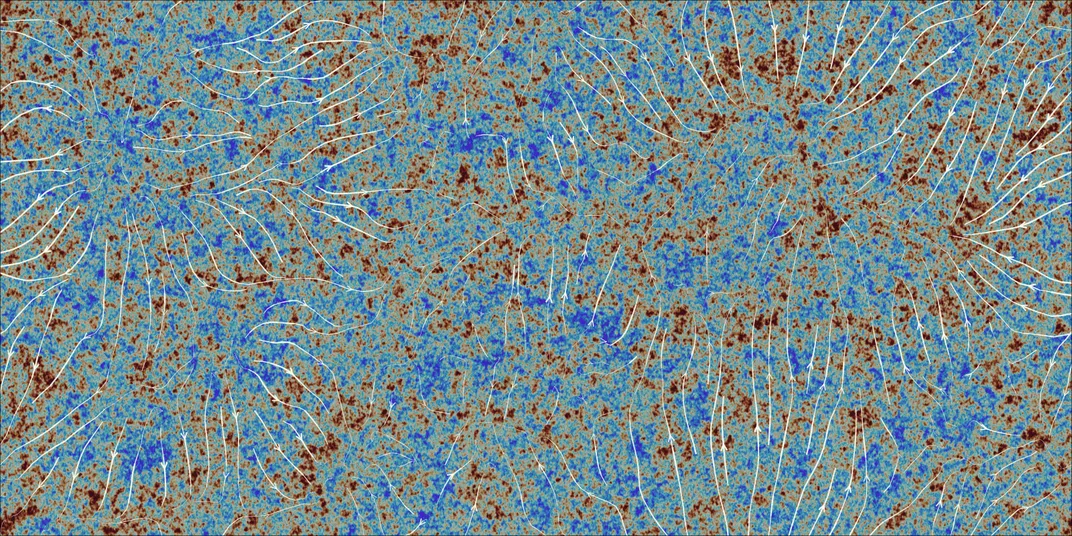
This innovation comes alongside the recent development of both the JWST and the Roman space telescope, which can see light that has traveled toward Earth for billions of years, allowing astronomers to peer at the young universe. Using these tools, astronomers have observed the presence of bright galaxies and supermassive black holes—things that should not be there according to leading theories of early cosmic development, Zier says. Lumina will allow researchers to test these theories against the new observations and, he hopes, help solve these tensions.
JWST “can study individual objects in great detail, while Roman will survey much larger areas of the sky and find larger samples of rare, bright galaxies,” Zier explains. “Comparing both their abundance and clustering with simulations like Lumina will help us distinguish between different explanations for the unexpectedly large number of bright galaxies in the early universe.”
Beyond offering scientists a new tool to study the universe, Lumina also offers a chance to watch in vivid detail the early formation of the universe—and the processes that began the long march to humanity.
“People want to know where we come from,” Zier says. “Lumina gives us a look into that past.”