
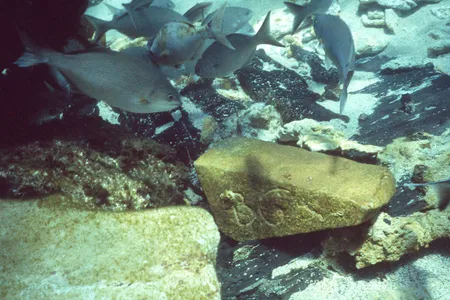
When the Dutch East India Company’s flagship “Batavia” sank in 1629, it went down with large, carved sandstone blocks in its hold. The stones are now shedding light on trade at the dawn of global capitalism

Featuring more than 1,800 sites from 181 countries and territories, UNESCO’s tentative list is a treasure trove of lesser-known marvels

Archaeologists collaborated with members of the GunaiKurnai Aboriginal community to explore layers of ash from burned grasses dating back thousands of years inside Cloggs Cave

For Three Hours Every Day, Open Ocean Transforms Into Australia’s ‘Ghost’ Reef
An isolated wonder some 1,200 miles from the nearest city, Montgomery Reef disappears as quickly as it appears, mirroring the supposed vanishing of its original owners, a tribe of Indigenous giants

Scientists are preserving the animals’ reproductive cells in liquid nitrogen in a bid to boost genetic diversity in future populations

Scientists long believed that these whales, which swim throughout the Southern Hemisphere, mainly feasted on krill and small crustaceans called copepods, which are disappearing from the warming ocean. A new study suggests that the cetaceans have a more varied, flexible diet

A new museum dedicated to stories surrounding the S.S. “Great Britain” is about to open in Bristol, where the ship is permanently dry-docked

Karenia cristata, a rare type of microscopic algae that produces toxins that harm nerve cells, can be lethal at very low concentrations

Two new studies find that British colonists arriving via ship in the late 18th century likely introduced smallpox, which devastated Aboriginal communities far more than previously known

The shiny objects—each roughly twice the size of a basketball—began to appear on July 3. Authorities initially worried that they were hazardous but have since determined that they’re likely safe bits of space junk

Last year, geologists dated the crater in Western Australia at 3.47 billion years old, which was disputed by other experts. Now, they’ve revised the estimate to 3.02 billion years old—but some still aren’t convinced

The Nithe Station, usually submerged under a reservoir, will be accessible this summer as officials drain the site to perform dam maintenance

Even rural birds prefer human-made objects, such as colored glass and wire, when given the choice between them and natural decorations, like leaves and shells, according to a new study

The insects are estimated to be worth up to $141,000, according to Australia’s Department of Climate Change, Energy, Environment and Water. Exotic cockroaches could harm the country’s wildlife and agriculture

Mucus, feces, skin and other shed tissue allowed researchers to investigate which creatures have been swimming in two deep-sea canyons without having to observe or catch them

New research shows that the ancestors of the Barkindji people in Australia ritually added river mussel shells to a burial site for centuries after the dingo died, suggesting they cared for it deeply

The new study found that they lost their arboreal habitat due to a drying climate, a dire warning for the modern-day marsupials that face a similar threat

It Took Millions of Years for Australia’s Famous Twelve Apostles Landmark to Rise Out of the Sea
The iconic tourist destination provides a beautiful view, but also represents a physical record of Earth’s climate history

Wild Cockatoos Learn Which Snacks Are Safe to Eat by Copying Their Friends, New Research Suggests
Munching on the wrong items can lead to illness, but social learning might help the birds avoid making a potentially deadly mistake. The phenomenon could help explain why certain cockatoos have fared so well in urban environments

The country implemented a national vaccination program to prevent the disease in 2007. New data show that in 2021, no women under age 25 were diagnosed with cervical cancer, marking a major milestone
Page 2 of 20