
From a Small Island in Denmark, This Man Lived Through the Transition From Hunter-Gathering to Farming 6,000 Years Ago
A new analysis of the Rødhals Man suggests he witnessed the Neolithic Revolution in his lifetime, growing up eating mostly foraged seafood before shifting to more land-based, likely farmed, foods as an adult

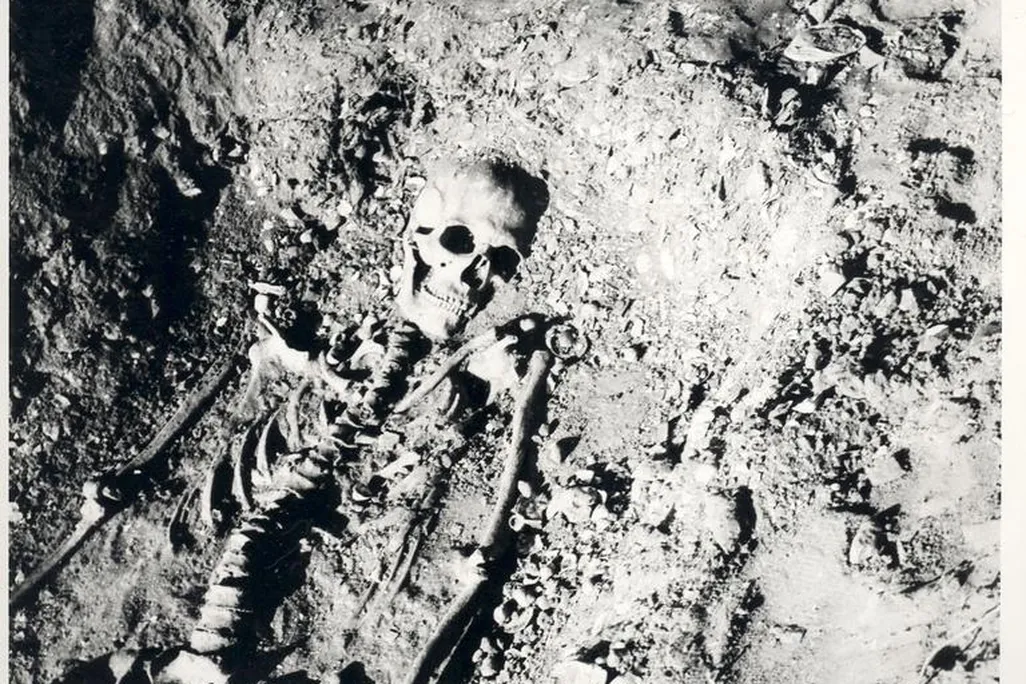
Archaeologists have identified a man who likely lived through the shift from hunter-gathering to farming, a dramatic transition that reshaped human history and ultimately paved the way for modern society as we know it.
Researchers have uncovered new details about the diet, lifestyle and health of the “Rødhals Man,” an indigenous hunter-gatherer who lived some 6,000 years ago in what is now Denmark. The findings, published November 16 in the journal Antiquity, suggest the Rødhals Man witnessed the Neolithic agricultural revolution and seemingly found a way to co-exist with farmers.
Rødhals Man is the name given to a near-complete skeleton discovered in 1956 in a shell midden—essentially, an ancient trash dump—on the small Danish island of Sejerø.
For years, researchers were perplexed by the remains. Radiocarbon dating suggested the man was alive between 3900 B.C.E. and 3800 B.C.E., after Neolithic farmers had already begun arriving on the nearby island of Zealand, and lived during a time when people were starting to eat mostly land-based foods grown and raised by farmers. But his DNA revealed that his ancestry was entirely indigenous—he belonged to the Western Hunter-Gatherer genetic group—and his diet consisted primarily of seafood.
“There was something wrong and it is always when things don’t fit that you may be on the track of something important,” lead author Anders Fischer, an archaeologist at the University of Gothenburg, tells New Scientist’s Chris Simms.
So, researchers decided to take another look at the remains. Their analysis revealed that the Rødhals Man was between 30 and 40 years old when he died—probably closer to the upper end of this range, based on degenerative changes to his body. In life, he stood roughly five feet tall and was right-handed. He had black hair and dark skin, and there’s a very high likelihood his eyes were blue.
The Rødhals Man shows no signs of having experienced violence, and he appears to have been healthy during the early part of his life. Later, as he aged, he developed inflammation or a vitamin deficiency.
An investigation of his teeth and bones revealed that his diet changed over the course of his life. As a child, he mostly ate creatures like mollusks, flatfish or eels, which he likely foraged from the shallow waters surrounding the island. Starting around age 11, however, he began to eat more land-based protein, in addition to seafood.
Making a major dietary change like this is unusual, according to Marcello Mannino, an archaeologist at Aarhus University who was not involved with the study. He tells New Scientist that “such cultures were often very conservative in terms of their dietary habits, because diet was interlinked with the subsistence practices that shaped that culture together with religious and cosmological views of the world.”
Sejerø is tiny, measuring just 4.6 square miles, so it probably didn’t support many wild, land-dwelling animals. But nearby Zealand was much larger, around 2,702 square miles, and farming had already been underway there for several decades.
Together, the findings suggest the Rødhals Man began interacting with farmers as a preteen and may even have adopted some elements of their way of life. For example, he might have spent part of the year on Zealand, living in a farming community and eating farm-raised animals, and part of the year living on Sejerø and foraging for seafood.
Further supporting the theory that the Rødhals Man interacted with farmers, the researchers note that his burial more closely resembles those of early farmers, rather than those of hunter-gatherers.
The Neolithic Revolution started roughly 12,000 years ago, when humans began settling down and domesticating plants and animals. This shift ultimately gave rise to the complex societies and civilizations that define the modern world.
Did you know? Agricultural revolutions
Other “agricultural revolutions” include technological improvements in 18th-century Britain and the Green Revolution of the mid-20th century, which saw the emergence of new varieties of crops like wheat and rice across the world.
However, the so-called revolution was not a single event that happened everywhere at once—it was a gradual, uneven and highly complex process that unfolded over several millennia. “Farming and foraging communities coexisted in the same region, while some groups took a combined approach, juggling early forms of farming with hunting, fishing, and foraging,” Tom Hale writes for IFLScience.
Rødhals Man, the findings suggest, embodies this messy middle. He was “an eye-witness to one of the most fundamental transformations in prehistory, the transition from foraging to farming,” Meadows says in a statement. “He did not fully embrace the farmers’ lifestyle or run away from them, but adopted some components of farmer culture while maintaining the way of life of his indigenous ancestors.”
