
Even Replacing Some of Your Dietary Dairy With Plant-Based Alternatives Can Lead to Nutrient Deficiencies, Study Suggests
More people are swapping animal products with vegan milks, yogurts and cheeses, so scientists wanted to investigate the potential public health effects. Their findings hint that consumers should look for items with extra nutrients added, called fortified foods

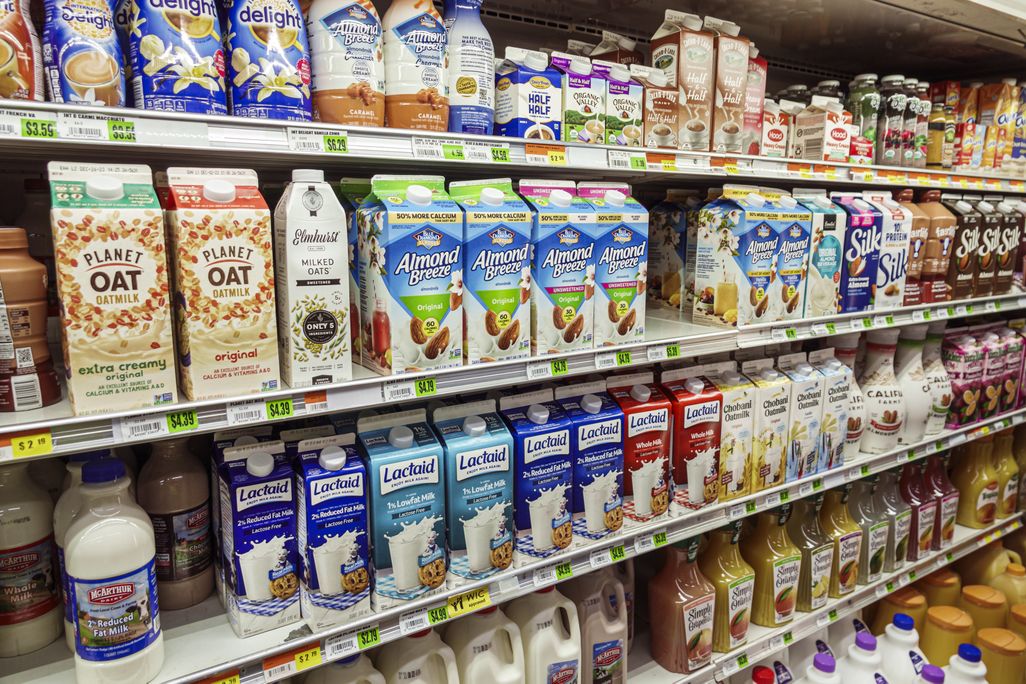
Alternative dairy products are widely available in many countries. Grocery stores and cafes frequently offer “milks” made from soy, almond, oat, rice or other crops. That’s good news for people who don’t consume dairy, as well as for our planet, since the production of plant-based milk is more environmentally friendly than regular milk.
But relying on these plant-based alternatives—even partially—might carry health risks. In a study published in the September issue of the journal Lancet Planetary Health, researchers ran computer simulations based on United Kingdom nutrition data and found that swapping standard dairy for vegan versions can lead to deficiencies of four vital nutrients. However, that could be combated by mandating that nutrients be added to plant-based dairy alternatives, as well as bread, making them fortified foods.
Vegan milks, cheeses, yogurts, ice creams and more are becoming increasingly popular as people turn to them for health or sustainability reasons. However, they often lack certain nutrients found in dairy.
To explore the potential public health implications, researchers pulled data from the U.K.’s National Diet and Nutrition Survey involving more than 3,500 people between the ages of 1.5 and 100 years old. They put that information into a computer model to simulate how swapping out regular milk, yogurt and cheese with commercially available plant-based versions affected intake of four micronutrients: iodine, calcium, riboflavin and vitamin B12.
The results weren’t great. Even replacing a modest amount of dairy caused a decline in intake of all analyzed micronutrients. Iodine took the biggest hit. Your thyroid gland needs iodine to make certain hormones, and it’s also crucial for brain development. The micronutrient is especially important for infants, adolescents and pregnant people.
The survey data revealed that 54 percent of girls ages 14 to 18 weren’t eating enough iodine. Replacing just 35 percent of dairy with plant-based alternatives would cause the deficiency to jump to 65 percent. Similarly, 32 percent of women ages 19 to 49 were iodine deficient at baseline, and it would rise to 42 percent after the same dairy swap.
If dairy intake was completely replaced, 80 percent of teenage girls and 72 percent of teenage boys would be iodine deficient, according to the computer simulations.
Did you know? Other drivers of iodine deficiency
In recent years, many people have been replacing their typical table salt with trendier versions, like Himalayan, sea and kosher. However, that’s contributing to a rise in iodine deficiency, since table salt is often fortified with the micronutrient.
“A strength of the study is that it looks at partial replacement rather than only a complete switch, which better reflects how most people actually change their diets. It also breaks the results down by age and sex, which shows clearly who is most at risk,” says Ian Givens, director of the University of Reading’s Institute for Food, Nutrition and Health in England and a registered nutritionist, in an expert reaction compiled by the Science Media Centre.
However, “there are limitations,” adds Givens, who wasn’t involved in the study. “The findings are based on modeled reduction of dairy intake, so they show a risk of inadequacy rather than confirming deficiency but are still valuable data.”
Next, the researchers investigated whether fortification of vegan dairy products, as well as the staple food bread, might help avoid these predicted micronutrient deficiencies. The strategy worked. Computer simulations suggested that adding iodine to both types of food caused iodine deficiency to drop to 37 percent among teenage girls at 20 percent dairy replacement. And at a complete dairy swap, deficiency was projected to be at 43 percent among adolescent girls.
Ultimately, the team’s findings indicate that more foods should have fortification requirements.
“Nutrition policy must evolve in tandem with environmental targets,” study co-author Katie Nicol, a human nutrition researcher at the University of Surrey in England, says in a statement. “However, it is important that shifts towards more sustainable diets do not compromise on public health. Fortification of foods is one way that this could be achieved; however, government policy is needed to make this happen.”
The good news is that some companies are already doing this.
“For anyone choosing plant-based milk, I’d recommend checking the label and choosing one fortified with iodine, such as Alpro,” Nichola Ludlam-Raine, a registered dietitian and spokesperson for the British Dietetic Association, who did not participate in the study, tells the Guardian’s Ian Sample. She notes that organic drinks don’t contain added nutrients.
And all of Oatly’s unflavored, non-organic oat drinks contain added nutrients, including iodine, calcium, riboflavin and vitamin B12, says Caroline Orfila Jenkins, the company’s vice president for science and technology, to the outlet. “This research underlines the importance of appropriate fortification as diets become more plant-based.”
