
Anthropic Says Its A.I. Discovered a New Enzyme System That Resembles the Revolutionary Gene-Editing Tool CRISPR
Experts at the company don’t know what the newfound system does, so its potential utility in biology—if any—remains unclear. But the work marks a major advancement because the A.I. made this discovery mostly on its own
/https://tf-cmsv2-smithsonianmag-media.s3.amazonaws.com/accounts/headshot/Margherita_Bassi.png)
/https://tf-cmsv2-smithsonianmag-media.s3.amazonaws.com/filer_public/a0/c7/a0c7f0f1-1d56-4cbe-9ac6-2aa724305fdd/screenshot_2026-09-28_at_125214.png)
The artificial intelligence company Anthropic claims that its A.I. Claude has taken a major step in the field of biology. It has autonomously discovered a novel enzyme system that resembles the Nobel Prize-winning gene-editing technology CRISPR, according to a September 23 statement. Researchers described the findings in a preprint study, which has not been peer-reviewed.
“This is an exciting example of how A.I. agents can contribute to biological discovery,” says Feng Zhang, a molecular biologist at the Broad Institute of MIT and Harvard who wasn’t involved in the study, in the statement. “I hope this work encourages more scientists to explore how A.I. can support their research.”
Still, Anthropic scientists have no idea what the newfound enzyme system does. They can’t say whether it will be as useful as CRISPR, which has revolutionized research, such as by helping scientists create personalized medicines to treat genetic diseases. Nevertheless, the work represents a major advancement in A.I. autonomy, writes Dimitri Perrin, a computer scientist at Queensland University of Technology in Australia, in the Conversation.
Researchers instructed around 950 A.I. agents to search through a massive DNA database. They were on the hunt for “interesting new examples” of reverse transcriptases, enzymes that read a string of RNA and make a complementary DNA strand, per the statement. The A.I. could write its own code to do so and initially found about 200,000 of these enzymes.
After about 21 hours, one agent pinpointed something special: an unusual reverse transcriptase with a partner gene next to it and a long array of repeating DNA sequences. Collectively, that’s called an array-associated reverse transcriptase, or ART. CRISPR has these components, too.
Claude was not the first to spot this particular reverse transcriptase, per the Conversation. Rather, it discovered that the enzyme was embedded in the ART. Humans then stepped in with lab work and determined that the A.I. agent had identified a previously uncharacterized enzyme system in bacteriophages, or bacteria-killing viruses.
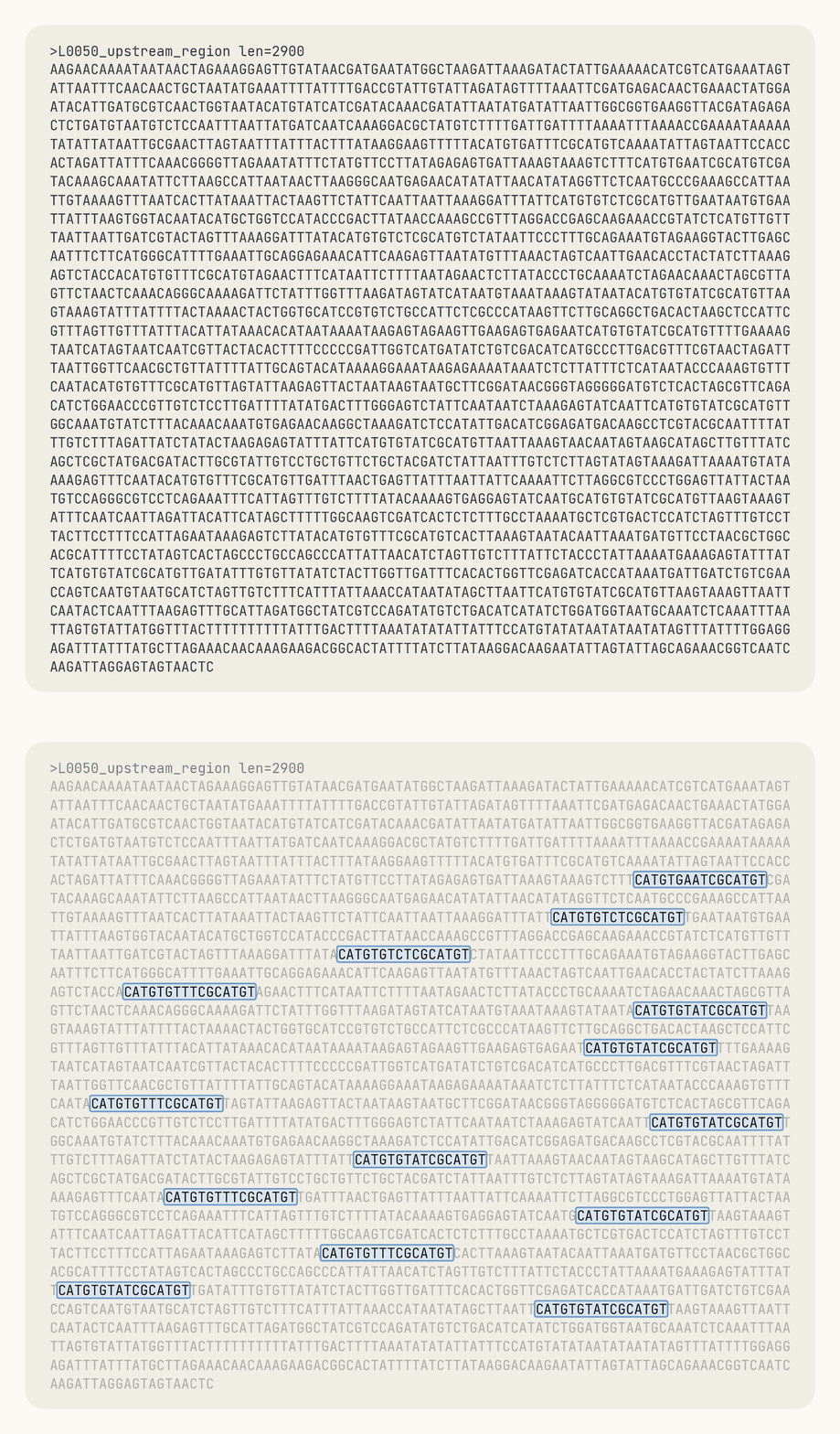
The newfound ART’s encoded similarities to CRISPR provide a reason to be excited, per Anthropic. CRISPR was discovered because of its repeating DNA sequences in 1987 in the bacterium Escherichia coli. It helps the microbe fend off viruses.
The breakthrough for researchers, however, came decades later. In 2012, biochemist Jennifer Doudna at the University of California, Berkeley, and colleagues figured out how to make the CRISPR protein system target specific genetic instructions, according to New Scientist’s Michael Le Page. Claude’s discovery, therefore, is more akin to the initial CRISPR finding around 40 years ago than the game-changing CRISPR technology we know today.
Moreover, the novel system’s “precise function, biotechnological utility (if any), or level of significance, is not yet clear,” writes Anthropic CEO Dario Amodei in a social media post. “But at minimum it is work I would have been proud to do as a PhD student.”
Some researchers are quite impressed. “What stands out is its ability to recognize an unusual biological pattern that was difficult to detect before, and to pursue it comprehensively as a research question,” Stanley Qi, a CRISPR researcher at Stanford University, tells Al Jazeera’s John Power. “Nature contains an enormous diversity of molecular systems we barely understand, and some patterns are very complicated but highly meaningful; A.I. could greatly expand our ability to explore them more effectively and rapidly.”
Qi isn’t the only scientist to recognize the usefulness of A.I. in research. Mario Rodríguez Mestre, a computational biologist at the University of Copenhagen, and his colleagues have been using Anthropic’s A.I.s to write code and draft manuscripts, among other tasks, for three years—and they’ve been researching ARTs for four years, reports the New York Times’ Carl Zimmer. While they haven’t published their research yet, Mestre says his team’s use of Anthropic’s services raises questions about whether Claude benefited from the content they shared.
Anthropic responded in a statement to the Times, saying, “We are not aware of any previously published work describing the ART system we recently found. Claude was also not trained on any user transcripts, and our molecular biology team has no such access, either.”
The clash comes after a similar controversy in mathematics. Earlier this month, OpenAI announced that its A.I. ChatGPT had solved a longstanding theoretical math problem about fluid movement. But two mathematicians—one of whom is an Anthropic employee—had also been working on the problem with the help of large language models such as OpenAI’s Codex.
Did you know? Another math problem
Claude helped the Anthropic researcher embroiled in the fluid-movement math problem debate approach a different one earlier this year. In July, mathematician Levent Alpöge used the A.I. to disprove the decades-old Jacobian conjecture.
Still, Amodei notes that there are differences between the two research fields. “Math can be done purely theoretically, while biology requires experimentation,” he writes on social media. “Some have used this to draw the conclusion that A.I.’s utility in biology will be limited. We think this is wrong.”
/https://tf-cmsv2-smithsonianmag-media.s3.amazonaws.com/accounts/headshot/Margherita_Bassi.png)