
Ben Franklin Wasn’t Serious When He Implied the Wild Turkey Would Be a ‘Respectable’ National Symbol … but He Wasn’t Wrong, Either
The birds strutted around North America for hundreds of thousands of years before hunters decimated their population. Credit its recovery to resourcefulness, a stubborn disposition and a little help
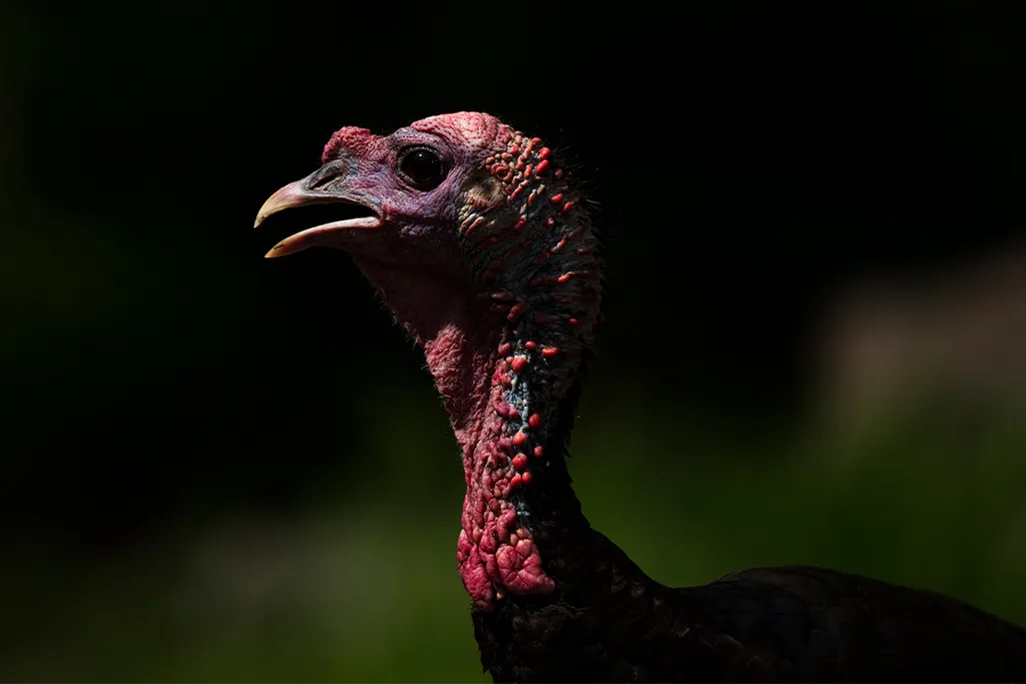
The wild turkey is a noble beast: the muscular, bronze-sheened ancestor of the barnyard turkeys we eat today. While the two technically belong to the same species, the barnyard variety is relatively new on the scene. People began domesticating wild turkeys in what is now Mexico more than 2,000 years ago, selectively breeding them over generations to become fat and docile. Wild turkeys, meanwhile, have inhabited North America for a much longer time—hundreds of thousands of years. Hunters still eat them, of course, and appreciate the lean gaminess of the wild flesh. But for most of us, the bird is less about sustenance than about a glimpse of the true national temperament: resourceful and restless, by turns noble and idiotic—as liable to swagger into view as to bolt for the trees.
This feathery American character has long invited comparison with another native bird. When the Continental Congress first chose the bald eagle for our fledgling nation’s heraldry, Benjamin Franklin wrote to his daughter in 1784 condemning it as “a bird of bad moral character,” given to stealing food from smaller birds rather than hunting for itself. The choice was in such poor taste, Franklin argued, that even the patently ridiculous turkey would be “a much more respectable bird,” as it was “peculiar” to the Americas. Though Franklin was teasing the young republic’s taste in civic symbols, the turkey was, in many ways, a perfect pick. It’s one of the few large birds that is unequivocally, evolutionarily American—at home on this continent long before there was a republic to invest it with meaning.
With their range stretching across North America, from the desert Southwest to the forested Northeast, wild turkeys have long been prized by Native peoples for their meat and feathers, which were often used in arrow fletchings and ceremonial regalia. In the Southwest, ancestral Pueblo peoples are thought to have raised turkeys for centuries before using them as a food source.
Thanks to Spanish exports from the Americas, eating turkey had already become fashionable in Europe by the time the English got to Jamestown and Plymouth. There, the plentiful wild birds became staples, seen as symbols of the New World’s abundance. But unregulated hunting and deforestation devastated turkey populations in the United States, which fell from an estimated 10 million to roughly 200,000 by the mid-1930s. Newspapers across the country ran frantic headlines: “Wild Turkeys Nearly Extinct,” the Washington Post declared on December 28, 1905.
Fun facts: An anatomical tour of a turkey
-
The fleshy part that extends over (or dangles from) a turkey’s beak is called the snood. It serves a decorative purpose while also helping turkeys disperse heat
-
The appendage that hangs outward from the neck is called the wattle or dewlap. While it has no clear biological function, the largest and proudest wattles tend to belong to the dominant male in a given flock.
-
The nodules on the head of a turkey are called caruncles. Caruncles on a male swell and change color as the creature becomes aroused during mating season—a sign to females that he’s ready to go.
-
The plumes that project from a turkey’s chest are known as the beard. These feathers, technically known as mesofiloplumes, help males attract mates. Female turkeys have them too, sometimes!
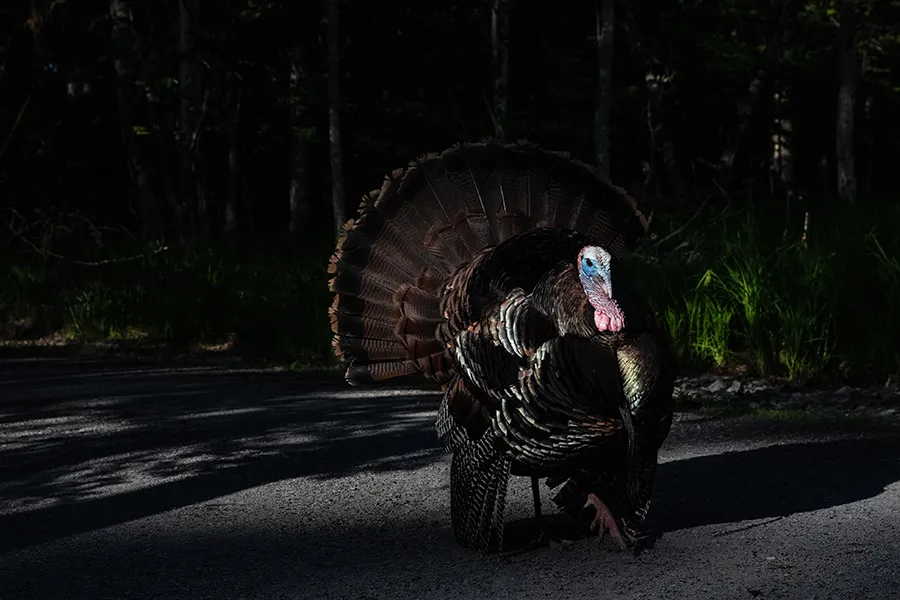
But beginning in the 1950s and ramping up during the early 1970s, a coalition set out to bring the species back. The main technique was deceptively low-tech. Biologists stretched rocket nets—mesh rigs fired by small charges—across clearings and, at just the right moment, whoomp! They safely captured whole flocks, then banded, boxed and ferried them to areas where turkeys had vanished. Biologists had long thought the species could thrive only in large tracts of unbroken forest—but as forests regrew on abandoned farms, the birds found new habitats in the thin seams of woods and fields along the edges.
As important as rocket nets were, the key to sustained recovery was an unlikely alliance that formed around the turkey. Wildlife officials, conservation groups and private landowners pitched in—providing areas for trapping and releases, and moving birds from recovering populations into places where they’d disappeared. The financial engine supporting these efforts had been started decades earlier, in 1937, when Congress passed the Pittman-Robertson Act, which used an excise tax on firearms, ammunition and eventually archery equipment to fund wildlife restoration. Hunters thus helped bankroll the very work that would bring the species back. That user-pay, public-benefit model became the backbone of modern conservation—and decades later, amid the burgeoning environmental movement of the early 1970s, the National Wild Turkey Federation was founded, mobilizing hunters and conservationists around research and habitat protection and promotion of the bird’s recovery.
Subscribe to Smithsonian magazine now for just $19.99
This article is a selection from the November 2026 issue of Smithsonian magazine
From their nadir, wild turkeys rebounded to six million or seven million by the late 20th century. Today they strut in 49 states (all but Alaska) and in the District of Columbia, returning not only to deep woods but also to parking lots, woodlots, vacant lots, garden plots and many spaces in between. And while their numbers have dipped to roughly five million or six million today, if you live in a suburb where your dog now negotiates right-of-way with a sequined tom, you’re witnessing a restoration so thorough it sometimes feels like a prank. In Albany, California, a flock has claimed a Shell station near the freeway; in Midcoast Maine, drivers routinely brake for marching bands of hens and gawky, half-grown poults.
The turkey is a civic fable with feathers—a reminder that small taxes can be powerful tools, that restoration works best when many hands take part and that even the most unlikely wildlife can rebound when we give it room. Every time a flock delays school pickup, we’re seeing more than the sum of its feathers. We’re seeing an American icon do what icons do best: reflect us back to ourselves—stubborn, ingenious and improbably alive.
Preparations not found in Rockwell paintings
By Sonja Anderson
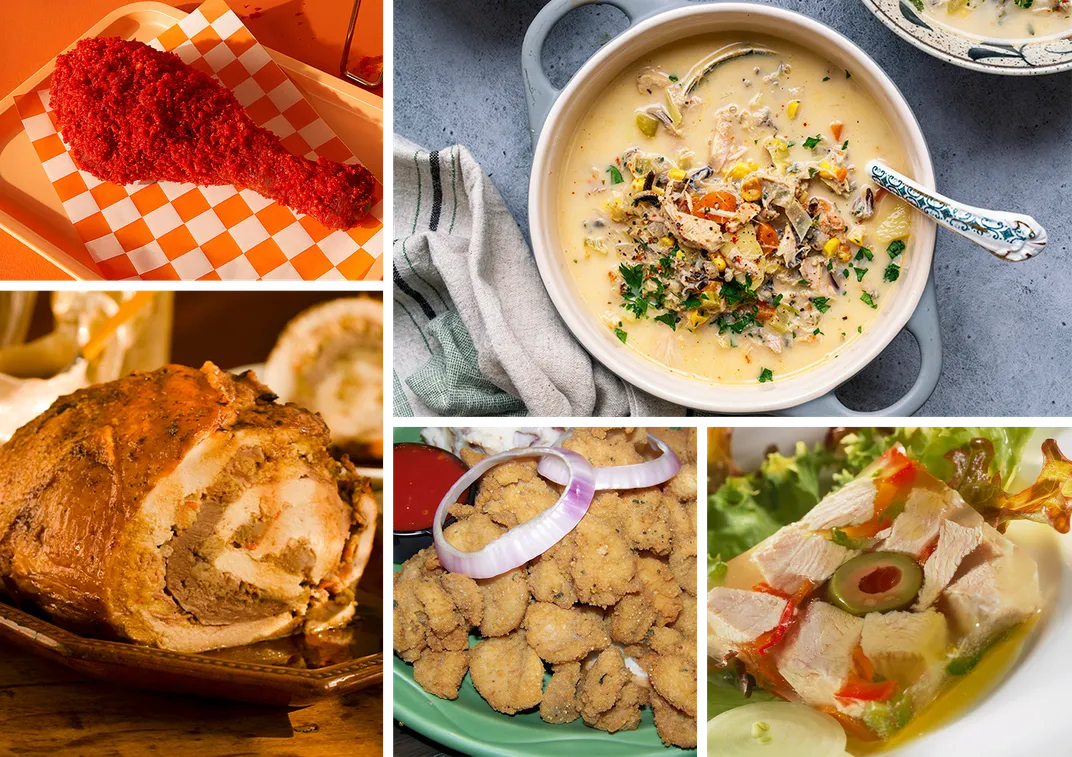
Red-hot bird: In 1885, American cooking educator Juliet Corson published a recipe for “Deviled Turkey,” using cayenne, dry mustard and lemon to make a spicy bird. Today, modern cooks coat turkeys in crushed Flamin’ Hot Cheetos.
Good gravy! To make giblet gravy, a staple of Southern food, just boil the neck and organs for a broth and combine with roux and cream. Some chefs add chopped hard-boiled eggs. The resulting sauce is known for its deep umami flavor.
Making things gel: In the mid-20th century, Americans enjoyed turkey aspic: a meaty mold of gelled turkey collagen and cooked vegetables. The concept can be traced to a tenth-century Arabic cookbook.
Indelicate delicacy: Turkey fries have nothing to do with crispy spuds: They’re turkey testicles, which you coat in batter and dunk in hot oil. The delicacy has long been celebrated in Illinois: Multiple festivals still serve it up yearly.
Go and stuff it! The three-bird “turducken” was trademarked in Louisiana in the 1980s and drew on an old tradition called engastration: A medieval Spanish recipe describes cow stuffed with lamb, goose, chicken, pigeon and starling.