
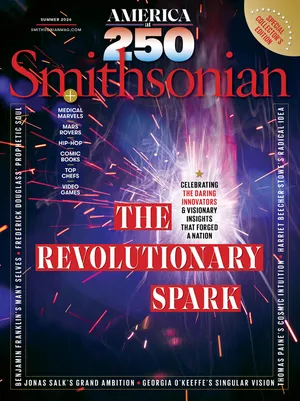
America at 250: The Revolutionary Spark
A Smithsonian magazine special report
Some Presidents Offer More Than Just Policy. Here Are Five Who Brought Their Innovative Spirit to the Office
One president invented campaign buttons so he could just stay home during election season. Another one rallied Americans to go to the moon. And one—only one—holds a patent.
/https://tf-cmsv2-smithsonianmag-media.s3.amazonaws.com/accounts/headshot/Sonja_headshot.png)
/https://tf-cmsv2-smithsonianmag-media.s3.amazonaws.com/filer_public/c2/ea/c2eaeb51-0d65-484e-b00d-3921d66b7a86/opener.jpg)
In 1896, William McKinley ran his presidential bid largely from home, circulating mass-produced political swag instead of hitting the trail. The effort included a pivotal piece of merch: the first modern campaign button. Coated in celluloid, the buttons’ metal backs were equipped with sharp pins to attach to lapels.
In 1803, Thomas Jefferson negotiated the $15 million Louisiana Purchase. With it, the United States gained some 828,000 square miles of land west of the Mississippi River, which settlers would soon trek across to develop America’s frontier. Jefferson, a lifelong innovator, also devised a wheel cipher for encoding messages sent between France and the U.S.
Long before Abraham Lincoln issued the Emancipation Proclamation, he transported cargo on a Midwest flatboat and conceived a nifty way of freeing boats when they ran aground. In 1849, after leaving Congress, Lincoln filed Patent No. 6,469, describing built-in air chambers for “buoying vessels over shoals.” To this day, he’s the only president to hold a patent.
Theodore Roosevelt established the U.S. Forest Service, protecting 150 national forests by 1910, and designated more than 50 national wildlife refuges and 11 swaths of land that would become national parkland. He signed the 1906 Antiquities Act, giving presidents the authority to establish national monuments. In all, Roosevelt protected some 359,375 square miles of American land.
John F. Kennedy pioneered America’s space odyssey. In 1961, amid Cold War tensions, Kennedy deemed a moon landing the ultimate expression of American dominance. “No single space project in this period will be more impressive to mankind,” he told Congress. The idea took off, and less than six years after the president’s assassination, Neil Armstrong’s boot made the first-ever moondust footprint, in 1969.
Fun fact: The lighter side of presidential innovations
-
Rutherford B. Hayes inaugurated the tradition of the annual White House Easter Egg Roll on April 22, 1878.
-
While presidents throughout the 20th century casually excused turkeys from Thanksgiving slaughter, George H.W. Bush was the first to grant one an official pardon, in 1989.
Subscribe to Smithsonian magazine now for just $19.99
This article is a selection from the Summer 2026 issue of Smithsonian magazine
/https://tf-cmsv2-smithsonianmag-media.s3.amazonaws.com/accounts/headshot/Sonja_headshot.png)