
/https://tf-cmsv2-smithsonianmag-media.s3.amazonaws.com/filer_public/d5/41/d54193b7-aca9-4f18-9695-1cf52589cd9c/view-of-lancaster.jpg)
During the American Revolution, the City of Lancaster, Pennsylvania, Served as the United States’ Capital for Just One Day
The nascent nation’s leaders fled to the inland city as the British advanced on Philadelphia in September 1777. They held one meeting at the local courthouse before moving on to York
/https://tf-cmsv2-smithsonianmag-media.s3.amazonaws.com/accounts/headshot/meilan_headshot2.png)
:focal(750x500:751x501)/https://tf-cmsv2-smithsonianmag-media.s3.amazonaws.com/filer_public/d5/41/d54193b7-aca9-4f18-9695-1cf52589cd9c/view-of-lancaster.jpg)
The Second Continental Congress had already adjourned for the day when a letter arrived for its president, John Hancock. In the September 18, 1777, missive, Lieutenant Colonel Alexander Hamilton delivered a dire warning: “If Congress have not yet left Philadelphia, they ought to do it immediately without fail, for the enemy have the means of throwing a party this night into the city.” He’d learned this lesson the hard way, losing his horse and one of his men to British gunfire while attempting to cross a nearby river.
Hamilton’s message triggered an early morning exodus from Philadelphia, which had served as the capital of the nascent United States for much of the previous year. (Under threat from the British, the nation’s leaders operated out of Baltimore between December 1776 and February 1777.) Over the next week, more than two dozen delegates made their way west to Lancaster, Pennsylvania, with a trove of important government records in tow. The men followed a circuitous route to avoid detection, traveling nearly 180 miles when “the directest road is not more than 88 miles,” as Massachusetts delegate John Adams reported in a letter to his wife, Abigail.
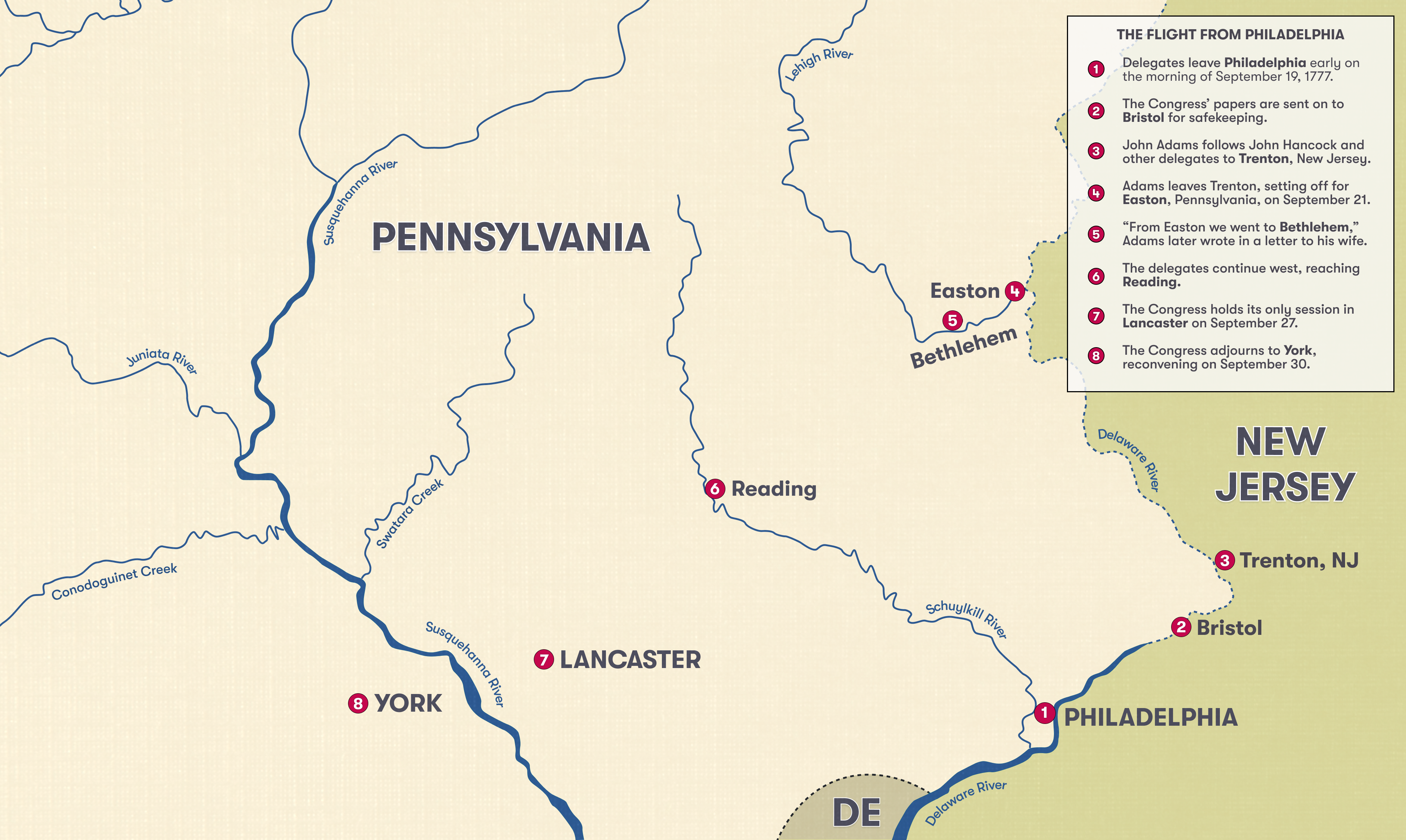
The Congress convened in Lancaster’s courthouse on September 27, meeting for just a few hours to discuss routine matters related to the ongoing war with Great Britain. Toward the end of the session, the delegates decided to relocate west once again, this time to York, across the Susquehanna River. The men realized that “it wasn’t that hard for them to get here, so it wasn’t going to be that hard for the British to get here,” says Stephanie Townrow, director of interpretation and exhibitions at LancasterHistory, a nonprofit museum and research center. Lancaster’s brief stint as the nation’s capital was over almost as quickly as it began.
Today, Lancaster is one of just nine American cities that have served as the U.S. capital, however fleetingly. “That makes Lancaster a member of a very exclusive club,” says Adam Zurn, author of Capital Day: Lancaster and the Revolution and the founder of the “Uncharted Lancaster” blog. “We were the third capital, and we were the one to shelter Congress when it was under imminent threat.”
Need to know: The nine capitals
- Philadelphia; Baltimore; Lancaster; York; Princeton, New Jersey; Annapolis, Maryland; Trenton, New Jersey; New York City; and Washington, D.C. have all held the title of the nation’s capital.
- The seat of government changed most recently in 1800, when Congress moved from Philadelphia to Washington.
- After the Civil War, three Midwestern congressmen proposed moving the capital to St. Louis, which would be more geographically central for the now-bicoastal nation. The bill failed to gain enough support to advance past the House of Representatives.
Lancaster’s one-day tenure as the country’s capital went largely unnoticed by locals in 1777. “It was very insignificant in the larger scheme of wartime,” Townrow says. Nearly 250 years later, however, the city wears its title with pride, even hosting an annual Capital Day celebration to commemorate the occasion.
Lancaster during the American Revolution
When the American Revolution began in 1775, Lancaster was the Colonies’ largest inland city, “surrounded by rich farmland and dozens of mills, ironworks and rifle shops,” historian Thomas J. McGuire writes in The Philadelphia Campaign. Home to an estimated 3,000 people, the city “was a large supply depot and crucial staging area for troops and supplies passing between New York State, Virginia and the western frontier at Fort Pitt,” on the other side of Pennsylvania.
Lancaster’s contributions to the Revolution weren’t limited to a single day in 1777. Craftsmen manufactured rifles for the Continental Army, and “farmers supplied many of the provisions that kept our soldiers alive,” Townrow says. The city also housed British and Hessian prisoners of war, as well as hospitals where locals cared for wounded soldiers.
Support for the patriot cause ran strong in Lancaster, but the local populace also included loyalists and individuals who were apathetic toward the fight for independence. The region was home to many German immigrants, some of whom had recently arrived in North America and had little stake in the conflict. Sizable communities of pacifist Quakers and Anabaptists (including the Amish) lived in Lancaster, too.
/https://tf-cmsv2-smithsonianmag-media.s3.amazonaws.com/filer_public/b5/5d/b55d4330-0a3c-4b38-aa78-9411a3102568/courthouse.jpg)
How did Lancaster emerge as a viable temporary capital? It was “a well-known and established Colonial city,” Townrow says, and many Philadelphians and members of the Continental Congress had visited it before. They knew that Lancaster “had good infrastructure, a courthouse and lots of taverns.”
Most importantly, the city was also relatively close to Philadelphia, “far enough from the immediate reach of the British Army yet close enough to remain connected to the war effort,” Zurn writes in Capital Day.
According to Townrow, “one of the old-fashioned rules of war … is that if you take your enemy’s capital, you win” the fight. The British had already captured the key port city of New York, but Philadelphia—where the First Continental Congress convened in the fall of 1774 and the Declaration of Independence was adopted in 1776—remained in rebel hands. When British General William Howe set sail from New York in July 1777, his intended destination was the Chesapeake Bay, where his troops would land before marching north to Philadelphia.
/https://tf-cmsv2-smithsonianmag-media.s3.amazonaws.com/filer_public/c5/d3/c5d3b2b1-8c38-4446-8f22-51cd149a30a3/john_nixon_reading_the_declaration_of_independence_to_the_peop-3d34070c8034df7031369d30bcaa18b6.jpg)
George Washington, commander in chief of the Continental Army, had no inkling of Howe’s plan. “When the British fleet leaves sight of shore, Washington has no idea where [Howe’s] going,” Zurn says. “He could be going north to Boston, could be going south to Charleston. Washington’s kind of in this wait-and-see position.”
As weeks passed with little news of Howe’s movements, the patriot leaders grew restless, debating whether to keep their soldiers close in case of an attack on Philadelphia or send the men north to help ward off British forces in New York. In his diary, Henry Melchior Muhlenberg, a German minister who lived in Pennsylvania, likened the British strategy to “a great hunting expedition in which hunters and farmers form a large circle and drive the wild animals from every side into a central net, whereupon the noble connoisseurs of the hunt can amuse themselves.”
The two rival armies met near Brandywine Creek, about 30 miles southwest of Philadelphia, on September 11. Washington had already sent his best scouts to New York, so he was operating at a reconnaissance disadvantage that greatly influenced the outcome of the battle. Better informed of the enemy plan, Howe managed to outflank the rebels, prompting Washington to order a retreat.
/https://tf-cmsv2-smithsonianmag-media.s3.amazonaws.com/filer_public/72/b2/72b2c0cc-fe91-4142-adc6-73b722dc4321/washington_and_lafayette_at_the_battle_of_brandywine.jpg)
“The Americans fell back through the evening, giving up the field and the defensive line they had hoped would protect Philadelphia,” Zurn writes in Capital Day. But “while Washington’s army had been outmaneuvered and defeated, it had not been annihilated” and would live to fight another day. The same held true for the nation’s government—provided that its representatives could avoid capture and execution as traitors to the British crown.
When the Congress met on September 14, the delegates resolved that if they should “be obliged to remove from Philadelphia, Lancaster shall be the place at which they shall meet.”
Lancaster as the temporary capital of the U.S.
Hamilton sent his warning to the delegates on September 18, after encountering the British while crossing the Schuylkill River.
At the time, Hamilton was serving as an aide to Washington, who’d ordered him to destroy several mills along the route that the British were following to reach the capital. Hamilton “took possession of a flat-bottomed boat for the purpose of transporting himself and his comrades across the river, should the sudden approach of the enemy render such retreat necessary,” fellow officer Henry Lee III wrote in his memoir.
When British soldiers arrived on the scene, Lee distracted them, giving Hamilton an opportunity to escape to safety. As Hamilton wrote in his letter to Hancock, however, “The boats were abandoned and will fall into their hands. I did all I could to prevent this but to no purpose.”
/https://tf-cmsv2-smithsonianmag-media.s3.amazonaws.com/filer_public/b5/7f/b57fa185-d41a-4d96-b51c-771f8dc0c058/the_flight_of_the_congress_bm_186808084556.jpg)
Adams’ letter to Abigail, sent from York nearly two weeks later, details what happened next in dramatic fashion. Early on September 19, the future president recalled, “the Congress were alarmed, in their beds, by a letter from Mr. Hamilton.” Hancock and several other delegates quickly rode out to Bristol, northeast of Philadelphia, bringing with them records of congressional proceedings, as well as papers from the War Office, the Treasury Office and other departments. These documents “are of more importance than all the members,” Adams wrote, so the delegates took a roundabout route, traveling north through New Jersey, then crossing back into Pennsylvania at Easton to make their way southwest to Lancaster. “This tour has given me an opportunity of seeing many parts of this country, which I never saw before,” Adams reported.
The delegates weren’t the only ones fleeing Philadelphia as the British advanced. Patriots fearful of retribution flocked to Lancaster, filling up every available room. “People are camping on the commons … and out on farm fields nearby, so the city is just at capacity,” Zurn says.
Howe’s forces marched into Philadelphia on September 26, beginning a nearly nine-month occupation of the city. The following morning, 28 delegates representing 11 states assembled in Lancaster’s courthouse at 10 a.m. to discuss how to proceed. Led by Hancock, their ranks included Adams, his cousin Samuel Adams and “financier of the American Revolution” Robert Morris.
/https://tf-cmsv2-smithsonianmag-media.s3.amazonaws.com/filer_public/08/74/0874c41c-e084-4594-be36-be33c6b79791/iiif-public_law_lljc008_03820755-full-pct_1000-0-default.jpg)
The meeting was brief, summarized in just one page in the Journals of the Continental Congress. “They convened in Lancaster for about three hours on a Saturday and made two resolutions, one of which was to go directly to York,” Townrow says. Although Zurn attests that “there really wasn’t much going on,” he draws attention to two of the letters reviewed by the Congress during the session.
One of the missives was from Thomas Conway, an Army officer who’d fought at Brandywine. He complained about a French colleague’s promotion to major general and sought his own advancement—a request that Washington refused. Later that year, while the Congress was stationed in York, the disillusioned officer would mount the so-called Conway Cabal, a loosely organized effort to oust Washington from power. It, too, would fail. The “full treachery” of this attempted coup isn’t yet apparent in the letter, Zurn says, but “you can see these seeds … of disgruntledness being set there.”
The second message was addressed to Hancock from Washington himself. “I have not had the honor of addressing you since your adjournment to Lancaster, and I sincerely wish that my first letter was upon a more agreeable subject,” the general wrote on September 23. He detailed the troubles that had plagued his men over the past few days, chief among them a lack of vital supplies. “At least one thousand men are barefooted and have performed the marches in that condition,” Washington added before requesting that “any shoes and blankets to be had in Lancaster or that part of the country” be seized for the Army’s use.
/https://tf-cmsv2-smithsonianmag-media.s3.amazonaws.com/filer_public/ae/68/ae681874-52cd-437a-a068-30a56cf1a86e/courthouse3.jpg)
The Congress readily obliged Washington’s request, resolving to collect “firearms, shoes, blankets, stockings, provisions and other necessaries [from] persons of disaffected and equivocal characters”—in other words, Zurn explains, loyalists or individuals who simply were unwilling to speak out against the British crown. “We often think that there are these armies, and the people for the most part are just witnesses to that,” he adds, but in actuality, the events of the war directly shaped locals’ everyday lives.
Ultimately, the delegates decided to cut their time in Lancaster short, opting to put the Susquehanna, a river with a ferry but no bridge, between themselves and the British. York, some 20 miles west, would serve as the nation’s fourth capital, holding the title from September 30, 1777, to June 27, 1778, just over a week after the British abandoned Philadelphia in response to France’s entry into the war as America’s ally.
In York, the Congress adopted the Articles of Confederation, which is often described as the U.S.’s first constitution, and celebrated the signing of two treaties with France. The Articles styled the country’s name as “the United States of America” (in the Declaration, the “u” in “united” was lowercase), a fact that has prompted some modern-day locals to misleadingly describe York as the nation’s first capital. “Today, most, if not all, historians working with county history don’t buy it,” journalist Jim McClure wrote in a 2020 editorial. “Academics outside of York County aren’t even aware of the claim. Yet it keeps echoing around York County.”
The legacy of Lancaster’s time as the U.S. capital
/https://tf-cmsv2-smithsonianmag-media.s3.amazonaws.com/filer_public/cb/60/cb6056e7-5494-40d8-8a04-7b61ba2a21e5/fo020183_1.jpg)
Today, few physical traces of Lancaster’s stint as the U.S.’s seat of power remain. Although the courthouse where the delegates met burned down in 1786, a Windsor chair and a Pennsylvania coat of arms that hung over the building in 1777 survived and are now on view at LancasterHistory.
Local celebrations of Capital Day gained traction in 1976, with the bicentennial celebration of American independence. That September, some 250 Lancastrians gathered in front of Old City Hall for a ceremony featuring historical re-enactors and a high school marching band’s rendition of “The Star-Spangled Banner.” As a speaker told the crowd, “What we have been in the past and what we are today is the result of what has been handed down to us by our predecessors these last 199 years.”
This year’s Capital Day is slated for September 26, the day before the 249th anniversary. Attendees can participate in walking tours highlighting the city’s history, enter trivia matches and costume contests, or watch a parade. Townrow is especially excited to see the pets that locals bring to the festivities. Last year, a 9-year-old brought her gerbil in a bag, and a girl clad in a Colonial-style bonnet rode in on a miniature horse.
“That’s the perfect encapsulation of what Capital Day is,” Townrow says, “... all these diverse people just coming together to celebrate the community, celebrate Lancaster and have fun with it.”
/https://tf-cmsv2-smithsonianmag-media.s3.amazonaws.com/accounts/headshot/meilan_headshot2.png)