Learning from the Connective Power of Orchids
A horticulturist reflects on the new Smithsonian-U.S. Botanic Gardens collaborative exhibition as it connects stories, scholarship, and art to this extraordinary species
:focal(512x344:513x345)/https://tf-cmsv2-smithsonianmag-media.s3.amazonaws.com/filer_public/e2/80/e280102a-858e-426f-a7e7-efe71a6c5869/2026orchidexbt-260130-hl53-s.jpg)
It’s truly remarkable to stand at the milestone of the 30th anniversary of the Smithsonian–U.S. Botanic Gardens orchid exhibition. What began three decades ago as a bold, creative partnership has grown into a tradition that brings joy, curiosity, and connection to countless visitors every year. For ten years of this partnership, I've had the honor of contributing and can say without hesitation that this year’s exhibition, More than a Flower: The Connective Power of Orchids, has been one of the most meaningful, high-level curation and celebratory experiences.
This year feels especially extraordinary as it marks the culmination of years of research, collaboration, and listening. To me, this project is shaped not only by science and horticultural expertise, but also by heart. Of course, I’m incredibly proud of the breathtaking blooms that stop people in their tracks. But what inspires me most is what this exhibition sparks: moments of recognition, belonging, wonder, and connection. Moments where orchids become more than flowers, where they become bridges.
/https://tf-cmsv2-smithsonianmag-media.s3.amazonaws.com/filer_public/9f/ab/9fabfb01-454c-42a1-9f5f-7b1214828c5b/2026orchidexbt-260130-hl45-s.jpg)
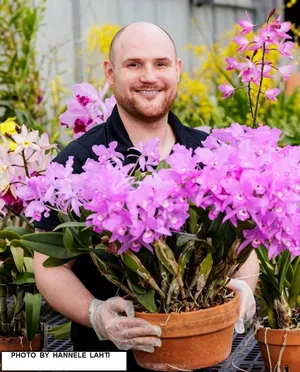
For centuries, orchids have inspired awe and imagination. From the flamboyant petals of the Cattleya to the serene elegance of Paphiopedilum, there’s a magic to them that has always pulled people in. I’ve long said that there’s an orchid for everyone, and this year’s exhibition celebrates that truth in the fullest sense. These flowers don’t simply decorate a space; they invite people to see themselves in nature’s incredible diversity. They inspire pride, curiosity, joy, and celebration. In many ways, the blooms become luminous reminders of reflection and possibility.
Their beauty is undeniable. But it’s their stories--the unexpected, intricate, deeply human stories--that have kept me moving forward through this work. The More than a Flower: The Connective Power of Orchids exhibition highlights that orchids aren’t “just pretty flowers.” They are history. They are science. They are craft. They are culture. They are a community.
What I’m celebrating most is the community involved in this exhibition. It showcases the dedication of many thoughtful and passionate individuals. I am profoundly grateful to be part of an institution where living collections coexist with art, history, and scholarship, creating experiences that resonate long after visitors leave.
/https://tf-cmsv2-smithsonianmag-media.s3.amazonaws.com/filer_public/19/a8/19a891d0-014c-4e4c-8e0b-0433b431bba7/gh10-250508-hl04-s.jpg)
Established in 1974, the Smithsonian Gardens Orchid Collection (SGOC) is a Nationally Accredited Plant Collection™ and one of the most diverse orchid collections in the world, safeguarding nearly 5,000 specimens representing more than 1,300 species. Housed within the Smithsonian Gardens Greenhouse Facility in Suitland, Maryland, the collection is cared for by a dedicated team whose work advances orchid conservation, research, education, and public engagement, making it truly an Orchid Collection for a Nation. Guided by its CODIE framework—Conservation, Outreach, Display, Innovation, and Education—SGOC emphasizes rare and endangered species, historically significant orchids, and plants of enduring horticultural value.
In this work, you never fully know how it might inspire those around us. For example, one person smiled and reminisced over the Phalaenopsis Tina Turner ‘Simply the Best’, saying, “I LOVE TINA! I remember dancing to that song at my wedding.” A Morning at the Museum visitor and their family feel welcome in the space and express excitement about the scent of Dendrobium speciosum. Meanwhile, congressional spouses were amazed by the number of North American native orchids from their home state in the Midwest. And just last week, our “Expert is In” program had over 80 people attend, including dozens of kids asking questions about our botanical world and others taking a day off from work just to have the chance to engage with the knowledge we could share with them. One participant was so inspired that he hand-drew an image of the Vanda ampullacea within the exhibition. These personal connections are excellent examples of what makes the Smithsonian special and the role that Smithsonian Gardens cultivates.
As we celebrate this 30-year legacy, I hope you’ll take a moment in the coming weeks to visit the exhibition at the National Museum of African American History and Culture (open until April 26, 2026). And if you do, consider what strikes you, what surprises you, and what moves you.