These Objects From the Smithsonian Collections Mark the 150th Anniversary of the Battle of Little Bighorn
As the 150th anniversary of the Battle of Little Bighorn approaches, approximately 19 tribes have committed to participating in a commemorative event. This historical tribute is expected to draw thousands of Native Americans and visitors to the battle area
:focal(490x369:491x370)/https://tf-cmsv2-smithsonianmag-media.s3.amazonaws.com/filer_public/81/27/8127d5b7-4f00-4c77-a513-43a7cec809ff/blb_1.jpg)
“There are not enough Indians in the world to defeat the Seventh Calvary.” – George Armstrong Custer
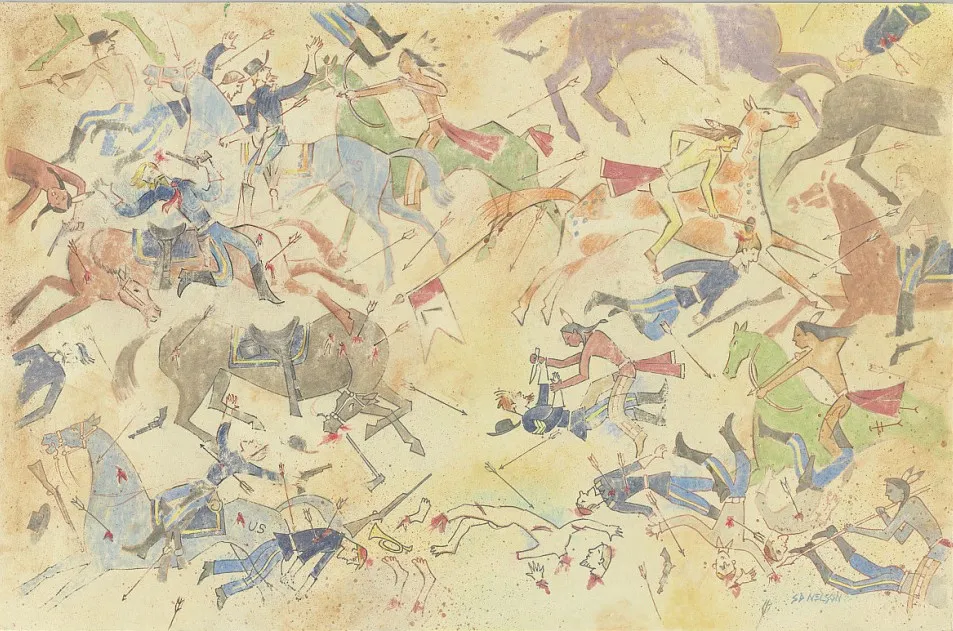
On June 25, 1876, Lieutenant Colonel George Armstrong Custer led over 200 men of the Seventh Cavalry Regiment and Indian scouts into the Little Bighorn valley in south-central Montana. Awaiting him were an estimated 7,000 to 10,000 Lakota, Cheyenne, Arapaho and Dakota camped along the Little Bighorn River. The Native Americans called this area “The Valley of the Greasy Grass.”
Eight years earlier, the United States established Paha Sapa (the Black Hills) and surrounding area as part of the Great Sioux Reservation. This area was for set aside for the exclusive use by the Sioux bands (known collectively as the Oceti Sakowin), in accordance with the Fort Laramie Treaty signed on April 29, 1868, by representatives of the United States and Sioux. Then in 1874, gold was discovered in the Black Hills. Word quickly spread as miners began trespassing onto the Oceti Sakowin hunting grounds, extracting the gold and establishing residence on Sioux treaty land. The Oceti Sakowin reacted by protecting their territory against invasion. In turn, the miners demanded U.S. military protection so that they could continue their extraction of Black Hills gold.
/https://tf-cmsv2-smithsonianmag-media.s3.amazonaws.com/filer_public/30/95/30959f39-3330-4529-959d-739fd5f76be5/blb_8.webp)
In late 1875, the U.S. government issued an ultimatum for all Lakota and Cheyenne people to report to reservations by January 31, 1876, or be considered hostile. This deadline was ignored by most of the Oceti Sakowin and Cheyenne bands. On February 8, the U.S. War Department ordered armed operations against the hostile Indians. On March 30, the United States Army began their summer campaign to force the Lakota and Cheyenne back to their reservation. On April 9, Crow Indian Scouts were recruited from Crow Agency (near Livingston, Montana) to scout for the U.S Army campaign against their traditional enemy, the Lakota. From April 26 to May 9, 30 Arikara scouts were also recruited for the campaign.
During an early June Sun Dance ceremony, held at Deer Medicine Rocks on the west bank of Rosebud Creek, Montana, respected Hunkpapa Lakota spiritual leader Sitting Bull had a vision of United States soldiers falling into his camp, prophesizing a battle victory against the U.S. Army. On June 18, the Lakota and Cheyenne entered Little Bighorn Valley to begin setting up their enormous village. On June 22, Custer, the Indian scouts and 12 companies of the Seventh Cavalry began their march up Rosebud Creek. June 24, Custer and his companies halted at present day Busby, Montana. His Indian scouts were sent ahead to the Crow's Nest mountain lookout to view the Little Bighorn Valley. The scouts returned and reported a large village has been sighted along the river. At dawn on June 25, Custer and a regiment began riding toward the valley.
/https://tf-cmsv2-smithsonianmag-media.s3.amazonaws.com/filer_public/3c/e0/3ce085a8-cbe7-468a-b18d-5a5174f2658a/blb_5.jpg)
/https://tf-cmsv2-smithsonianmag-media.s3.amazonaws.com/filer_public/cf/81/cf81cfe9-1fe3-484a-837f-274f6a45809b/blb_9.jpg)
/https://tf-cmsv2-smithsonianmag-media.s3.amazonaws.com/filer_public/5f/9c/5f9c7c24-8f08-484c-8e90-91905479090f/blb_6.jpg)
/https://tf-cmsv2-smithsonianmag-media.s3.amazonaws.com/filer_public/80/f9/80f9c101-1871-49cc-a245-3180314a0b31/blb_10.png)
The U.S. Supreme Court’s 1980 decision in United States v. Sioux Nation of Indians awarded the Sioux Nation $17.1 million for their land guaranteed by treaty. In 1881, a granite memorial was erected on Last Stand Hill by the War Department, and white marble markers were placed where each U.S soldier had fallen. On Memorial Day 1999, red granite markers were added to the battle site to honor the Natives killed. Ownership of the Black Hills remains the subject of a legal dispute between the Sioux Nation and the U.S. government. This Sioux did not accept the monetary settlement, which would now amount to close to $1 billion. The Oceti Sakowin continue to seek the return of the land promised to them.
The 150th anniversary of the Battle of Little Bighorn will feature a large-scale, multitribal celebration that blends Native cultural observances with National Park Service programming and is expected to draw thousands of Native participants and visitors to the battlefield site and surrounding area.
To begin the commemoration, Lakota spiritual Leader Arvol Looking Horse, 19th Keeper of the Sacred White Buffalo Calf Pipe, is leading the Pȟeží Slá Wókiksuye (Greasy Grass Memorial) Horse Ride from South Dakota on a 360-mile ride spanning 15 days. Horse riders from tribal communities will travel to the battle site ahead of the event, including the Crazy Horse Memorial Ride and the Cheyenne Victory Ride.
The Crow Tribe is hosting Crow Native Days this week to celebrate their nation's culture and history. Included will be a rodeo, powwow, parade, arrow tournament and other events. But the highlight of Crow Native Days will be the 34th annual Little Bighorn Battle re-enactment hosted by the Real Bird Family (Crow), scheduled for 1 p.m. on June 26, 27 and 28, on Real Bird Loop, located on the eastern frontage road between Crow Agency and Garryowen, Montana.
/https://tf-cmsv2-smithsonianmag-media.s3.amazonaws.com/filer_public/e7/7d/e77d77e2-5545-48b4-b8b8-b1d74da493c3/blb_3.jpeg)