
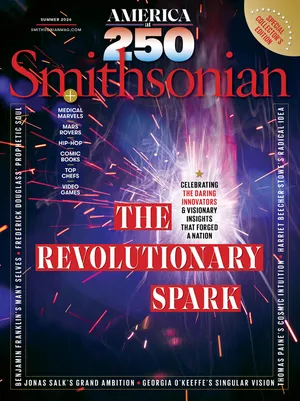
America at 250: The Revolutionary Spark
A Smithsonian magazine special report
Every Generation of Teenagers Redefines Pop Culture Through Its Favorite Music, Fads, Movies and Trends
When new government policies allowed kids more time to grown up, the teenager was born. And every decade or so, they’ve changed the ways they entertain themselves … and everyone else
/https://tf-cmsv2-smithsonianmag-media.s3.amazonaws.com/filer_public/78/3b/783ba21c-ca3e-4ba2-8f05-e7446f141388/teen_culture.jpg)
The United States invented the teenager in the mid-20th century—and then teenagers reinvented the nation, repeatedly. The creation of a new demographic was an accident, really. New Deal policies moved teens from the workplace to the classroom. A booming post-World War II economy gave them disposable income. The rise of the automobile offered unprecedented freedom. Soon companies began to see teenagers as customers. Off in high schools five days a week, teens formed their own communities, proving grounds for generation—defining media, fashion and communications trends. Those obsessions reshaped the social landscape, from the birth of rock ’n’ roll to the rise of emojis. In each era, teens identified themselves by what they watched, listened to and read, where they hung out and how they talked to one another. Here’s a sampling of their favorites.
The Silent Generation
Teens in the 1940s and ’50s/https://tf-cmsv2-smithsonianmag-media.s3.amazonaws.com/filer_public/88/8f/888f5815-6919-4c8a-adc6-bd73ed546f1e/mcdrewi_ec033-2.jpg)
Rebel Without a Cause: The James Dean coming-of-age classic played into adults’ fear of “delinquents,” and it turned an undergarment, the T-shirt, into a fashion statement when paired with jeans.
Disc jockeys: Teens who wanted to listen to something different from their parents anointed radio D.J.s such as rock ’n’ roll hype man Dick Clark and rap forerunner Jocko Henderson as their tastemakers.
Drive-in restaurants: Car-centric dining chains—think A&W, Sonic and Bob’s Big Boy—became public squares.
Pen pals: Inspired to act as international peacemakers, postwar-era teens sought to correspond with their overseas peers.
Transistor radios: These low-cost devices gave control of the dial to teenagers, who turned listening to music into a hobby.
Did you know? Elders carry big sticks
-
Despite the description, the Silent Generation was very vocal and highly influential, fueling monumental social shifts.
-
Well-known activists of the Silent Generation include Martin Luther King, Jr., Gloria Marie Steinem, Dolores Huerta, John Lewis and Angela Davis.
-
About 71 percent of Boomers and members of the Silent Generation (age 65+) voted in the 2024 presidential election, more than younger generations.
Boomers
Teens in the 1960s and ’70s/https://tf-cmsv2-smithsonianmag-media.s3.amazonaws.com/filer_public/10/73/1073f025-2374-4e24-aee1-25b64c06182a/phone.jpg)
Beach party films: Beach Party and similar movies were heavy on fun, light on moral lessons and almost entirely devoid of adults.
Music festivals: Woodstock is the most famous of the era’s rock festivals, which allowed teens to connect with artists and like-minded fans. A countercultural movement flourished.
“Going out”: Teens told their parents (and pollsters) that it didn’t matter where they were going, as long as they were out of the house—often just driving around.
Princess telephones: The utilitarian black rotary telephone got an upgrade to meet the demands of the teen market. AT&T’s Princess model, which debuted in 1959 in a rainbow of colors, was the first phone series to be an interior design choice.
Teen crush magazines: Tiger Beat and other teeny-bopper titles featured photos of hunky stars and casually intimate details about teen heartthrobs, making them a precursor to today’s voracious celebrity gossip culture.
Gen X
Teens in the 1980s and early ’90s
/https://tf-cmsv2-smithsonianmag-media.s3.amazonaws.com/filer_public/bf/2b/bf2b8f19-bf6e-431f-8cc9-44afd81d2d13/walkmantilt.jpg)
Portable music: Music became personal for Gen Xers, who could broadcast beats from their boombox or listen privately anywhere on a Walkman—first a portable cassette player and then a portable CD player.
The mall: Most Gen X teenagers held after-school or summer jobs—the last cohort for which that was true—which meant malls were where many both worked and played.
Motorola pagers: Beepers, first used by doctors, made savvy teens of the early ’90s the first always-connected generation.
MTV: The network influenced the aesthetic of ’80s teendom, with video jockeys in bright colors, fast-paced editing and its unrivaled ability to anoint the next big artist.
Millennials
Teens in the late 1990s and 2000s/https://tf-cmsv2-smithsonianmag-media.s3.amazonaws.com/filer_public/ad/87/ad876d56-8f0d-4ee1-87f3-42ffc43c79f2/skater_silo.jpg)
Smart teen flicks: Tapping into teens’ self-deprecating sense of humor, Hollywood produced inexpensive satires like Rushmore, Legally Blonde and Mean Girls, hits in theaters and at the local Blockbuster.
Napster: Teenagers started and fueled the short-lived and controversial peer-to-peer music sharing service that pushed the record industry into the online era.
Skate parks: Cities erected structures in parks and public areas to keep skateboarders off the streets, but their style couldn’t be contained. Even those who never attempted to ollie adopted their loose-fitting fashion.
MySpace: Teens flocked to this early social media site, where they could shape their own identities, customizing pages with music, photos and designs to connect with friends.
YA literature: Book series about teens—think Twilight, The Hunger Games, Gossip Girl—soared in popularity and received the Hollywood treatment, becoming pop culture for all ages.
Zoomers
Teens in the 2010s and 2020s/https://tf-cmsv2-smithsonianmag-media.s3.amazonaws.com/filer_public/74/99/7499c72d-d62d-42ea-bc4a-f30c7755356f/emojis.jpg)
Animation: Animated movies, including classics like Shrek and 2020s breakouts like KPop Demon Hunters, continue to attract teens. According to a UCLA study, nearly half of Gen Z watchers prefer them to live-action options.
Mood music: Today’s teens are ignoring the genre distinctions of past generations. They rely on algorithmic streaming services to create playlists that fit a mood or an activity.
TikTok: More than half of Zoomers—many of whom were teenagers during the pandemic—are on TikTok every day. Fast-evolving trends have helped popularize the short-form video platform, now a widespread source of news, comedy and advice.
Emojis: These teens are the first native emoji speakers, broadening the language’s vocabulary, customizing characters, and making them common in all kinds of conversations, from the classroom to the dating scene to the workplace.
Nostalgia TV: Streaming video services now provide tens of thousands of television options, available on demand. A frequent choice for today’s adolescent audience: the hits of their parents’ generation, like Friends, ER and The West Wing.
Subscribe to Smithsonian magazine now for just $19.99
This article is a selection from the Summer 2026 issue of Smithsonian magazine