
A Brief History of the Salem Witch Trials
One town’s strange journey from paranoia to pardon
/https://tf-cmsv2-smithsonianmag-media.s3.amazonaws.com/filer_public/40/e6/40e69d4a-6016-4815-ba7a-01fce1bb2e5d/examination_of_a_witch_-_tompkins_matteson.jpeg)
The Salem witch trials occurred in colonial Massachusetts between early 1692 and mid-1693. More than 200 people were accused of practicing witchcraft—the devil’s magic—and 20 were executed.
In 1711, colonial authorities pardoned some of the accused and compensated their families. But it was only in July 2022 that Elizabeth Johnson Jr., the last convicted Salem “witch” whose name had yet to be cleared, was officially exonerated.
Since the 17th century, the story of the trials has become synonymous with paranoia and injustice. Fueled by xenophobia, religious extremism and long-brewing social tensions, the witch hunt continues to beguile the popular imagination more than 300 years later.


/https://tf-cmsv2-smithsonianmag-media.s3.amazonaws.com/filer_public/67/4d/674d12b7-f9b8-4bae-af44-f1264c198037/salem_village_-_map_of_-_project_gutenberg_etext_17845.jpeg)
Tensions in Salem
In the medieval and early modern eras, many religions, including Christianity, taught that the devil could give people known as witches the power to harm others in return for their loyalty. A “witchcraft craze” rippled through Europe from the 1300s to the end of the 1600s. Tens of thousands of supposed witches—mostly women—were executed. Though the Salem trials took place just as the European craze was winding down, local circumstances explain their onset.
In 1689, English monarchs William and Mary started a war with France in the American colonies. Known as King William’s War to colonists, the conflict ravaged regions of upstate New York, Nova Scotia and Quebec, sending refugees into the county of Essex—and, specifically, Salem Village—in the Massachusetts Bay Colony. (Salem Village is present-day Danvers, Massachusetts; colonial Salem Town became what’s now Salem.)
The displaced people placed a strain on Salem’s resources, aggravating the existing rivalry between families with ties to the wealth of the port of Salem and those who still depended on agriculture. Controversy also brewed over the Reverend Samuel Parris, who became Salem Village’s first ordained minister in 1689 and quickly gained a reputation for his rigid ways and greedy nature. The Puritan villagers believed all the quarreling was the work of the devil.
In January 1692, Parris’ daughter Elizabeth (or Betty), age 9, and niece Abigail Williams, age 11, started having “fits.” They screamed, threw things, uttered peculiar sounds and contorted themselves into strange positions. A local doctor blamed the supernatural. Another girl, 12-year-old Ann Putnam Jr., experienced similar episodes. On February 29, under pressure from magistrates Jonathan Corwin and John Hathorne, colonial officials who tried local cases, the girls blamed three women for afflicting them: Tituba, a Caribbean woman enslaved by the Parris family; Sarah Good, a homeless beggar; and Sarah Osborne, an elderly impoverished woman.
The witch hunt begins
All three women were brought before the local magistrates and interrogated for several days, starting on March 1, 1692. Osborne claimed innocence, as did Good. But Tituba confessed, “The devil came to me and bid me serve him.” She described elaborate images of black dogs, red cats, yellow birds and a “tall man with white hair” who wanted her to sign his book. She admitted that she’d signed the book and claimed there were several other witches looking to destroy the Puritans.
With the seeds of paranoia planted, a stream of accusations followed over the next few months. Charges against Martha Corey, a loyal member of the church in Salem Village, greatly concerned the community; if she could be a witch, then anyone could. Magistrates even questioned Good’s 4-year-old daughter, Dorothy, whose timid answers were construed as a confession. The questioning got more serious in April, when the colony’s deputy governor, Thomas Danforth, and his assistants attended the hearings. Dozens of people from Salem and other Massachusetts villages were brought in for questioning.
/https://tf-cmsv2-smithsonianmag-media.s3.amazonaws.com/filer_public/55/25/552587cf-d7e9-49e1-86b6-91ac0b725486/2560px-martha_corey_and_her_persecutors.png)
On May 27, 1692, Governor William Phips ordered the establishment of a Special Court of Oyer (to hear) and Terminer (to decide) for Suffolk, Essex and Middlesex counties. The first accused witch brought in front of the special court was Bridget Bishop, an older woman known for her gossipy habits and promiscuity. When asked if she committed witchcraft, Bishop responded, “I am as innocent as the child unborn.” The defense must not have been convincing, because she was found guilty and, on June 10, became the first person hanged on what was later called Gallows Hill.
Just a few days after the court was established, respected minister Cotton Mather wrote a letter imploring the court not to allow spectral evidence—testimony about dreams and visions. The court largely ignored this request, sentencing the hangings of five people in July, five more in August and eight in September. On October 3, following in his son Cotton’s footsteps, Increase Mather, then-president of Harvard, denounced the use of spectral evidence: “It were better that ten suspected witches should escape than one innocent person be condemned.”
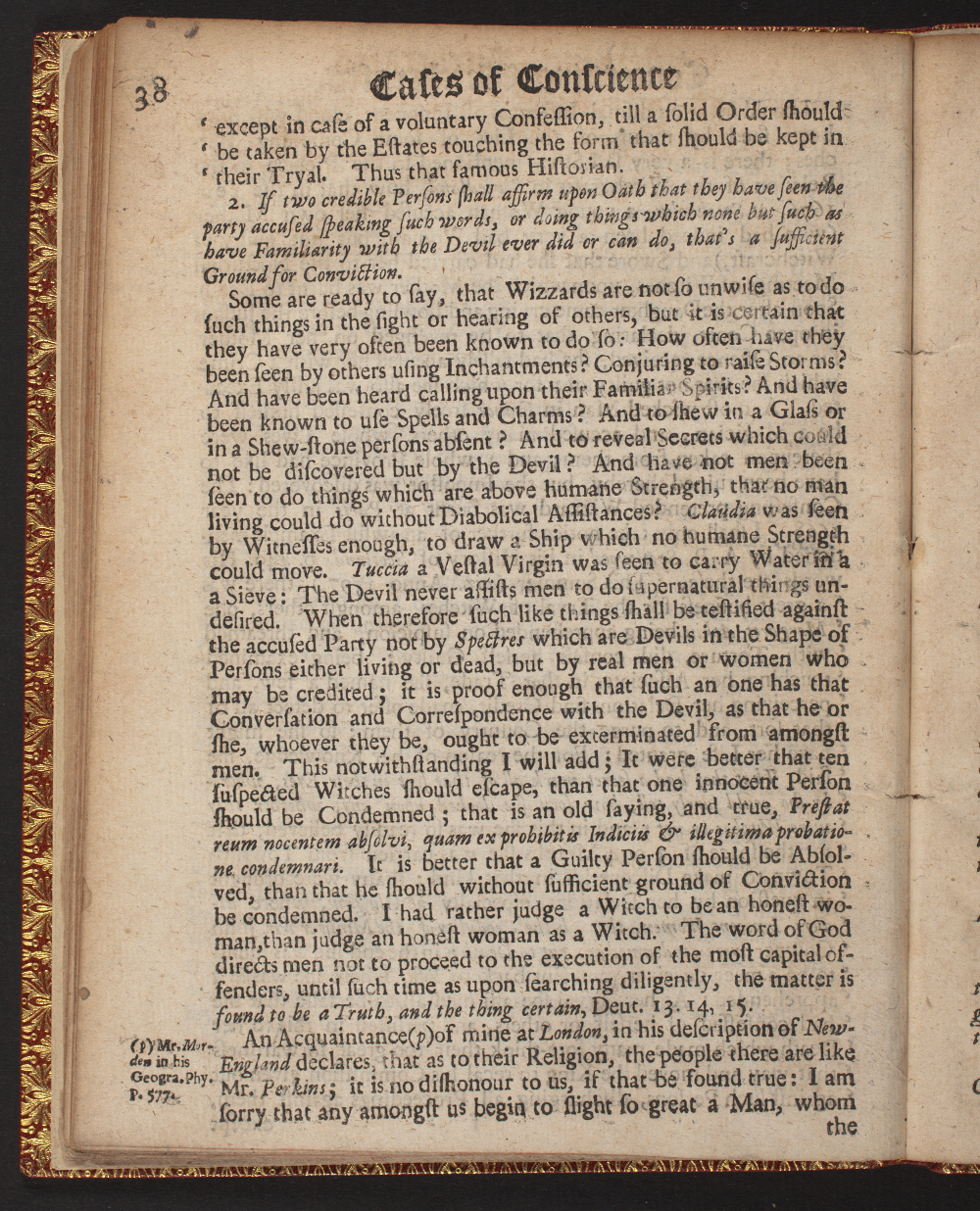
Phips, in response to these pleas and his own wife’s questioning as a suspected witch, prohibited further arrests and released many accused witches. He dissolved the Court of Oyer and Terminer on October 29, replacing it with a Superior Court of Judicature, which disallowed spectral evidence and condemned just 3 out of 56 defendants.
By May 1693, Phips had pardoned all those imprisoned on witchcraft charges. But the damage was already done. Nineteen men and women had been hanged on Gallows Hill. Giles Corey, Martha’s 71-year-old husband, was pressed to death in September 1692 with heavy stones after refusing to submit himself to a trial. At least five of the accused died in jail. Even animals fell victim to the mass hysteria, with colonists in Andover and Salem Village killing two dogs believed to be linked to the devil.
/https://tf-cmsv2-smithsonianmag-media.s3.amazonaws.com/filer_public/2d/56/2d5624dd-cbd4-4cf1-8406-fe59f1d12c22/witchcraft_at_salem_village.jpeg)
Restoring good names
In the years following the trials and executions, some involved, like judge Samuel Sewall and accuser Ann Putnam, publicly confessed error and guilt. On January 14, 1697, Massachusetts’ General Court ordered a day of fasting and soul-searching over the tragedy of Salem. In 1702, the court declared the trials unlawful. And in 1711, the colony passed a bill restoring the rights and good names of many of the accused, as well as granting a total of £600 in restitution to their heirs. But it wasn’t until 1957—more than 250 years later—that Massachusetts formally apologized for the events of 1692. Johnson, the accused woman exonerated in July 2022, was left out of the 1957 resolution for reasons unknown but received an official pardon after a successful lobbying campaign by a class of eighth-grade civics students.
In the 20th century, artists and scientists alike continued to be fascinated by the Salem witch trials. Playwright Arthur Miller resurrected the tale with his 1953 play The Crucible, using the trials as an allegory for the anti-communist McCarthyism then sweeping the country. Scholars offered up competing explanations for the strange behavior that occurred in Salem, with scientists seeking a medical cause for the accusers’ afflictions and historians more often grounding their theories in the community’s tense sociopolitical environment.
/https://tf-cmsv2-smithsonianmag-media.s3.amazonaws.com/filer_public/87/50/8750d715-a657-481c-a599-939e16d4499d/gettyimages-1176018717.jpg)
An early hypothesis now viewed as “fringe, especially in historical circles,” according to Vox, posited that the accusers suffered from ergotism, a condition caused by eating foods contaminated with the fungus ergot. Symptoms include muscle spasms, vomiting, delusions and hallucinations. Other theories emphasize a “combination of church politics, family feuds and hysterical children, all of which unfolded in a vacuum of political authority,” as Encyclopedia Britannica notes. Ultimately, the causes of the witch hunt remain subject to much debate.
In August 1992, to mark the 300th anniversary of the trials, Nobel Laureate Elie Wiesel dedicated the Witch Trials Memorial in Salem. Also in Salem, the Peabody Essex Museum, which houses the original court documents, mounted an exhibition reckoning with and reclaiming the tragedy in late 2021 and early 2022. Finally, the town’s most-visited attraction, the Salem Witch Museum, attests to the public’s enduring enthrallment with the 17th-century hysteria.
Editor’s Note, October 24, 2022: This article has been updated to reflect the latest research on the Salem witch trials.