
A Smithsonian magazine special report
The Gunboat ‘Philadelphia’ Lasted One Day in Battle. It’s Still Telling Us About the Revolution 250 Years Later
The 29-ton ship went to war against the British, then sat at the bottom of Lake Champlain for 160 years. Now it’s a relic of ragged glory
/https://tf-cmsv2-smithsonianmag-media.s3.amazonaws.com/filer_public/52/43/5243d43c-428a-4f22-800e-17a3a8b129f0/b1703304_copy_3.jpg)
In the summer of 1776, when the 56 delegates of the Thirteen Colonies signed the United States’ Declaration of Independence, construction was already underway on eight gunboats, part of a planned fleet to be commanded by Brigadier General Benedict Arnold. By the fall, one of the flotilla’s gunboats, the Philadelphia, would join the fight against the British Royal Navy at the Battle of Valcour Island in Lake Champlain, between New York and Vermont. The Philadelphia, flat-bottomed, weighing about 29 tons and measuring 54 feet long, was mounted with three cannons—one 12-pounder and two 9-pounders—and eight swivel guns.
/https://tf-cmsv2-smithsonianmag-media.s3.amazonaws.com/filer_public/6d/a3/6da39466-2a4f-4d95-bb92-c291f8698389/b1703287_copy_2.jpg)
/https://tf-cmsv2-smithsonianmag-media.s3.amazonaws.com/filer_public/f2/aa/f2aa2d71-64c6-4d22-97aa-57c2fd755cd0/b1703298_copy_2.jpg)
The Revolutionary War had begun more than a year earlier, and Arnold, who would later become infamous as a traitor, was still working for the Continental Army. The gunboats’ construction was officially under his directive, but the assistant deputy commissary general, Hermanus Schuyler, administered the day-to-day production in Skenesborough, New York, by soldiers who’d previously been ship carpenters. Their skills were so valuable that these soldiers became some of the highest-paid workers in the army, earning an estimated $34 a week; only Schuyler himself made more. Enslaved people of African descent were also vital to the completion of the gunboats, particularly in mining iron ore and blacksmithing. In fact, the regiments and units stationed around Lake Champlain would become notably integrated, comprising free citizens, Native Americans and enslaved Black men, says Kenneth Cohen, chair of military history and curator of early American history at the Smithsonian National Museum of American History (NMAH).
Did you know? Before the Battle of Valcour Island, the Continental Army invaded Quebec
-
In September 1775, about a year before the Battle of Valcour Island, the Continental Army invaded British-controlled Quebec to head off any British forces who might use the province to attack the Colonies from the north.
-
That winter, around 10,000 British and German troops arrived and routed the Americans, who burned its boats and retreated to Fort Ticonderoga—where it began building the fleet that would serve the patriots in the Battle of Valcour Island.
-
Visitors at the National Museum of American History can observe conservation efforts and explore a 3D model of the gunboat.
/https://tf-cmsv2-smithsonianmag-media.s3.amazonaws.com/filer_public/56/d2/56d2c579-bad6-487a-bf92-5a3467f09ca1/b1707538_copy.jpg)
In October, after a summer of shipbuilding, fighting commenced. The Philadelphia was captained by Benjamin Rue from Pennsylvania. On October 11, the day the Battle of Valcour Island began, the noble ship’s career started and ended with poignant speed: Six hours into the exchange of fire, just after sunset, the Philadelphia was struck by one of the Royal Navy’s 24-pound cannonballs. The vessel swiftly sank. By the battle’s end, two days later, the Brits’ higher-caliber arsenal had damaged or destroyed much of the American fleet. Defeated, Arnold torched the remaining boats as he and the surviving crew retreated, eventually reaching the safety of Fort Ticonderoga, near the south end of Lake Champlain.
The Philadelphia rested largely undisturbed at the bottom of the lake for nearly 160 years. But in 1934, Lorenzo F. Hagglund, an underwater engineer working for a salvage company, discovered timbers in the lake from the wreckage of another ship the patriots had used at Valcour. A World War I vet who’d trained near Lake Champlain, Hagglund was also a novice historian—-and he suspected the Philadelphia might still be underwater, too. The next year, with help from locals who’d passed on stories of the gunboat’s demise for generations, Hagglund managed to locate the Philadelphia and raise it from Lake Champlain. For more than two decades, he displayed the gunboat through the region as a historical attraction—even exhibiting it at one point as a roadside landmark on New York State’s Route 22. In 1964, four years after Hagglund’s death, the Smithsonian acquired the vessel.

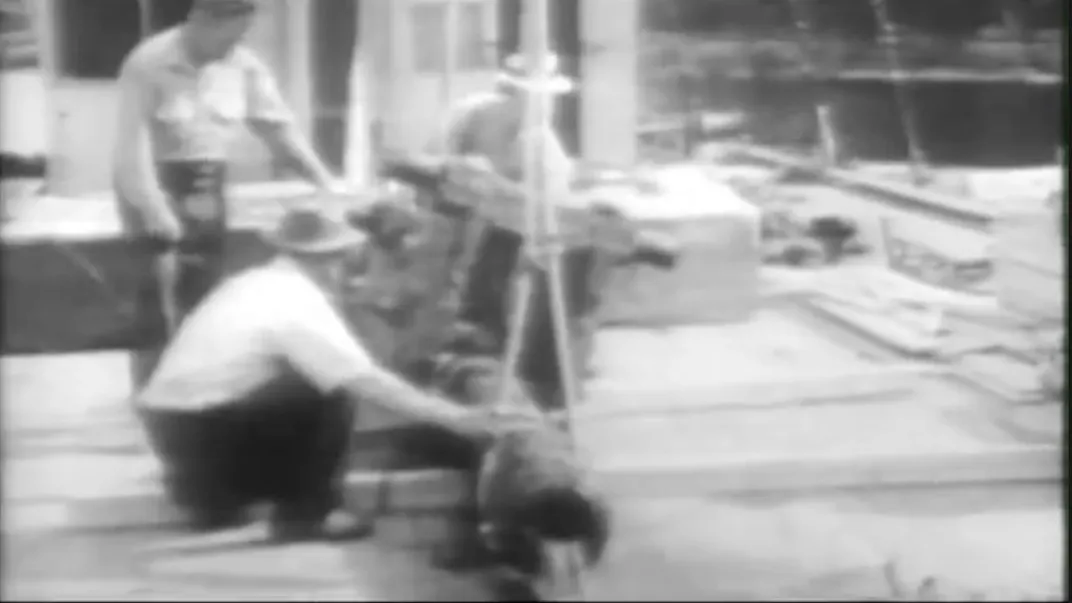
Conservators at NMAH made minor changes, shoring up the timbers that fractured when the British shot penetrated the Philadelphia’s hull—and which decayed further underwater. Starting July 1965, the boat was on permanent display at the museum. Then, in the early 2000s, the Smithsonian began a decades-long conservation project in partnership with Texas A&M’s Center for Maritime Archaeology and Conservation. In 2018, the endeavor entered a more ambitious phase, marshaled by Cohen and Jennifer L. Jones, curator and project coordinator at NMAH. (Jones first encountered the Philadelphia in 1983, when she was an intern at the museum. Her first Philadelphia task was simple: vacuuming.) The project’s goal, Jones and Cohen say, is not to recreate the 1776 boat. Instead, they’re doing something more delicate: stabilizing the intricate structure of the craft. “We’re not reconstructing,” Jones says. “We are cleaning and making sure that it lasts for another 200 years or more.”
/https://tf-cmsv2-smithsonianmag-media.s3.amazonaws.com/filer_public/9d/cd/9dcd7121-a27f-4f34-95e6-82aaba454158/b170741304_copy.jpg)
/https://tf-cmsv2-smithsonianmag-media.s3.amazonaws.com/filer_public/92/ee/92eeecfb-d253-4e27-95fc-ea513d400362/b170743206_copy.jpg)
/https://tf-cmsv2-smithsonianmag-media.s3.amazonaws.com/filer_public/14/c4/14c42967-222a-479b-bd11-a395abb5b0b0/b170752825_copy.jpg)
Today, the oldest surviving American warship looks undeniably like a relic, but it still has a ragged glory. Visitors can see precisely where the cannonball struck the starboard side; the added wood is painted gray to distinguish it from the original structure. Jones lovingly describes the original materials that make up the boat, including green oak harvested in and around Skenesborough. Among other next steps, the team plans to raise the boat onto rubber isolation pads, to reduce the impact of low-level vibrations from the museum floor. In the ongoing preservation process, the team will continue to add structural elements to support weakening timbers while replacing any pieces that might threaten the overall structural integrity. For example, says Peter Fix, a research scientist at Texas A&M, the gunboat’s planks were originally fastened with iron spikes, which “corroded during the 159-year immersion in Lake Champlain.” Conservators have augmented the fastenings to keep all the planking secured.
Cohen argues that the importance of the Battle of Valcour Island is often overlooked. “The battle was significant,” he says. “By virtue of building the fleet, the Americans then force the British to also build a fleet ... [all of which] makes this a much more long, drawn-out war than the British had hoped for.”
That delay proved crucial: The British held off their invasion from the north until the following year, allowing the Continental Army precious time to regroup and triumph at the critical Battle of Saratoga in the fall of 1777. The gunboat Philadelphia had served briefly but bravely—and today, its planks and cannons tell a complicated tale of the ingenuity that threw off the monarchy.
Editors’ note, April 15, 2026: This article has been updated to reflect the correct dimensions of the gunboat.
Editors’ note, April 30, 2026: An earlier version mischaracterized George Washington’s salary as commander of the Continental Army. In fact, he received no regular salary but was reimbursed for his expenses.

Subscribe to Smithsonian magazine now for just $19.99
This article is a selection from the April/May 2026 issue of Smithsonian magazine