
Why Are These Whales Floating Upside-Down? They Might Just Be Moms Who Need a Break From Feeding Their Babies
Each year, southern right whales migrate thousands of miles from their feeding grounds to breed, give birth and raise their young. Taking rests and regulating their calves’ nursing schedules might help mothers conserve energy while they’re far from food
/https://tf-cmsv2-smithsonianmag-media.s3.amazonaws.com/accounts/headshot/SarahKuta.png)
/https://tf-cmsv2-smithsonianmag-media.s3.amazonaws.com/filer_public/63/7f/637f114f-ffdf-48dc-b200-f219c89f63bc/upside-down-whale.png)
Southern right whale mothers occasionally turn belly-up in the water, with their pectoral fins stretched high into the air and their blowholes submerged beneath the waves—a highly unusual position for the hulking marine mammals. Now, researchers have come up with a possible explanation for the strange behavior.
Writing in a paper published on July 6 in the journal Mammalian Biology, scientists posit that some moms float upside-down because they need a break from their nursing calves.
“When she’s upside-down, her mammary slits are above the water, or they’re just that little bit too difficult for the calf to get to,” study co-author Renae van Noort, a biologist at the University of Western Australia, tells National Geographic’s Melissa Hobson. “It could be a way for [mom] to be like ‘give me a minute.’”
Southern right whale mothers spend their summers feeding near Antarctica. Once they’ve bulked up, they travel to waters off southern Australia, South Africa, Argentina and Chile to give birth and raise their calves.
Mothers fast while they’re caring for their young, relying on stored energy in their blubber to get them through the months-long calving season. At the same time, however, their bodies are working overtime to produce thick, calorie-rich milk for their hungry babies. During this important period, southern right whale mothers must conserve energy whenever and however possible—and van Noort and her colleagues set out to understand how they do so.
They used drones to record 75 hours of video footage of 59 mother-calf pairs in the Head of Bight, a protected bay off the state of South Australia that serves as a southern right whale nursery. On average, mothers spent about 33 percent of their time resting, while their calves took breaks around 13 percent of the time, the team found. Most of the mothers floated with their backs at the water’s surface or just below it. But around a quarter of them sometimes rested upside-down, with their bellies above or below the surface. They did so only about 19 percent of the time, but the behavior occurred often enough to puzzle researchers.

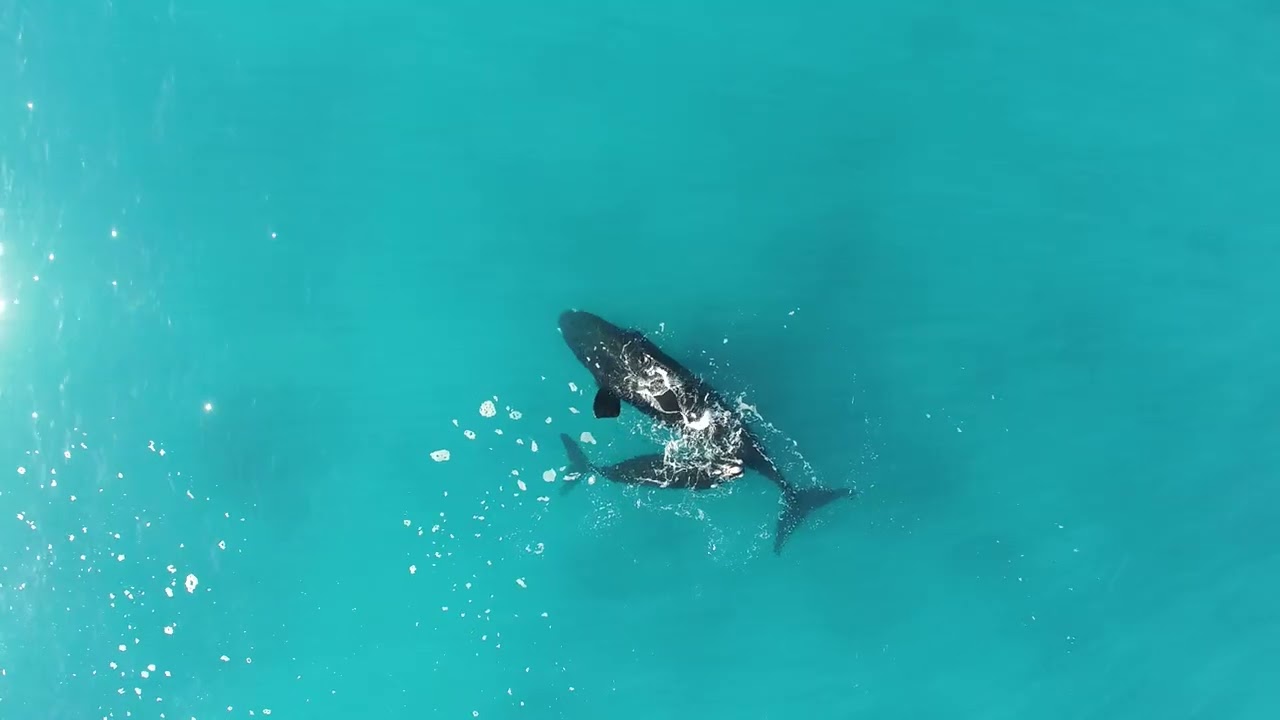
The scientists realized that the behavior was largely limited to lactating mothers, plus one whale in the late stages of pregnancy. This suggests rolling over might have something to do with the energetic demands of reproduction. An analysis of the video footage seemed to confirm this hunch: The more time mothers spent upside-down, the less time their calves spent feeding.
When they’re nursing, southern right whale calves grow rapidly, adding up to nearly five inches in length per day at birth. Their mothers, by contrast, lose around a quarter of their body weight throughout the breeding season.
“She can’t go to the supermarket while she’s here and stock up on food,” study co-author Kate Sprogis, a marine mammal ecologist at the University of Western Australia, tells National Geographic. “The only way she can get fat again is by migrating all the way back” to the Southern Ocean.
So, in the meantime, the researchers think mothers periodically restrict access to their milk, as a self-preservation mechanism of sorts.
While a whale floating upside-down might seem sick or injured, the researchers think the opposite is true. This behavior “may actually be an indicator of a healthy mother carefully managing her energy reserves during one of the most energetically demanding periods of her life,” Sprogis, van Noort and Fredrik Christiansen, a study co-author and marine biologist at Aarhus University in Denmark, write in the Conversation.
Another possibility is that the mothers are floating upside-down to cool themselves down. Southern right whales don’t have dorsal fins, which some other cetacean species use to help regulate their internal temperature. So perhaps they’re going belly-up to increase the skin surface area that’s in contact with the sea breeze, a bit like humans “dipping our legs in a cold pool on a hot day,” the researchers write in the Conversation.
However, Peter Corkeron, a marine ecologist at Griffith University in Australia who was not involved with the study, doesn’t think the cooling explanation holds up. He tells National Geographic that southern right whales can easily dump heat by “swimming around with their mouth open and letting seawater flush their mouth” because they have “masses of very fine capillaries in the roof of their mouth.”
Whatever the reason, it’s unclear why some southern right whale mothers rest upside-down but not others. The animals might be picking up the behavior “from their own mothers, from previous experiences with calves or maybe from observing fellow mothers,” Malin Lilley, a comparative psychologist at Texas A&M University who was not involved with the study, tells Scientific American’s Gennaro Tomma.
Fun fact: A behavior unique to right whales
Scientists haven’t seen a tendency to float upside-down in any other whale species.
Southern right whales were nearly wiped out during the 19th and 20th centuries. However, since an international moratorium on commercial whaling was enacted in the 1980s, their global population has recovered to an estimated 12,000 to 15,000 individuals. Still, the species faces numerous modern threats, including chemical and noise pollution, entanglement in fishing gear, climate change, habitat degradation and vessel strikes.
When they’re upside-down, the animals are particularly vulnerable to ship strikes. “In the advent of a threat, the position requires extra time for the whale to rotate to breathe, to dive and/or swim away quickly,” the researchers write in the paper, noting that the creatures are at even greater risk when they’re belly-up while submerged under the water and out of view.
Against this backdrop, the researchers say their findings underscore the need for stronger protections in southern right whale calving grounds. Shipping vessels are already banned in the Head of Bight during breeding season, so ship strikes aren’t a threat there. But the researchers would like to see similar protections enacted in all southern right whale calving areas around the globe.
Perhaps the findings will encourage officials to more seriously consider vessel exclusion zones or speed restrictions, “instead of just brushing [these protections] off as a ludicrous and impossible idea,” Corkeron tells National Geographic.
/https://tf-cmsv2-smithsonianmag-media.s3.amazonaws.com/accounts/headshot/SarahKuta.png)