
/https://tf-cmsv2-smithsonianmag-media.s3.amazonaws.com/filer_public/cb/72/cb726792-ecc1-446c-b20b-ce1ce610ebe3/ezgif-7013df4c21cb050d.jpg)
Speed Limits for Ships Protect Endangered Right Whales From Vessel Strikes. Could the Animals Survive Without Them?
Since 2008, rules requiring ships to slow down to avoid collisions with North Atlantic right whales have reduced fatalities of the critically endangered animals. Now, NOAA is calling the regulations into question, raising concerns for the mammals’ future
:focal(1024x683:1025x684)/https://tf-cmsv2-smithsonianmag-media.s3.amazonaws.com/filer_public/cb/72/cb726792-ecc1-446c-b20b-ce1ce610ebe3/ezgif-7013df4c21cb050d.jpg)
Even though whales take up a lot of space, they can be surprisingly stealthy in the water. Regina Asmutis-Silvia, executive director of Whale and Dolphin Conservation North America, knows firsthand how difficult it can be to spot one and avoid a collision.
When she’s steering a research boat, Asmutis-Silvia looks for specific types of ripples at the surface or spouts of water from a blowhole to signal that a whale is nearby. But even so, the animals can be unpredictable.
“They’re not out here paying attention to you,” she says. “Whales that are looking for food and eating are very focused. It’s probably the whale version of hangry!”
Recently, Asmutis-Silvia was slowly moving a boat she operates as part of a research project with Woods Hole Oceanographic Institution in Massachusetts, having noticed signs of whales in the area. Suddenly, a North Atlantic right whale popped up just 30 feet ahead, off the boat’s bow. “That’s not atypical whale behavior for right whales,” Asmutis-Silvia says. “These animals do what they want.”
She had time to turn her vessel away from the mammal, because of her low speed, but many other cases don’t end so harmlessly. Whale strikes have been on the rise in areas along the East Coast, likely due to the growth of global shipping in the past few decades. Worldwide, vessels fatally hit an estimated 20,000 whales each year. Recent examples of dead whales washing ashore on New York and Delaware beaches have brought the toll of vessel strikes into the public eye.
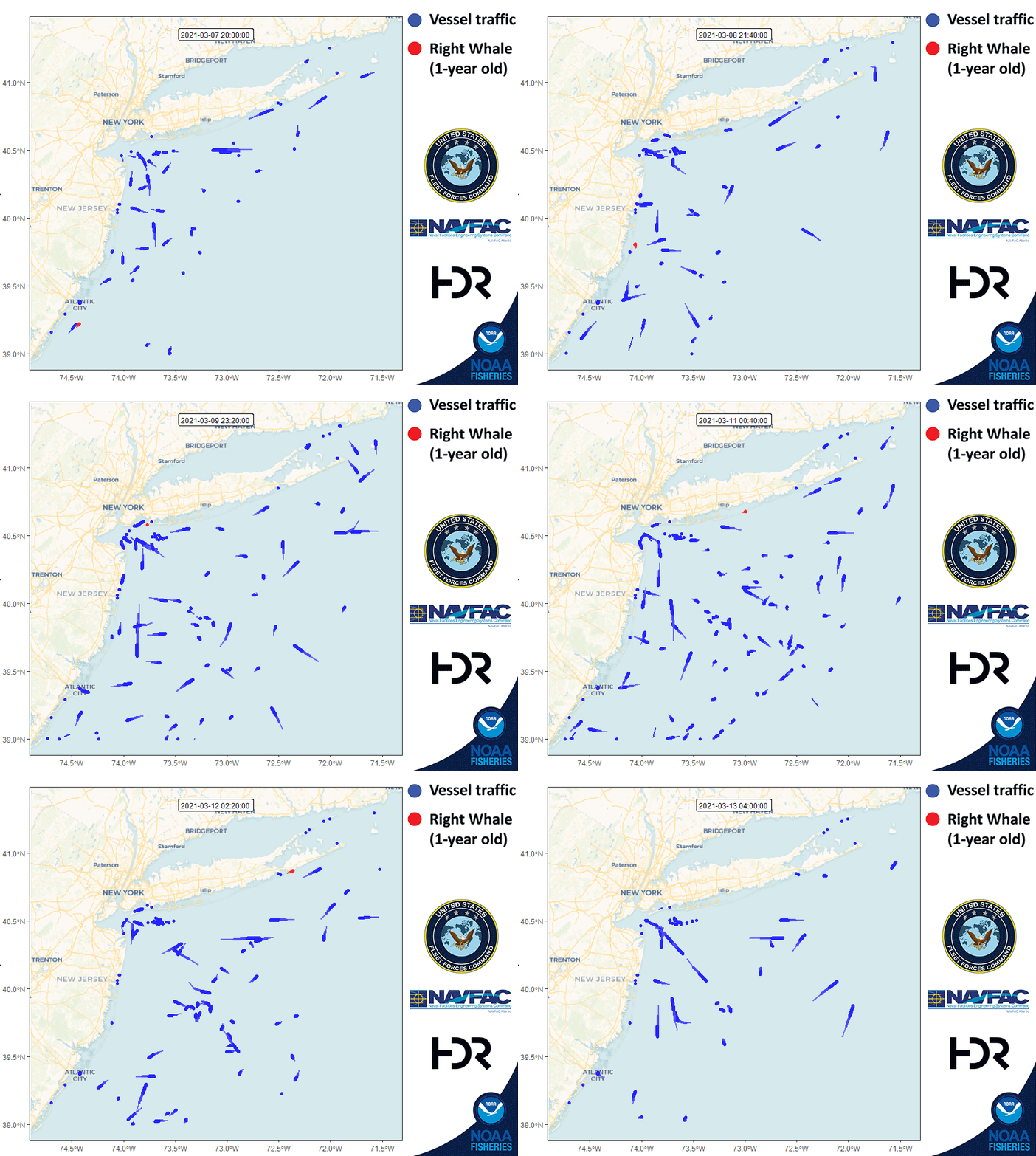
Since 2008, the National Oceanic and Atmospheric Administration (NOAA) has regulated ship speed in some areas along the East Coast to protect critically endangered North Atlantic right whales. Mother-calf pairs are often sighted within about 40 miles of the New England shoreline. Because whales move north to south along the coast and major shipping lanes span east to west, the animals and vessels are liable to collide. Research has shown that the best way to prevent collisions, aside from rerouting ships entirely, is to have ships slow down.

![[Rare Footage] Swim Alongside a Right Whale and Her Calf](https://th-thumbnailer.cdn-si-edu.com/05j7coL4ZiusgO7dn6Dt0AkloYA=/1072x603/https://tf-cmsv2-smithsonianmag-media.s3.amazonaws.com/embedly/Screenshot_2026-06-26_at_12.02.18PM.png)
Now, NOAA, which enforces laws within 230 miles of the United States’ coast, is calling into question the necessity of this ship speed regulation. The agency has begun investigating whether technology to detect whales may be sufficient to prevent strikes.
While conservationists support developing detection technologies, they are concerned that a change to the current speed limit could lead to more injured whales on our beaches and higher risks to the endangered right whales. Weakening the existing protections would be “really dangerous for the survival of the species,” says Brett Hartl, government affairs director for the nonprofit Center for Biological Diversity.
Each whale lost is critical
North Atlantic right whales are among the most endangered whale species on the planet; only about 380 remain in the wild. Although vessel strikes affect other species, too, protecting this threatened population was the impetus behind NOAA’s original speed regulations.
Documented incidents of vessels striking right whales, specifically, are not increasing in frequency, but they are still happening continuously, says Jessica Redfern, associate vice president of Ocean Conservation Science at the New England Aquarium. “This is not a sustainable level of human-caused mortality: It puts the species at risk of extinction,” Redfern says.
“The loss of each whale, particularly females, is compounded by the loss of their reproductive potential,” she adds. For instance, one female right whale on the East Coast named Wart has given birth to seven calves since 1982—and accounting for those calves’ descendants, she is responsible for adding at least 31 whales to the species’ small population. Yet female right whales are especially vulnerable to vessel strikes, because they spend a lot of time near the surface feeding with their young, Redfern says. Right whales don’t have a dorsal fin on their backs, making them even harder to spot from a ship.
Collisions aren’t only dangerous for whales; they’re also a safety risk for smaller vessels. If hitting a deer can damage a car, imagine what hitting an 80,000-pound animal can do to a small boat, says Asmutis-Silvia.
Her team’s research boat goes out only in ideal conditions—not when it’s windy, foggy or dark. Even in fair weather, “I often have a hard time locating or tracking these animals,” she says. The ability to detect whales plummets further under suboptimal conditions.
North Atlantic right whale populations have begun to grow slightly in recent years, and 2026 has seen the best calving season since 2009. But while this progress is positive, the International Fund for Animal Welfare also notes that it’s “fragile.” North Atlantic right whales have faced an unusual mortality event since 2017, and the primary causes of death are vessel strikes and entanglement with fishing gear.
With these threats and others, a high-calf-birth year is not a guarantee of success for the whales. In the 2023 to 2024 calving season, for instance, one-quarter of the 20 new calves died. As Amy Warren, scientific program officer at the New England Aquarium, told WABE’s Emily Jones last month, “We’re one more bad year away from a number they can’t rebound from.”
Slowing down is effective
Since 2017, ships have killed at least 15 North Atlantic right whales, seriously injured three and injured or contributed to the poor health of nine more.
Those casualties happened despite the ship speed regulation, but experts say the rule has decreased lethal vessel strikes overall. According to a 2013 study, reducing vessel speed can cut whale deaths from ship strikes by up to 90 percent by giving both whales and boat captains time to avoid each other. “Slowing ships down is the only thing that works,” Hartl says.
/https://tf-cmsv2-smithsonianmag-media.s3.amazonaws.com/filer_public/06/55/06557b17-bbf4-4714-98a6-72ca5d8fba42/ezgif-78c5944654eccaff.jpg)
/https://tf-cmsv2-smithsonianmag-media.s3.amazonaws.com/filer_public/6c/54/6c546dfe-67f4-4c59-9a14-aaf3272a94c0/11468719096_f7acc916b7_k.jpg)
The current vessel speed regulation was a temporary rule when it was created, in 2008. It required most vessels 65 feet or longer to travel no faster than ten knots (about 11.5 miles per hour) in designated seasonal management areas along the East Coast. These zones are meant to protect whales when they are most active, during the breeding season, for example. NOAA’s data indicates that most vessels comply with the mandatory speed rule. The fine for noncompliance can range from $11,000 to $100,000.
In 2022, NOAA proposed amendments that would lower the vessel size threshold to 35 feet, expanding the regulation, but it withdrew the proposal last year.
Then, in March 2026, NOAA’s National Marine Fisheries Service requested information from the public that could help revise the existing speed rule, calling reduced vessel speed only “one of the ways” to prevent whale strikes.
NOAA Fisheries spokesperson Rachel Hager acknowledges in an email that the current vessel speed regulations have proved effective. But she adds that the agency is interested in finding ways “to reduce unnecessary regulatory and economic burdens while ensuring responsible conservation practices for endangered North Atlantic right whales.”
/https://tf-cmsv2-smithsonianmag-media.s3.amazonaws.com/filer_public/95/ee/95eeb58c-ab4f-4a9a-8954-40a1ebaa6ff0/small_boat-2.jpg)
The shipping and recreational-vessel industries have long pushed to weaken rules about ship speed, Hartl says. The National Marine Manufacturers Association, a trade group that represents recreational boating, argued on its website in 2024 that new monitoring and detection technology is sufficient to protect whales, without the vessel speed rule. “Technology has the potential to provide transformational tools to prevent species extinction while allowing marine industries, including fisheries, boating and shipping, to continue to flourish,” according to Hager.
Some of the technologies that the agency suggests could replace the speed rule—such as aerial surveys and acoustic monitoring to search for whales—are already in use. These tools alert vessels to whales in the area, NOAA says, and new technology is in development that could make detection even more rapid and accurate. But once a whale is identified, vessel operators will still have to react, whether by changing course or adjusting their speed.
Currently, when detection tools find evidence of three or more whales nearby, a voluntary dynamic management area is declared, wherein boats are asked, but not required, to slow down.
Advocates of vessel speed regulation argue that voluntary measures won’t work as well as a mandate. The original 2008 speed rule included a plan to monitor voluntary compliance, which found that “vessel cooperation levels are low, and therefore, the reduction in risk provided by the voluntary dynamic management areas is minimal.”
“What is the conservation value of simply using detection technology? That’s the big frustration with all of this,” says Asmutis-Silvia. She argues that a mandatory measure is necessary to get more vessel operators to comply. “Once you know there’s whales in the area, then what do you do?”
Key context: Whale-spotting technologies
In the San Francisco Bay Area, whale-detection technology powered by artificial intelligence might help ship captains spot gray whales, a species that scientists say has been dying at “an alarming rate” in the area this year.
NOAA opened a public comment period about the potential change through June 2. The agency will now review the comments and decide whether it will take the next step, which would be to officially propose a rule change. That would initiate another public comment period. So, if anything shifts, it likely won’t happen for months, says Asmutis-Silvia.
Conservationists argue that monitoring technologies have a place in protecting right whales, but that regulations on speed have to stay. “Protecting whales through measures known to be effective, such as speed restrictions, and funding the development of other approaches are not mutually exclusive,” Redfern says.
“You can’t put aside your best conservation tool,” Hartl says. “With an endangered species that’s down to so few individuals, every death is really critical, and there’s just no margin for error. … You have to do everything, try every technique, to save them.”