
While Exploring a 500-Year-Old Shipwreck Off the Coast of Sweden, Underwater Archaeologists Discovered Medieval Chain Mail That May Have Belonged to German Mercenaries
“Gribshunden” was the “floating castle” of King Hans of Denmark and Norway. It exploded and sank in 1495, but the Baltic Sea’s low salinity has kept contents remarkably well preserved
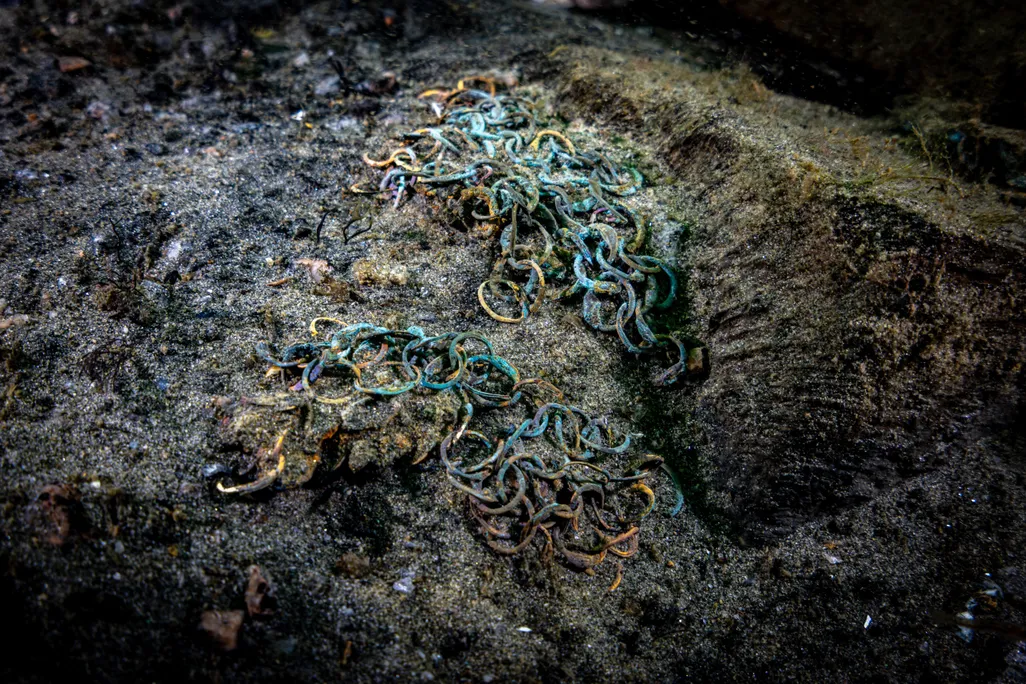
More than five centuries after a royal Danish warship exploded and sank off the coast of Sweden, underwater archaeologists have uncovered finely crafted chain mail armor resting on the Baltic seafloor.
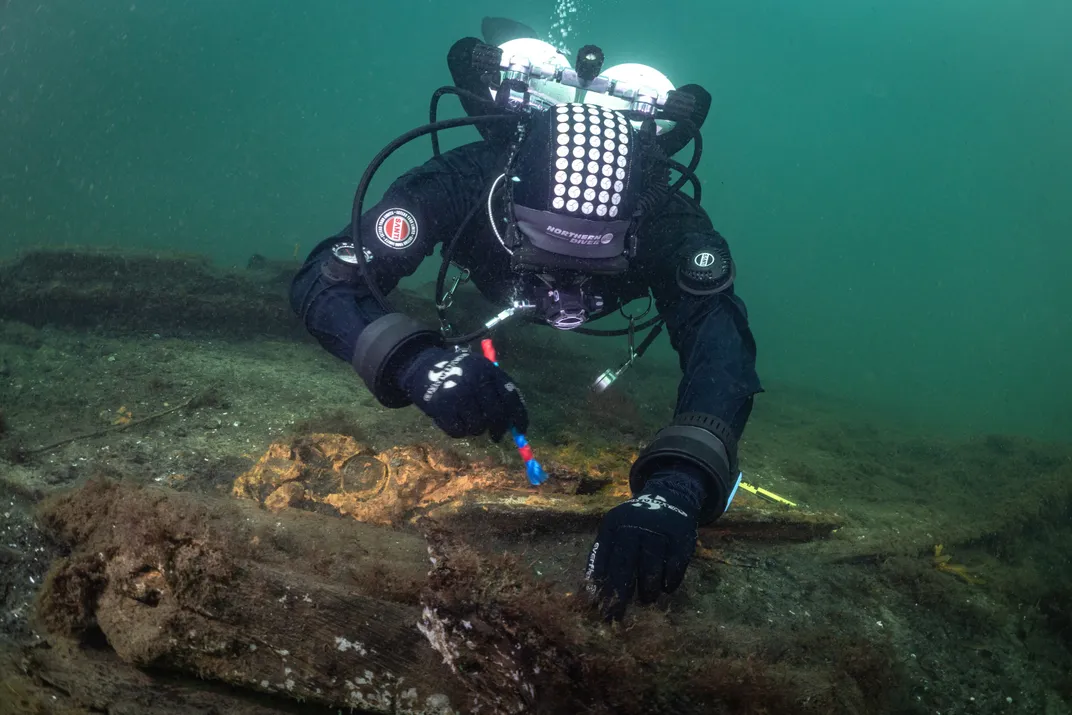
The copper-alloy mail fragments were recovered in October from the wreck of Gribshunden, or Griffin, the 15th-century flagship of King Hans of Denmark and Norway. Researchers discovered the armor alongside a rare munitions chest while surveying the area beneath the vessel’s forecastle, an elevated combat platform at the ship’s bow.
“It was in the process of documenting the chest that I unexpectedly discovered exposed mail-armor fragments in the vicinity of the chest, along other items that could indicate more chests,” Rolf Warming, an archaeologist at Stockholm University who leads the project with Södertörn University’s Johan Rönnby, tells Live Science’s Kristina Killgrove in an email. “It was only by chance that we came across it, and it shows just how much is still on the wreck site.”
To map the newly explored section of the ship, the researchers paired diver-led excavation with high-resolution 3D photogrammetry and an uncrewed robotic survey boat operating on the surface, according to a statement. Together, the armor, the munitions chest and earlier finds of lead objects possibly linked to ammunition molds could point to a dedicated military storage zone.
“Historical sources indicate that German mercenaries, or Landsknechts, were aboard Griffin when it sank in 1495,” Rodrigo Pacheco-Ruiz, a maritime archaeologist at the University of Southampton and co-investigator on the project, says in the statement. “This part of the ship may therefore have been used to stow equipment associated with these soldiers, including their armor, although we’ve yet to establish a precise function for the space.”
When Gribshunden set sail from Copenhagen in the summer of 1495, it led an 18-ship royal fleet bound for a political summit in Kalmar, Sweden, as Smithsonian magazine’s Jo Marchant reported in 2021. Hans, who ruled Denmark and Norway from 1481 to 1513, hoped to quell Swedish rebels and revive the Kalmar Union, which united the three kingdoms. Acting as both a diplomatic showcase and a “floating castle,” Marchant wrote, the flagship carried Danish noblemen, courtiers, a royal astronomer and roughly 150 German mercenary soldiers.
“It was important to demonstrate military prowess, and the German and Swiss mercenaries were the finest you could get at that time,” Warming tells Live Science.
The voyage ended in catastrophe while the ship lay anchored north of the small island of Stora Ekon, near Ronneby in southern Sweden. Gribshunden erupted in flames and sank rapidly. A 16th-century account of Hans’ life suggests its gunpowder stores accidentally ignited, while other hypotheses point to a possible lightning strike. Many aboard perished in the fire or drowned, though Hans survived because he was ashore at the time.
Rediscovered by local divers in 1971 and formally identified in 2013, the Gribshunden has survived in remarkable condition, thanks to the Baltic Sea’s low salinity, which keeps wood-eating shipworms at bay.
Did you know? Shipworms
Shipworms—which are actually a type of saltwater clam—have tormented seafarers for centuries. In fact, they may have weakened the hulls of the ships of the Spanish Armada when it failed in attacking England in 1588, leaving the ships vulnerable to cannonballs and storms.
Measuring nearly 100 feet long and resting in about 30 feet of water, the vessel is a rare surviving example of a late-medieval “caravel”-style ship, constructed with hull planks laid edge to edge over an internal frame so it could carry heavy cargoes and guns. That design placed Gribshunden in the same technological generation as the vessels sailed by Christopher Columbus and Vasco da Gama. Previous dives also yielded a fearsome carved figurehead depicting a monster swallowing a screaming man.
Despite the exceptional craftsmanship of the newly recovered chain mail, its quality does not automatically tie it to an elite knight or king. “This kind of armor could remain in use for extended periods, often undergoing repairs or being reused, so these fragments may represent older military equipment that was still active,” Warming explains in the statement.
Researchers are now conducting chemical analyses on the armor and on samples taken from the munitions chest to determine the chain mail’s origins and the chest’s contents.
It is actually a really fascinating research question of ours that could illuminate supply chains and the military logistics,” Warming tells Live Science. “Did the mercenary forces bring their own ammunition and tool kit aboard, or was this supplied by the royal fleet?”