
Where Exactly Were the First Humans to Be Captured in a Photograph Standing? Three Obsessed Filmmakers Solved the Nearly 200-Year-Old Mystery
The sleuths spent two years digging into archives and building 3D models of 19th-century Paris. The location is now immortalized by a bronze plaque celebrating the historic site and the “poetic” early photograph

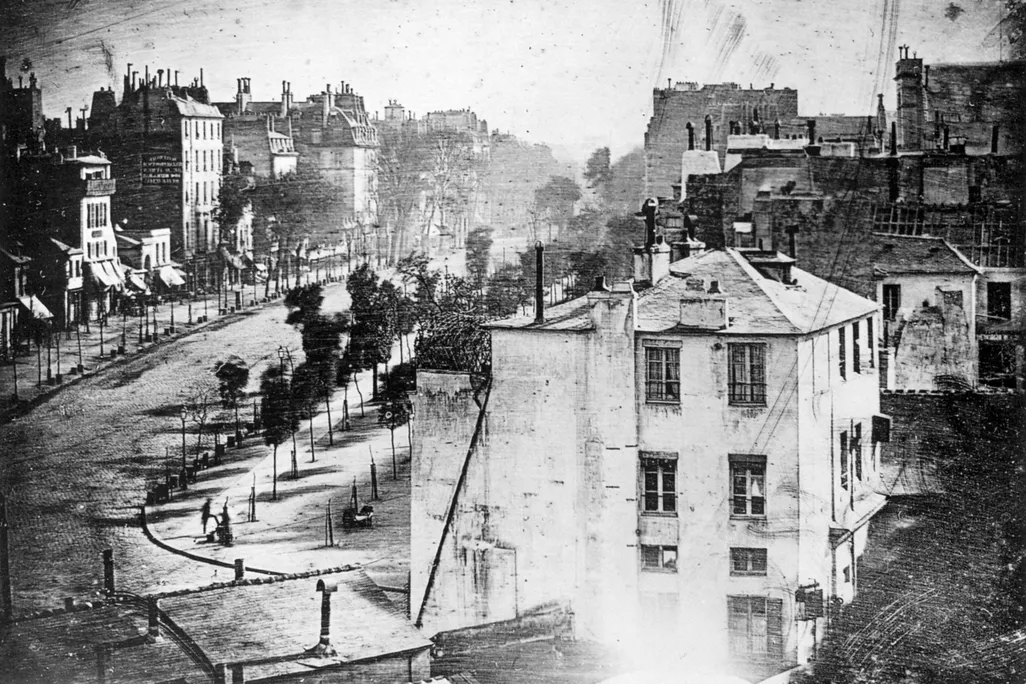
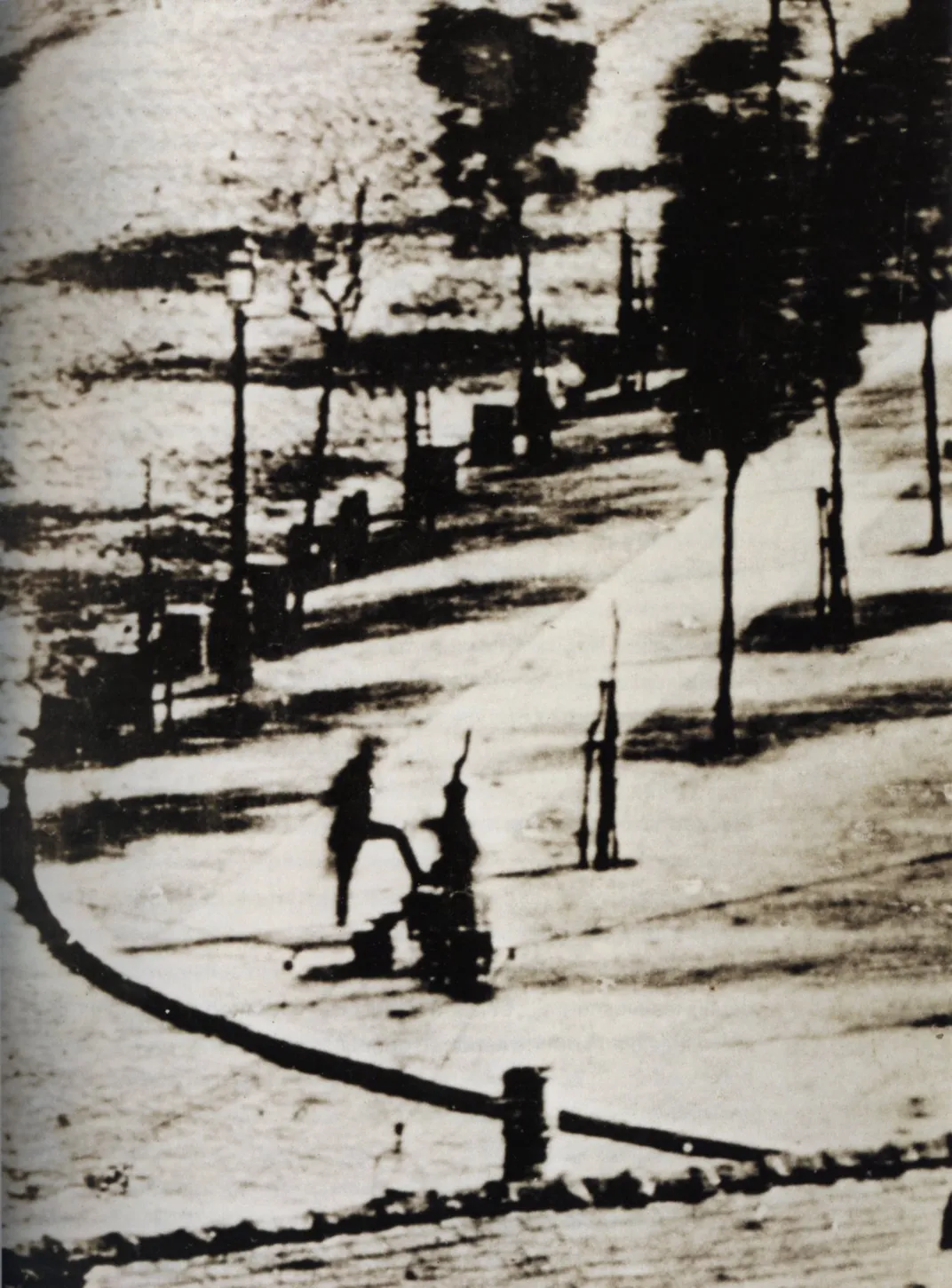
One spring morning in 1838, a man stopped to have his shoes shined on a Paris street. The mundane act, which would have been soon forgotten under normal circumstances, instead made history. The client and the shoeshiner are thought to be the first two human subjects ever captured in a photograph.
The photograph was taken by Louis Daguerre—a painter, printmaker and inventor of the “Daguerreotype” process—from his studio near the Boulevard du Temple. Though the street was a bustling thoroughfare, the photograph shows only these two figures. Why? No one else stood still long enough to be captured by Daguerre’s long-exposure camera, which took up to ten minutes.
Photography has evolved greatly since then, as has the Parisian streetscape. The boulevard was shortened to make way for the Place de la République. As a result, the exact location of the shoeshine stand was lost to history. That is, until some enthusiastic filmmakers started hunting for it in 2024.
“One day, I happened to be with my colleagues in the Place de la République, and we said to ourselves: ‘We’re pretty much where that photo was taken. It would be funny to try and find where exactly the shoeshiner and his client were standing,’” filmmaker Maximilien Van Aertryck tells Radio France’s Éric Chaverou. “We started looking around a bit and we quickly realized that the exact place had never been identified or marked. That’s where the idea for this project came from.”
That task was far from simple. Little remains of the 19th-century street where the photo was taken. Daguerre’s studio and his neighboring diorama theater burned down in 1839, and other buildings were demolished as part of Georges-Eugène Haussmann’s sweeping redesign of Paris.
“It’s so poetic, with those two lonely people on that huge frame,” Van Aertryck tells the New Yorker’s Lauren Collins. Alongside Axel Danielson, Van Aertryck directed Fantastic Machine, a documentary about the human obsession with cameras and images.
Did you know? Early photography
Daguerre built on the work of his late collaborator Nicéphore Niépce, who captured the world’s earliest surviving photograph, a smudgy view that took several days of exposure.
In their two-year search for the exact location of the shoeshine stand, Van Aertryck, Danielson and Kalle Boman combed city and museum archives to recreate the cityscape as it appeared in 1838. They found that three of the buildings from Daguerre’s era were still standing. From there, they commissioned 3D models of the area and hired two architectural firms to help triangulate the exact shoeshine location. One firm came up with one location. The other identified a point just a few feet away.
“We decided to split the difference,” Van Aertryck tells the New Yorker. “A colleague ran out to buy nail polish to mark the spot!”
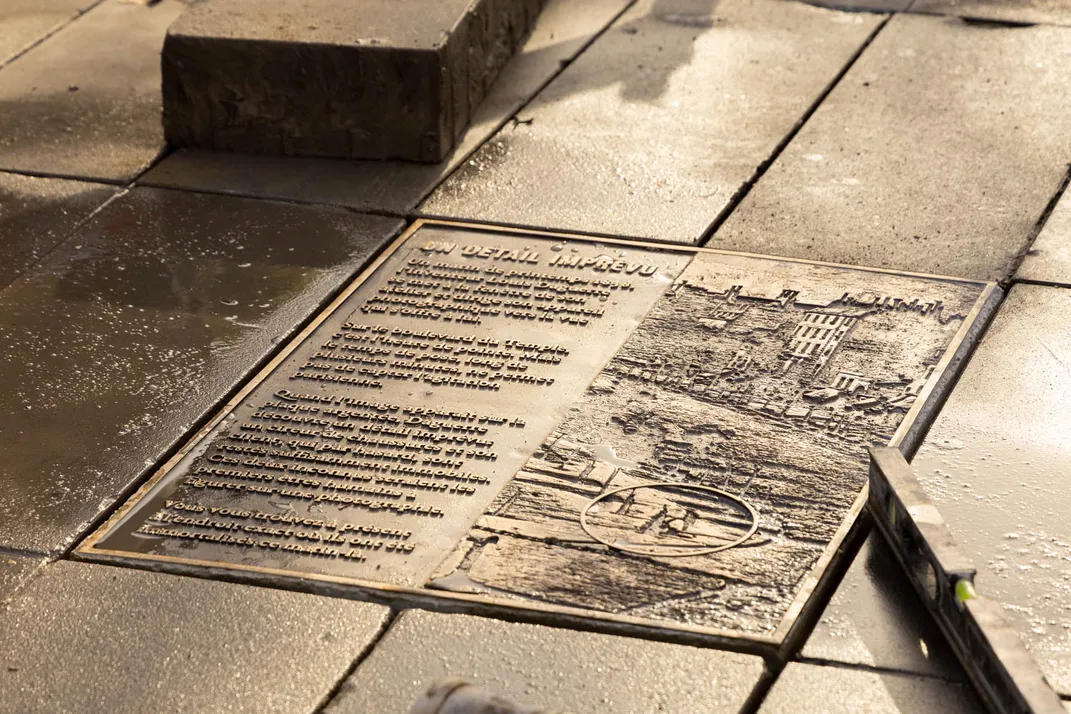
That spot is now home to a bronze commemorative plaque installed by the city of Paris on October 15. It is titled, in French, “Un Détail Imprévu,” or “An Unexpected Detail,” a reference to Daguerre’s accidentally historic depiction of the two dark silhouettes.
“This is the first photo of a social interaction and of labor,” Van Aertryck tells Le Monde’s Martin Fort. “It is magical and poetic.”
Nearly two centuries after the photograph was taken, new generations of pedestrians bustling through the Place de la République will have a chance to pause at this critical site in the history of photography—and maybe take a photo of it themselves.
“For us, this photo is really extremely fascinating because it sort of marks the beginning of a new era,” Van Aertryck tells Radio France. “This photo and this plaque remind us that past generations also experienced technological upheavals, with consequences that had to be understood and managed.”
