
Whalers Didn’t Just Sing Sea Shanties and Seek Adventure. Proof of Laborers’ Grueling Work Is in Their Skeletons, Buried in the Arctic
Remains buried on Svalbard show the brutal toll whaling took on men in the 17th and 18th centuries. Climate change threatens these kinds of archaeological sites across the Arctic
/https://tf-cmsv2-smithsonianmag-media.s3.amazonaws.com/accounts/headshot/SarahKuta.png)
/https://tf-cmsv2-smithsonianmag-media.s3.amazonaws.com/filer_public/60/87/60878321-be88-4c5a-bdab-b192228e13a6/dsc5700.jpg)
Whaling took a brutal toll on laborers in the 17th and 18th centuries, reshaping their bodies so dramatically that the effects can still be seen in their skeletons today.
In a new study published in the journal PLOS One, archaeologists describe the physical ramifications of hunting and processing the giant marine mammals in the High Arctic, grueling work that caused degenerative joint disease, trauma and other health problems.
Scientists investigated the remains of 20 whalers buried on Svalbard, a Norwegian-governed archipelago close to the North Pole. They studied graves at Likneset, also known as “Corpse Point,” a large whaling burial site with hundreds of shallow graves marked with stone cairns.
Whalers performed a variety of labor-intensive tasks, from hauling in live whales to processing their blubber for oil—often while working in cold, wet weather. Archaeologists found ample evidence of that strenuous workload in young men’s skeletons, which showed “advanced wear and degeneration normally associated with much later stages of life,” lead author Lise Loktu, an archaeologist at the Norwegian Institute for Cultural Heritage Research, writes in an email to Live Science’s Kristina Killgrove.
Did you know? The end of whaling?
The International Whaling Commission placed a moratorium on commercial whaling in 1986 that’s still in place today. Though a few countries allow the practice, the now-40-year-old moratorium is widely credited with saving numerous whale species from extinction.
They also found signs of scurvy, which is caused by severe, prolonged vitamin C deficiency. Scurvy was a common problem among seafaring explorers, who did not understand its biological cause, nor that it could be prevented by eating fresh fruit, vegetables and whale skin and blubber. The men were already fatigued and physically worn down from their work, and the disease likely weakened them even further, according to the researchers.
Several of the men had circular indentations in their tooth enamel, which suggests they regularly smoked pipes. This tobacco use likely contributed to their poor health, too.
One of the men showed signs of rickets, a childhood bone disease also caused by dietary deficiencies.
“Taken together, this paints a picture of men who worked under extreme conditions in the Arctic, but who in many cases also appear to have had difficult childhoods before they arrived there,” says study co-author Elin Therese Brødholt, a forensic anthropologist at Oslo University Hospital, in a statement.
Additionally, the study explored how climate change is affecting Likneset, which like other sites across the Arctic, has suffered from coastal erosion and permafrost degradation in recent decades.

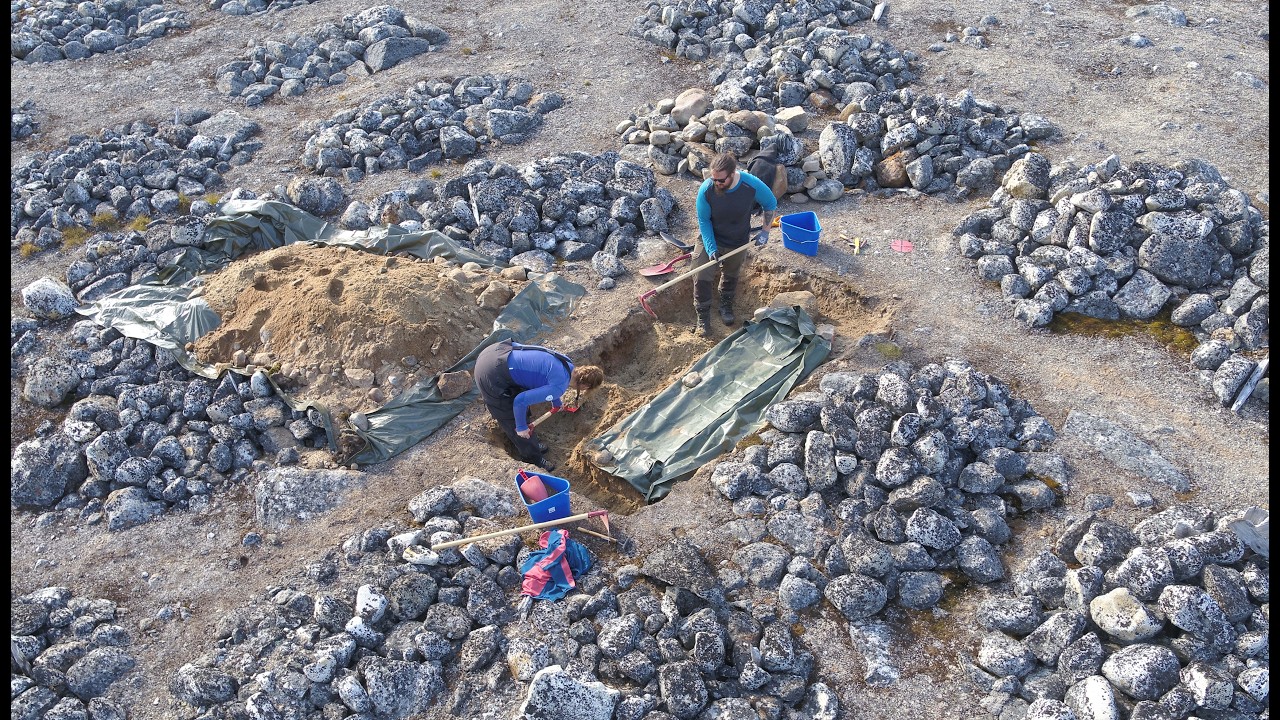
Permafrost refers to soil, sand, sediment and rock that remains at or below freezing temperatures for at least two years. It’s found throughout the Arctic and in some high-elevation regions. But as the Arctic heats up, “that frozen ground is becoming increasingly unstable,” Loktu tells Courthouse News’ Carly Nairn.
That’s bad news for archaeological sites, she adds. “Coffins collapse, stone grave structures shift and burial layers lose their original integrity,” she tells Courthouse News. “In some cases, graves are partially or completely destroyed as sediments erode into the sea.”
/https://tf-cmsv2-smithsonianmag-media.s3.amazonaws.com/filer_public/94/c9/94c9a243-d383-433d-99d9-e982efcf3937/dji_0331-scaled.jpg)
The researchers compared graves at Likneset that had been excavated in the 1980s, in 2016 and in 2019. Though the skeletons were still in fairly good shape, the textiles buried at the site had deteriorated over the decades, the researchers found.
Zooming out, the findings suggest Svalbard’s “managed decay” approach to cultural heritage—letting most sites deteriorate naturally, with minimal intervention—is becoming increasingly risky and may need to be reconsidered.
“As archaeological materials are no longer preserved in permafrost environments as they once were, there is an urgent need to integrate archaeological sites more fully into political and strategic planning frameworks,” the researchers write in the paper. “This integration should be guided by clearly defined knowledge priorities: which information must be documented and analyzed before it is irretrievably lost?”
Beyond causing damage to archaeological sites, scientists are worried about permafrost thaw for other reasons, too, including that it may cause ancient microbes to wake up and start producing greenhouse gases, which would further contribute to global warming, and that it could lead to high concentrations of toxic metals in waterways, harming wildlife.
/https://tf-cmsv2-smithsonianmag-media.s3.amazonaws.com/accounts/headshot/SarahKuta.png)