
Two Green ‘Fireballs’ Streaked Across the West Coast Sky, Some of the Latest in a String of Dazzling Meteors Above the U.S.
Some of the space rocks exploded, causing loud booms, and a piece of one may have crashed into a house
/https://tf-cmsv2-smithsonianmag-media.s3.amazonaws.com/filer_public/fc/6e/fc6e7341-9041-4b78-878b-2becb82e6f0b/ams143_2026_03_23_03_18_00_000_011431-trim-441-hd-meteor-wm-stacked.jpg)
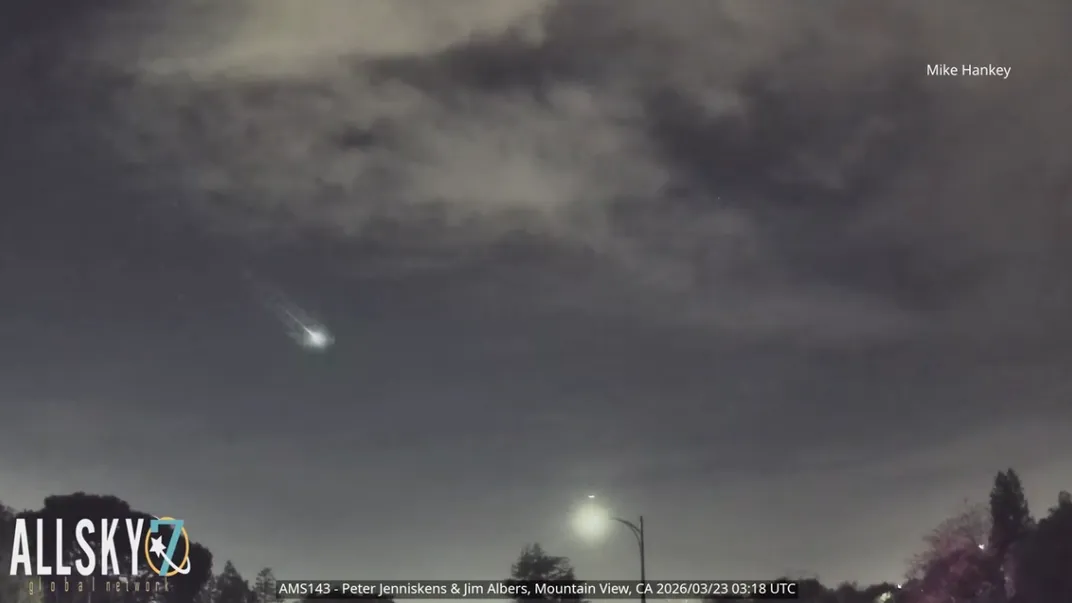
On March 22, hundreds of people saw a green meteor flash across the night sky above central California around 8:19 p.m., according to NASA. Early the next morning, around 6:07 a.m., residents in the Pacific Northwest witnessed another one flying above southern Oregon, per the agency.
“It was bright, it was green, it was spectacular,” says Jim Todd, director of space science education at the Oregon Museum of Science and Industry, to the Associated Press’ Claire Rush, describing the second event. “One tiny little piece of rock put on such a show.”
The sightings mark two of at least five “fireballs”—ultrabright meteors that outshine Venus—reported zooming above the United States in a week. Another one zipped across Ohio skies on the night of March 23. It followed a daytime meteor in the area on March 17, which broke apart above the state, startling residents and shaking houses with a resounding boom. And on March 21, a meteor exploded above the Houston area. A suspected piece of it, a rock roughly the size of a golf ball and unusually heavy, crashed through the roof of a home.


Despite the clustered timing, the events are probably unrelated, Mike Hankey, operations manager for the American Meteor Society, tells ABC10 in Sacramento. “Typically, they would be considered random events.” NASA also noted that the California meteor, at least, “does not appear to be related to other recent bright meteors,” per a social media post.
Fireball meteor activity tends to increase in February, according to tracking data collected over several years, Hankey says to ABC10, although researchers don’t know why.
Meteors, sometimes called “shooting stars,” are space rocks that enter the Earth’s atmosphere and start glowing because they’re burning up. “As a meteor travels through the atmosphere at high speeds, it creates friction, which heats the meteor and causes it to vaporize,” Todd tells KATU’s Bobby Corser.
Researchers estimate that around 48.5 tons of the stuff plummets toward the planet each day, but most of it turns into fine dust before hitting the ground. The few space rocks that do partially survive the hot, intense journey—around five to ten percent—end up as meteorites, which are typically between the size of a pebble and a fist.
The meteors above California and Oregon were likely green because of certain elements within them, reports the AP. When heated, magnesium produces blue-green light, and nickel can also emit green. Eyewitnesses of the California fireball noted that it changed colors—looking blue, green, red and orange—as it moved through the sky, per the San Luis Obispo Tribune’s Kaytlyn Leslie.
The space rocks that become meteors are usually too tiny to detect before they enter the atmosphere. The one that exploded above Ohio on March 17, for instance, originated from what was considered a small asteroid at about six feet wide and seven tons.
“Only three times in history has NASA tracked an object all the way to Earth,” Ralph Harvey, a planetary scientist at Case Western Reserve University, told the Akron Beacon Journal’s Anthony Thompson after that event. “This meteor was much smaller, so it was nearly impossible to see with a telescope” ahead of time.
Quick fact: How many recent fireballs?
The American Meteor Society has received reports of at least eight ultrabright meteors soaring through the skies above the United States and Europe since early March, reports AccuWeather’s Emilee Speck.
Jason Jenkins, who captured the Oregon fireball on his car’s dashboard camera while driving to work, tells the AP that the flash reminded him of a lightning strike. It was “cool to catch something like that,” he says.
“I won’t go without a dashcam ever again,” Jenkins adds. “I need to go buy a lottery ticket now.”