
/https://tf-cmsv2-smithsonianmag-media.s3.amazonaws.com/filer_public/74/0d/740db6c4-aa8f-45ee-af23-31a14fa97b6d/diary.jpg)
This Soldier Kept a Diary in the Trenches of World War I. A Child Found It at the Dump Decades Later, Pierced by a Bullet and Stained With Blood
Corporal Claude Nuttall recorded his wartime experiences in the diary. Now, after decades of research, a museum curator is telling the soldier’s story in a new book
/https://tf-cmsv2-smithsonianmag-media.s3.amazonaws.com/accounts/headshot/Ellen_Wexler.png)
:focal(750x500:751x501)/https://tf-cmsv2-smithsonianmag-media.s3.amazonaws.com/filer_public/74/0d/740db6c4-aa8f-45ee-af23-31a14fa97b6d/diary.jpg)
The day the boy found the diary, he’d been scrounging for treasures at the local dump in Stourbridge, England. He and his friends had entered through a small opening at the bottom of a wire fence. Then they spotted something among the bottles and cans: a nearly four-inch-long volume with a green cover, its pages turning in the wind.
The year was 1965, but the diary entries dated to 1918. Their author was a man named Corporal Claude Nuttall, who had served as an infantryman (or “Digger”) in the Australian Army during World War I. He met his wife, Violet Palfreyman, while recovering from an injury in an English hospital. Weeks after the wedding, he returned to the front.
Did Nuttall ever make it home? The boy wondered about the soldier’s fate, and the diary offered several ominous clues. The corner appeared to have been pierced by a bullet, and its pages were stained with blood. Nuttall’s last entry was dated August 10, 1918. The pages that followed were blank.
“Heavy bombardment by our guns. Push still in progress,” he wrote. “Packed up ready to move forward again. Prisoners still coming back. Wrote to Violet.”
The diary eventually made its way to Colin Reid, a former curator at the Dudley Museum and Art Gallery in England’s West Midlands, who spent decades researching the soldier’s story. The culmination of his efforts is the book The Digger’s Diary, which comes out this fall.
/https://tf-cmsv2-smithsonianmag-media.s3.amazonaws.com/filer_public/ae/d5/aed51f95-8dcd-4d86-b252-e080c69c8689/wedding-diary-entry.jpg)
“At the start, I wanted to solve the mystery of Claude’s fate,” Reid tells Smithsonian magazine. “An emotional compulsion, I suppose. The fact that his diary was unfinished, bloodstained and had been punctured by a bullet compelled me to find out if he had survived and returned back to Violet.”
The story of the diary’s discovery begins with the Stourbridge dump. The boy who found the volume was 12-year-old Alan Southall, who held onto it for three decades. In 1996, he showed up at the Dudley Museum asking for Reid, who was then working on a World War I exhibition. Southall pulled out the diary, which he’d carefully tucked inside a plastic bag, and asked whether the curator wanted to put it on display.
But Southall had other questions, too. In The Digger’s Diary, the curator recalls what his visitor told him: “For 30 years, I’ve wanted to know Corporal Nuttall’s fate. But I have never done anything about it, because I don’t think things ended well for him.”
The diary went on view in the museum’s exhibition, titled “The Great War.” But when the show closed, Reid kept thinking about the little book with the green cover. About a decade later, he decided to write a book of his own. The curator tracked down Southall, who let him borrow the diary.
Reid got to work, searching for any information he could find about the Australian soldier. “The more I learned, the more I wanted to learn,” he tells BBC News’ Aida Fofana and Sarah Julian. “Right from the very first moment that I held the diary, I had that real sense of connection with it. I was really hooked.”
Quick facts: Australia in the Great War
- On August 4, 1914, Australia entered World War I—the deadliest conflict in the country’s history.
- According to the Australian War Memorial, the country’s population was fewer than five million at the time, and the death toll was more than 60,000.
Born in 1895, Nuttall enlisted in the Australian Army’s 23rd Battalion in 1915, just after his 20th birthday. He traveled to the Western Front, where he fought the Germans. In his diary, he’d written that he’d been awarded a medal from George V; Reid had always wanted to know more about the courageous act that merited this reward. He found the answer in Nuttall’s military records: On his 21st birthday, in July 1916, the soldier had helped rescue injured soldiers from no man’s land, the perilous stretch of earth between opposing trenches.
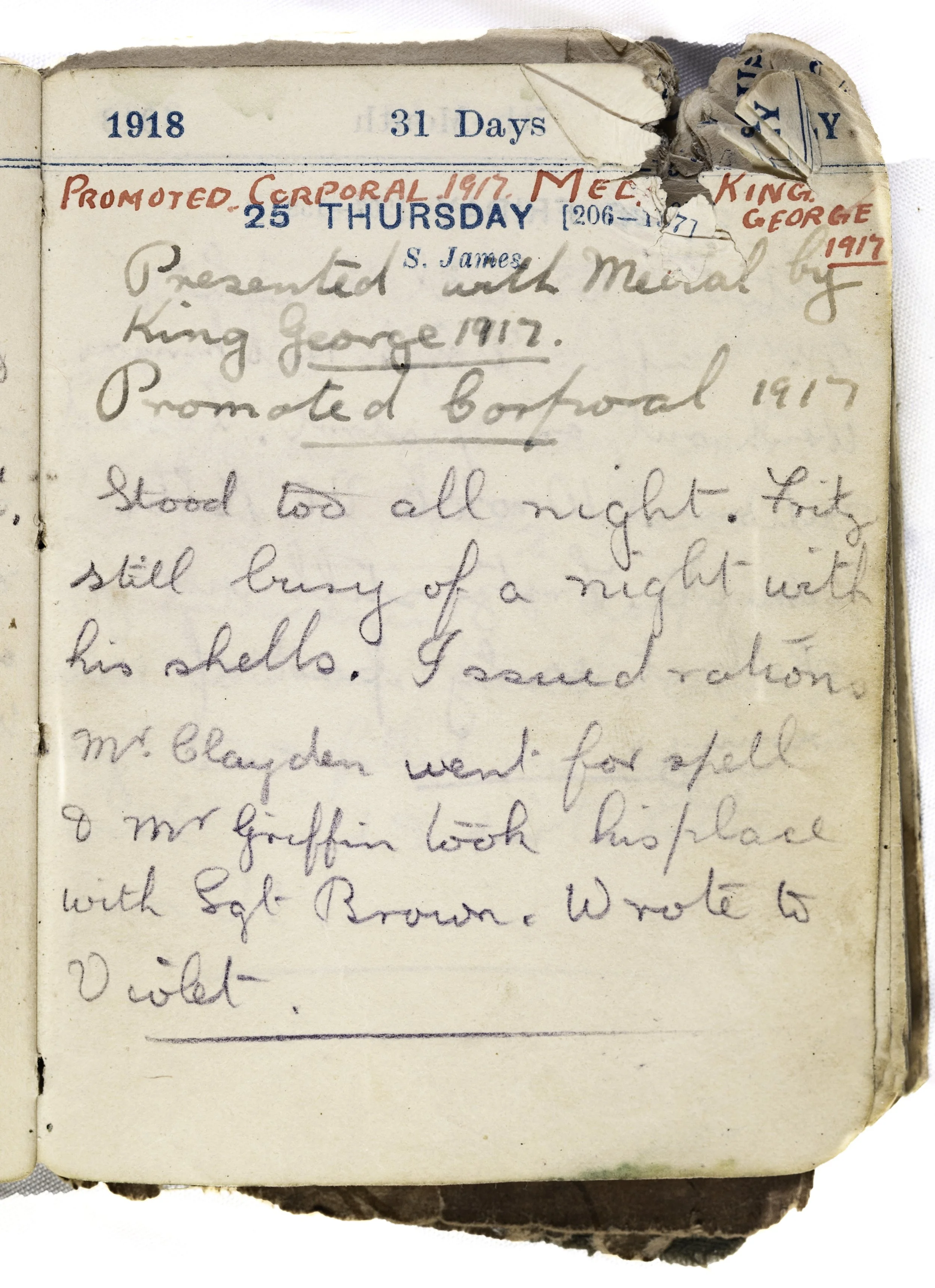
Later that year, Nuttall was wounded in northern France. He was sent to a hospital in Stourbridge, where he met Palfreyman. The couple tied the knot in March 1918. “All excited,” the corporal wrote in his journal. “Married 12:30 p.m. All went well.” Five weeks later, he shipped out again. His service records show that he died on August 13, 1918, just three days after his final diary entry.
Thanks to Palfreyman’s relatives, Reid tracked down photos from the couple’s wedding. He also traveled to Cheltenham, the Australian suburb where the soldier grew up, to meet Nuttall’s family, as well as the French battlefields where Nuttall had fought and died.
/https://tf-cmsv2-smithsonianmag-media.s3.amazonaws.com/filer_public/0f/6c/0f6c95d5-8966-413e-9a67-2999685357af/wedding-photo.jpg)
/https://tf-cmsv2-smithsonianmag-media.s3.amazonaws.com/filer_public/76/97/76975e02-44a9-47fc-8a4d-7d3f1d740130/claude.jpg)
In 2018, Reid and Southall met up with Arthur Thomas, the corporal’s nephew, to visit Nuttall’s grave in Harbonnieres, France. Together, they commemorated the 100th anniversary of his death. A few months later, the diary was returned to Nuttall’s family at a ceremony in Cheltenham.
“I keep saying that the saddest part is that my mother, her two sisters and even Claude’s own mother know nothing of this. I can’t tell them what’s happened,” Thomas told the Dudley News’ Kelly Harris in 2018. “I have seen pictures of Claude’s wedding and Violet’s family that they would never have seen.”
/https://tf-cmsv2-smithsonianmag-media.s3.amazonaws.com/filer_public/6f/5c/6f5c5aab-d31b-4437-aba1-cda207d692a6/last-diary-entry.jpg)
But what about the bloodstains? Was the bullet that struck the diary fatal? “I’m afraid that I can’t reveal that to you,” Reid tells Smithsonian. “It’s a huge spoiler, and the emotional climax of the book—definitely embargoed.”
He can, however, reveal Palfreyman’s fate, which was equally tragic. After Nuttall’s death, she married the owner of a carpet shop. The couple had a son named Eric and a baby girl who died soon after she was born. Palfreyman herself died from childbirth complications a few months later. “She and the child are buried together at Holy Trinity Church in Stourbridge,” Reid says, “barely 100 yards from the altar where she and Claude were married.”
The Digger’s Diary, as the author writes in the preface, is a “tribute to the man I discovered: a forgotten hero, a soldier of quiet fortitude and extraordinary courage.” But it’s also a tribute to the woman Nuttall fell in love with—and to Reid’s own wife, who shares her name. The book begins with a dedication page, which reads simply “For Violet.”
/https://tf-cmsv2-smithsonianmag-media.s3.amazonaws.com/accounts/headshot/Ellen_Wexler.png)