
This Mysterious Medieval Manuscript Has Stumped Scholars for Well Over a Century. Could Its Pages Have Been Bound Out of Order This Whole Time?
A new study claims that the pages of the Voynich Manuscript, thought to be written by several different scribes in 16th-century Europe, alternate irregularly. It may change the way codebreakers approach the text

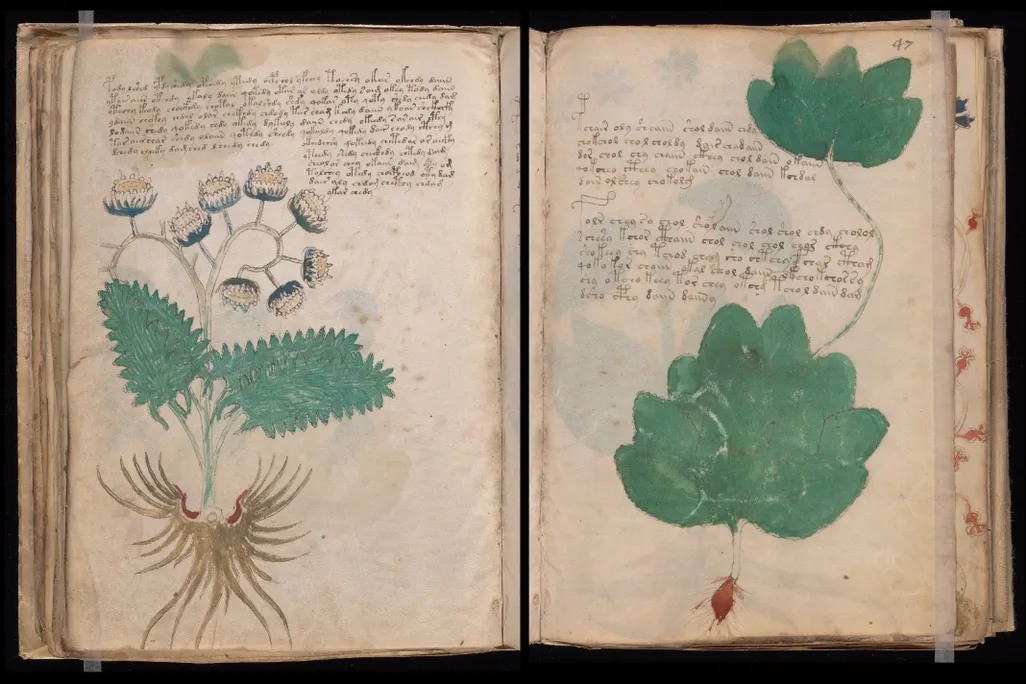
The Voynich Manuscript has been baffling researchers for over a century. Housed at Yale University’s Beinecke Rare Book and Manuscript Library, it is, on its surface, a handwritten and illustrated manuscript likely from 16th-century Europe. But no one (including artificial intelligence) has successfully deciphered its script, a language or code so unique that it has been dubbed “Voynichese.”
As it turns out, there might be another reason why experts are unable to make sense of the Voynich Manuscript. According to a study recently published in the journal Digital Medievalist, there is “strong evidence” that the manuscript’s pages are incorrectly bound.
While the manuscript is currently bound as a quire—several pages folded and sewn together to form a booklet—the study suggests it was originally designed as “a collection of individual bifolia,” or sheets folded in half to form two pages and stacked up and “meant to be read in sequence.”
“This means that any research that relies on the current sequence of pages needs to be revisited, since the manuscript is out of order,” study co-author Lisa Fagin Davis, the executive director of the Medieval Academy of America, tells Gizmodo’s Gayoung Lee.
The Voynich Manuscript is named for Polish-American bookseller Wilfrid Voynich, who purchased the text from a Jesuit college in Italy in 1912. It was bequeathed and sold a few times before ending up at Yale in 1969.
The book’s pages are made of vellum, or calf skin, which has been carbon dated to the early 1400s; its earliest recorded owner lived in Germany in the late 1500s. The manuscript’s 240 pages are filled with colorful illustrations and lines of carefully inked, repetitive letters with a passing resemblance to modern Western alphabets.
“It could be a code, a lost language, nonsense or something else entirely,” Davis tells Gizmodo. “The illustrations are equally bizarre, with fantastical plants, astronomical and zodiacal diagrams, bathing women and other illustrations that are not interpretable yet.”
Davis has studied the Voynich Manuscript before. In 2020, she concluded that five different scribes created the text. The differences between these scribes’ writing styles was key to the recent study, co-authored by Colin Layfield, an information scientist at the University of Malta.
Building on a paper from May, Davis and Layfield applied latent semantic analysis, a technique that can compare "any two pieces of text and derive a similarity score based on the words that are present and how related they are to one another and how they are used in general,” per the study.
Looks for patterns and similarities among the text’s symbols, they found that the pages of the manuscript alternate illogically in penmanship. One page will be written by one scribe, the next page by another, and so on. It doesn’t match the normal medieval manuscript creation process.
“Typically a single scribe writes in a quire ‘booklet,’ but the current binding has different scribes in the same quire, which, to be blunt, is simply not [how it is] done,” Layfield tells Gizmodo.
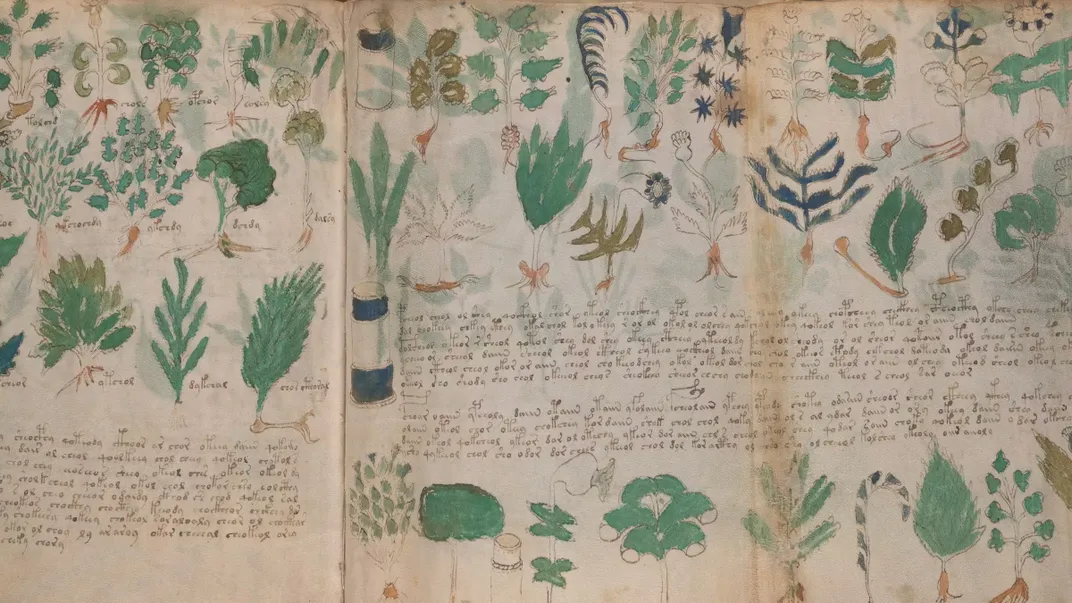
There were other oddities, too, such as a large water stain on the top of the book that doesn’t appear symmetrically on concurrent pages, Davis tells Live Science’s Kristina Killgrove.
Also, she adds, “there are several examples where the image goes off the page in the middle and comes out on the other side, even though there are a bunch of pages in between.”
It all suggests that the Voynich Manuscript was supposed to be “a collection of individual bifolia meant to be read in sequence,” per the study. At some point, those bifolia were incorrectly nested together.
Did you know? Out of order
Cain’s Jawbone is a 100-page murder mystery puzzle published in 1934. The catch? All its pages are out of order. Officially, only four people have solved it.
“Once you treat them as loose pages stacked together, all these artistic anomalies suddenly join up,” Layfield tells the Guardian’s Philip Oltermann.
There are still a lot of unknowns surrounding the Voynich Manuscript. The letters, or symbols, remain undeciphered. Experts have theorized that scribes purposefully encoded the text to keep it secret, or that they were attempting to put a written script to a mysterious language that was only ever spoken. Others believe the whole book is a hoax, written in gibberish by a medieval con man to dupe collectors.
“I think it’s likely we are looking … at an object that was made by a community that wanted to pass its knowledge forward,” Davis tells the Guardian. She says that some of the manuscript’s illustrations suggest its content relates to female sexuality and reproduction, as previous studies have suggested.
The new research may give experts a new edge in their efforts to decipher the vexing manuscript, whose very existence may be owed to the person who incorrectly compiled it.
“So few manuscripts have survived from the Middle Ages, because they weren’t bound,” Davis tells the Guardian. “The irony is that whoever misbound this manuscript still did us a huge favor by ensuring its survival.”
