
The World’s Tallest Trees Seem to Struggle to Make Their Own Food During Heat Waves, Leaving Them Vulnerable as the World Warms
Coast redwoods, which grow only from central California to southern Oregon, slow photosynthesis when temperatures ramp up, according to a new study. Scientists worry about the towering plants’ future amid climate change

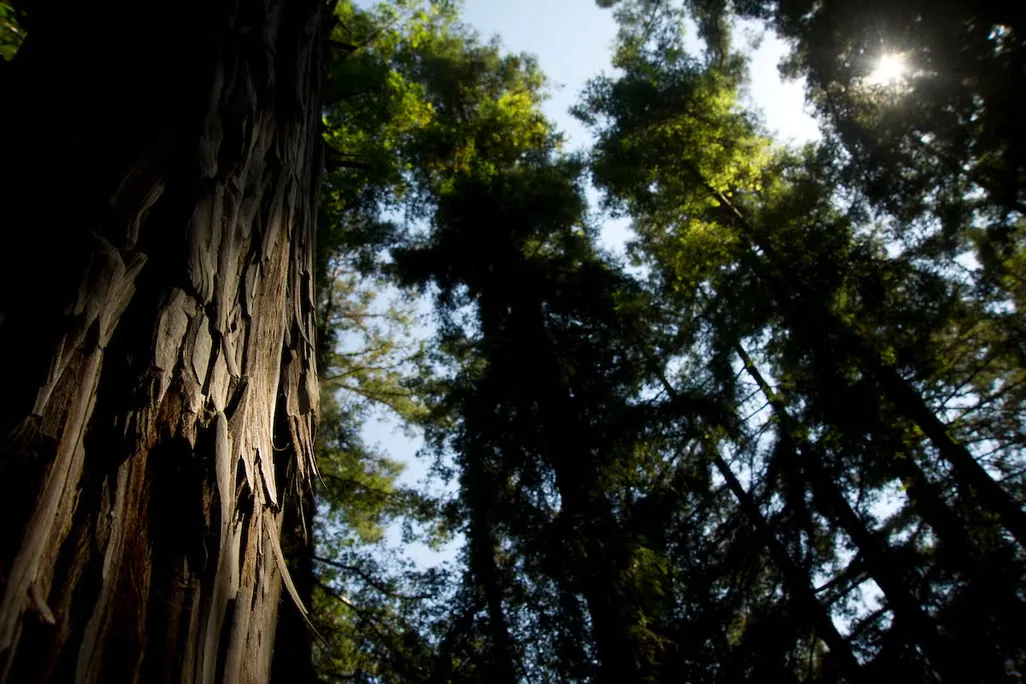
Coast redwoods are iconic giants of the Pacific Coast, found only in a narrow band of land stretching from central California to southern Oregon. These towering trees—the tallest in the world—are adapted to the region’s relatively cool, moist climate, particularly the thick summer fog that blankets their canopies during the dry season. But in recent years, the area has been getting hotter, and the fog has been dwindling, raising questions about how these ancient trees will fare in a warming world.
Now, scientists say they have an answer. A study published September 22 in the Journal of Geophysical Research: Biogeosciences finds that coast redwoods slow photosynthesis when temperatures spike, a discovery that suggests climate change could be threatening the trees’ long-term health and survival.
Through photosynthesis, plants convert sunlight, water and carbon dioxide into oxygen and sugars, which provide the energy and building blocks they need to grow. As trees build trunks, branches, roots and leaves, they store some of that carbon in their tissues. Because of their large size, thick bark and long life spans, coast redwoods act as massive carbon sinks, keeping it out of the atmosphere for decades or even centuries.
To better understand how rising temperatures might be affecting these processes in coast redwoods, researchers studied trees growing in Garcia River Forest in Mendocino County, California, near the southern part of the species’ range. Once or twice a month from July 2022 through October 2024—a span that included two heat waves—they took measurements for individual leaves, colloquially called needles.
Their analyses revealed that, during bouts of extreme heat, the needles were up to 18 degrees Fahrenheit hotter than the surrounding air. “That’s a huge difference and indicates that the leaves are stressed to the point where they can’t thermoregulate effectively,” lead author Lily Klinek, an ecologist at the University of California, Davis, tells Live Science’s Sarah Wild.
Based on the temperature difference, the team suspects that the leaves’ stomata—small, pore-like openings that help release heat via water vapor—were at least partially closed to help the tree retain moisture. But stomata also play an important role in photosynthesis, taking in the carbon dioxide needed for the process, so the results also suggest that the higher temperatures could be hampering photosynthesis.
Did you know? The world’s tallest living tree
The world’s tallest living tree is a roughly 380-foot-tall coast redwood named Hyperion, located in California’s Redwood National Park. Discovered in 2006, Hyperion has been officially off-limits to visitors since 2022 because tourists kept veering off established trails and damaging the delicate forest ecosystem. The towering plant is estimated to be about 600 years old.
To measure the impact of heat on photosynthesis more directly, Klinek and colleagues collected samples from the lower canopies of younger coast redwoods, whose branches are easier to reach than those of massive old-growth trees. Back in the laboratory, the team submerged the leaves in water and exposed them to a range of temperatures between 72 degrees and 110 degrees. Though their stomata were open and they had access to all the necessary ingredients for photosynthesis, their photosynthesis rates declined as temperatures increased.
This suggests that high temperatures might be directly affecting the trees’ ability to photosynthesize, rather than indirectly by prompting them to close their stomata and reduce their carbon dioxide uptake.
The findings indicate that coast redwoods are “really temperature sensitive,” Christopher Still, an ecophysiologist at Oregon State University who was not involved with the study, tells Science News’ Allie Skalnik. “You don’t see this as much with other species necessarily.”
Taken together, the study suggests that rising temperatures spurred by climate change could diminish coast redwoods’ ability to photosynthesize and store carbon. But it remains unclear whether the effects are temporary, or whether heat waves cause lasting damage. The researchers also say they haven’t discovered the point of no return—how hot it would have to get, and for how long, for that damage to become irreversible.
“Right now, the temperatures are coming back to normal in the fall and winter and letting the trees recover,” Klinek tells Vox’s Neel Dhanesha. “But in five or ten years, if temperatures are even hotter and heat waves are even more frequent, we don’t really know if there would be a recovery.”
