
The U.S. Has Lost Its Measles Elimination Status, Which It’s Held for 26 Years. Cases Have Now Surged to the Highest Levels in Decades
So far this year, the Centers for Disease Control and Prevention has confirmed more than 5,400 measles cases—the highest annual total since 1991—and 43 outbreaks. Dropping vaccination rates are likely to blame

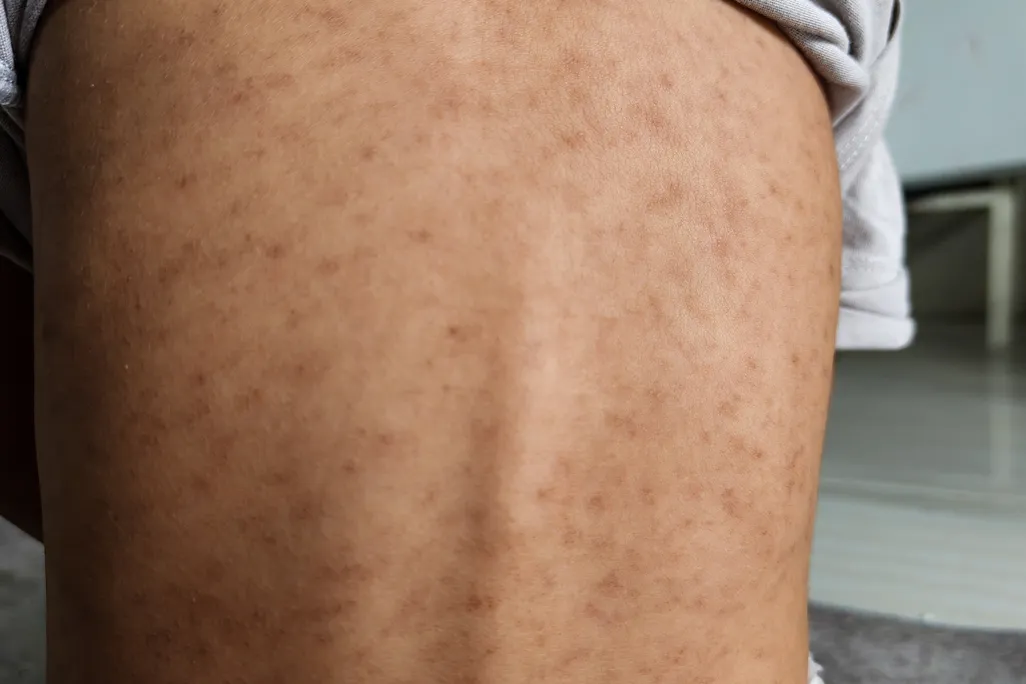
The United States has lost its measles elimination status as cases surge to the highest levels in decades.
The Pan American Health Organization (PAHO), an international public health agency for the Americas, has concluded that the U.S. no longer meets the criteria for measles elimination, according to the Wall Street Journal’s Liz Essley Whyte and Jennifer Calfas.
“Measles elimination is a vital sign for our public health system,” Demetre Daskalakis, a former director of the National Center for Immunization and Respiratory Diseases at the Centers for Disease Control and Prevention (CDC), tells CNN’s Brenda Goodman. “It shows cracks in our foundation. Losing elimination status means that we are less prepared as a nation to address infectious and noninfectious disease challenges.”
Measles was declared eliminated in the U.S. in 2000, meaning there had been no continuous spread of the disease for more than 12 months. However, in recent years, the highly contagious viral disease has made a comeback.
So far this year, the CDC has confirmed more than 5,400 measles cases—the highest annual total since 1991—and 43 outbreaks. According to CDC data, 96 percent of those cases involved individuals who were not vaccinated or whose vaccination status was unknown. At least ten individuals have died from the disease this year, with deaths occurring in Pennsylvania, New York and Wisconsin.
“Runaway measles outbreaks in the United States, as well as the needless deaths, are all due to low measles vaccination coverage,” Noel Brewer, a public health researcher at the University of North Carolina at Chapel Hill and chair of a committee that reports on U.S. measles activity to the PAHO, tells the Wall Street Journal. “We’ve gotten comfortable letting children be stopped by a deadly disease and die from it.”
Measles is a highly contagious viral disease that spreads through the air when an infected person coughs, sneezes or breathes. It typically causes a high fever, cough, runny nose and distinctive rash, but it can also lead to serious complications, including pneumonia, blindness, brain swelling and, in some cases, death. The first measles vaccine was authorized for public use in 1963.
The CDC recommends children receive two doses of the measles, mumps, rubella (MMR) vaccine, which is 97 percent effective at thwarting measles. At least 95 percent of the population needs to be vaccinated to prevent the disease from spreading. However, vaccination rates have fallen in recent years. During the 2025-2026 school year, 92.4 percent of kindergartners had received the MMR vaccine, down from 95.2 percent in 2019-2020, according to CDC data.
Quick fact: Changes to childhood vaccine schedule
In January, the CDC overhauled the U.S.’s childhood immunization schedule, reducing the number of diseases it recommends that all American children should be vaccinated against to 11, down from 17 a month earlier. The MMR vaccine was still suggested for all kids.
“It’s a very sad moment,” Anne Schuchat, an epidemiologist and a former deputy director of the CDC, tells KFF Health News’ Amy Maxmen. “Measles causes so much unnecessary suffering, everything from a high fever and missed work and school to long-term complications like progressive degenerative nerve disease and death.”
As viruses spread and replicate, small genetic differences accumulate, creating subtle variations in their genetic makeup. By comparing the genetic sequences of viruses collected during an outbreak, researchers can trace the relationships between different outbreaks and assess whether they likely stemmed from the same chain of transmission.
According to Nextstrain, a public database that tracks pathogen evolution, an outbreak that started in Texas in 2025 spread to Utah and Arizona, where the virus continued circulating for more than a year.
“There’s a general pattern of outbreaks seeding other outbreaks,” J.T. McCrone, an evolutionary biologist at the Fred Hutchinson Cancer Center who helps oversee Nextstrain, tells the New York Times’ Apoorva Mandavilli. “Measles is very contagious; it spreads very easily. We have a lot of connected communities in the U.S., and so you can hop from population to population and maintain a transmission chain.”
Measles has re-emerged as a public health challenge around the world. Canada lost its measles-elimination status in November 2025, followed by the United Kingdom in January 2026. Spain, Austria, Armenia, Azerbaijan and Uzbekistan also lost their status.
To regain its measles elimination designation, the U.S. must stop the continuous spread of the disease for at least 12 months. Doing so will require “stronger surveillance, speedy outbreak response and increased vaccination rates,” writes Katrine L. Wallace, an epidemiologist at the University of Illinois Chicago, for the Conversation.
Other countries have successfully regained their measles-free status, such as Brazil, which recovered the designation in 2024 after losing it in 2019.
Erica Schwartz, director of the CDC, told Reuters’ Yasmeen Abutaleb last week that the CDC would not alter its measles response if the U.S. lost its elimination status.
“We’re going to be doing the same exact thing that we’ve been doing today, which is working with the states,” Schwartz said. The CDC will make sure “we are leaning in to help them provide awareness about measles, emphasizing, re-emphasizing that the number one way to prevent measles is the MMR vaccine.”
