
The Tip of This Snake’s Tail Looks Like a Spider. But Inside, Its Bones Are ‘Bizarrely Normal’
High-tech scans reveal the first detailed look at the internal anatomy of the spider-tailed horned viper. The findings shed light on little-known snake vertebrae and highlight the difficulty of predicting what an animal looks like from its skeleton
/https://tf-cmsv2-smithsonianmag-media.s3.amazonaws.com/filer_public/b1/6a/b16a91bf-2945-4bf1-be26-b0f0039c530a/0274.jpeg)
The spider-tailed horned viper has a special trick to lure birds—at the tip of its tail, elongated scales form a bulbous lobe and sprout outward like spindly legs. As the snake lies in wait, it wiggles this strange-looking appendage on the ground in a way that resembles the motion of an arachnid. If the reptile is lucky, a bird might come investigate the makeshift spider, and that’s when the predator goes in for the kill.
This strange tail “is unlike any other studied [in] vipers and actually seems to be unique among all living reptiles,” Georgios Georgalis, a paleontologist at the Polish Academy of Sciences, tells Smithsonian magazine. “It represents a perfect ‘tool’ for successfully luring birds.”
But by looking at the viper’s skeleton alone, you would have no idea that it uses such a standout hunting strategy. Despite the strange external appearance of the tail, the animal’s underlying bones, Georgalis and others reveal in a new study, are “bizarrely normal,” per a statement from the Field Museum.

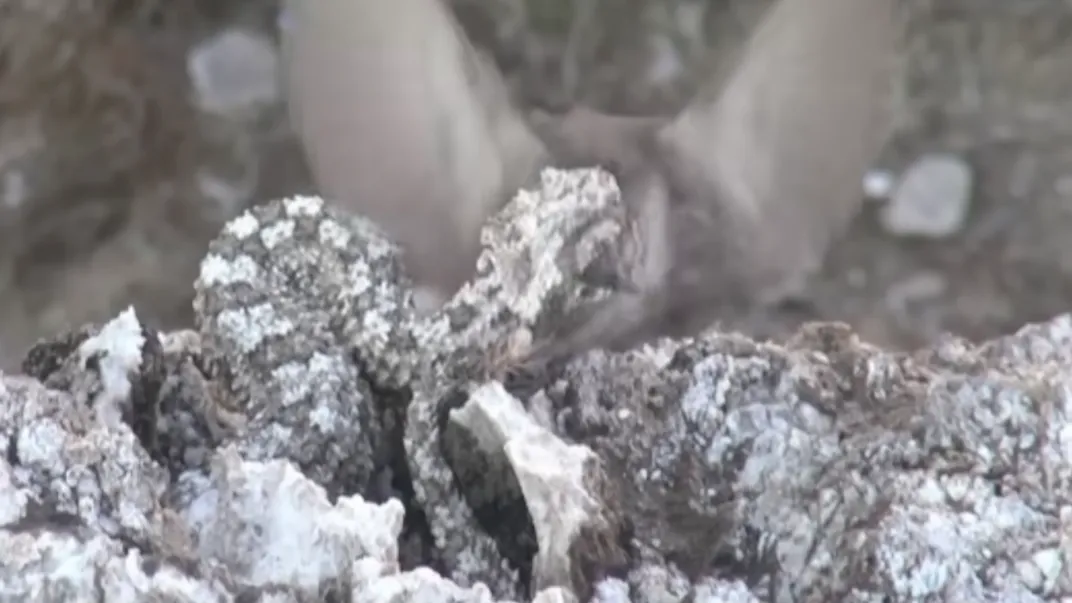
The new work, which created 3D images of the snake’s skeleton, was published today in The Anatomical Record and offers the first detailed look at the vertebrae of the spider-tailed horned viper (Pseudocerastes urarachnoides).
Well-known for their venom, vipers are among the world’s most iconic snakes, but scientists have not deeply examined their vertebral anatomy. In the few viper species with their spinal columns mapped out, the work has typically been limited to a few bones.
“Snakes, broadly speaking, display an incredible diversity of vertebral structures that are poorly studied and typically overlooked in herpetology,” Tiago Simões, an evolutionary biologist at Princeton University who was not involved with the study, tells Smithsonian. The function of some of these structures, which may be unique to certain species, he adds, “deserves much greater attention.”
Endemic to Iran, the spider-tailed horned viper is “one of the most fascinating viper species in the world,” Georgalis says. Its tail offered an especially interesting opportunity to study a snake’s skeleton more closely. He wanted to know: Did the extreme structure outside the tail show up in the vertebrae?
“The appendage at the end of its tail is so outrageous,” study co-author Sara Ruane, associate curator of herpetology at the Field Museum, says in the statement. When the museum’s scientists collected the first specimen of the viper in 1968, they “thought that it had some sort of deformity,” she adds, “like a tumor.”
It wasn’t until 2003 that researchers discovered another snake of the species with similar tail anatomy. Scientists formally described the viper three years later, and subsequent research revealed how the creature hunted using the tip of its tail.
Other snakes hunt with this strategy, known as caudal luring, but their tails look a little more standard—they might be a distinct color from the rest of the body, for instance, without the elaborate appendages seen in the spider-tailed horned viper.
Fun fact: Tail motion in snakes
While some snakes use tail movement to lure in potential prey, these motions might also serve to attract mates or signal possible threats. Snakes with tail rattles, made with hollow keratin segments, use them to ward off predators—and some scientists have suggested this behavior might have evolved from caudal luring.
In 2023, Georgalis approached Ruane with the idea of collaborating to study this species using the museum’s original specimen. “I couldn’t have been happier to finally do something with this snake,” Ruane says to Smithsonian, as the species had captivated her since her days as a doctoral student.
They decided to image the viper using the Field Museum’s new X-ray computed tomography lab, which allowed them to take thousands of X-ray images of the skeleton and stack them together into a 3D model. The team focused on how the snake’s vertebrae varied across its body—in different segments of the spine, such as the trunk section or tail section, these bones have distinct features, even within an individual. But experts didn’t know much about them.
/https://tf-cmsv2-smithsonianmag-media.s3.amazonaws.com/filer_public/c6/b2/c6b2ff9b-5f01-48fb-95a9-87ef9eb015ff/figure_9_tail_soft_tissues_v1_credit_to_sara_ruane_et_al-1.jpg)
The in-depth work with the spider-tailed horned viper now makes it “one of the most well documented viper species,” in terms of its vertebrae, Georgalis says. He expects the research will trigger other studies that map the vertebrae of vipers using 3D imaging.
Studying snake vertebrae is important to paleontology, because the fossil record of vipers—and snakes more broadly—largely consists of isolated vertebrae that might be hard to identify without a deep knowledge of snakes’ skeletal elements. So, Georgalis says the new study offers a step forward for understanding some of these specimens.
But the work also highlights a problem for paleontologists, who try to determine what extinct animals looked like from their skeletons alone. The normal-looking bones beneath the decoy spider would give no hint to the structure’s presence—or the fascinating hunting technique it enables.
“If we had tail vertebral remains of Pseudocerastes urarachnoides only as fossils today, we would not be able to reconstruct or imagine its spider-like tail,” Georgalis says. The findings demonstrate that in paleontology, “we should never forget that a skeleton alone cannot reveal the full magnificence of the external morphology of an animal.”