
See the Most Detailed Photo of the Milky Way’s Heart Ever Taken in Visible Light, Which Will Help Astronomers Hunt for Exoplanets
The European Space Agency’s Euclid telescope was built to study dark matter and dark energy, but for one day last year, it captured the densely packed stars brightening the center of our galaxy
/https://tf-cmsv2-smithsonianmag-media.s3.amazonaws.com/accounts/headshot/MicheleDebczak.png)
/https://tf-cmsv2-smithsonianmag-media.s3.amazonaws.com/filer_public/e3/7f/e37f3b4d-0ac2-4157-a2ac-068b22a39ef3/euclid_s_view_of_our_galaxy_s_bulge_article.jpg)
A new image puts the Milky Way’s densely packed center into perspective.
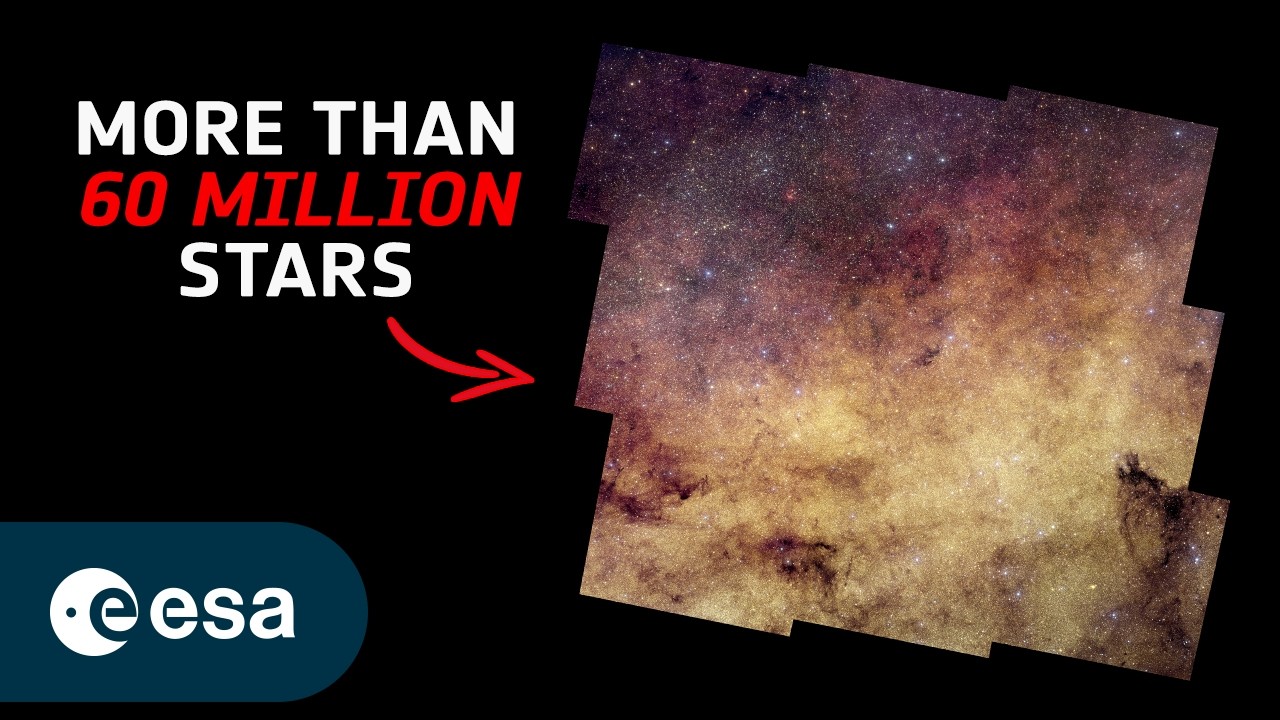
Released on June 24 by the European Space Agency (ESA), the sparkling snapshot contains more than 60 million stars, just a fraction of the 100 billion or so estimated to exist in our galaxy. It’s the largest and most detailed photo of the Milky Way’s middle ever taken in visible light, and it could help scientists identify planets far beyond the solar system, called exoplanets
The picture was captured by ESA’s Euclid space telescope, which launched in 2023 to map part of the night sky and uncover the mysterious influences of dark matter and dark energy on the universe. But on one day last March, astronomers put the instrument’s powerful technology to a different use.
“We’ve decided to point Euclid at the brightest area of the sky—and it works superbly. It’s extraordinary,” Jean-Charles Cuillandre, an astronomer at the Canada-France-Hawaii Telescope (CFHT) in Hawaii who works on the Euclid mission, tells the Agence France-Presse.
Over roughly 26 hours, the telescope’s visible light camera captured nine “pointings” each covering an area of sky larger than the full moon. They were stitched together to create the dazzling mosaic of the Milky Way’s center. The ESA also released a short video showing where the snapshot sits within the larger galactic bulge, the bright inner region of the galaxy. While Euclid’s original observations were in black and white, color was later added based on data from the CFHT.

“It was never built with this science in mind, but it has proved to be a superb facility for the work,” Eamonn Kerins, an astrophysicist at the University of Manchester in England, tells the Guardian’s Ian Sample.
Despite the extreme brilliance in this patch of the galaxy, Euclid’s camera was sensitive enough to differentiate between individual stars. This impressive capability also makes it an excellent tool for helping to identify exoplanets.
“This data fires the starting pistol in a new age of exoplanet discovery, where we go from knowing about 6,000 exoplanets to finding more than 100,000 across the galaxy,” Kerins says.
Starlight can reveal nearby exoplanets thanks to a phenomenon known as microlensing. When one star passes in front of another from an observer’s point of view, the closer star’s gravitational pull warps and brightens the background star’s light, acting as a “cosmic magnifying glass,” per an ESA statement. This can reveal whether the front star hosts a planet, because its gravity would also bend the background light, making it appear uneven.
The density of stars at the heart of the Milky Way makes it a perfect spot for catching such blips.
“During the last twenty years, almost 300 exoplanets have been discovered using this technique, all with ground-based telescopes and all towards the center of our galaxy. This image from Euclid includes 51 known planetary systems—and it will assist in studying many more that will be found,” Jean-Philippe Beaulieu, an astronomer at the Institut d’Astrophysique de Paris who has worked with Euclid, says in the statement.
Did you know? The black hole at our galaxy’s center
Within the dense cluster of stars in the middle of the Milky Way lies a supermassive black hole called Sagittarius A*.
The process of documenting a microlensing event takes around 20 days, which exceeds the limit of Euclid’s photographing capabilities, Andrew Paul reports for Popular Science. Instead, the newly released image will be used as a reference point for past and future planet-hunting missions.
NASA is set to launch its Nancy Grace Roman Space Telescope on August 30 with a goal of identifying thousands of new exoplanets. Having the new detailed image of the center of the Milky Way as a point of comparison will give astronomers more accurate measurements and a better understanding of the galaxy beyond our solar system.
/https://tf-cmsv2-smithsonianmag-media.s3.amazonaws.com/accounts/headshot/MicheleDebczak.png)