
See How Divers Clean This Statue of Jesus Christ Submerged Nearly 60 Feet Below the Surface of the Mediterranean
Located off the coast of northern Italy, “Christ of the Abyss” was installed in 1954 to commemorate lives lost at sea. The statue receives a routine cleaning every year
/https://tf-cmsv2-smithsonianmag-media.s3.amazonaws.com/accounts/headshot/Sonja_headshot.png)
/https://tf-cmsv2-smithsonianmag-media.s3.amazonaws.com/filer_public/66/d1/66d1cdac-92e5-4d36-802f-6eed9bfb4836/dsc7466.jpeg)
Since 1954, an eight-foot-tall bronze statue of Jesus Christ has been standing on the seafloor off of northern Italy. Created by sculptor Guido Galletti, Christ of the Abyss is a monument to lives lost at sea, and today it’s a popular Mediterranean diving attraction.
Installed nearly 60 feet beneath the waves, the statue is about 1,000 feet off the coast of the Liguria region. Because its location is an active coastal ecosystem, the artwork requires extra maintenance. Recently, Italian police divers visited the monument to perform the statue’s annual cleaning, removing a layer of crustaceans and bacteria using pressurized water guns.
Divers have been using this method since 2004, after one of the statue’s hands broke off and was repaired on land, report the Associated Press’ Silvia Stellacci and Nicole Winfield. Experts realized that their original cleaning method—scraping with metal brushes—had scratched the statue’s surface and was attracting corrosive marine life.

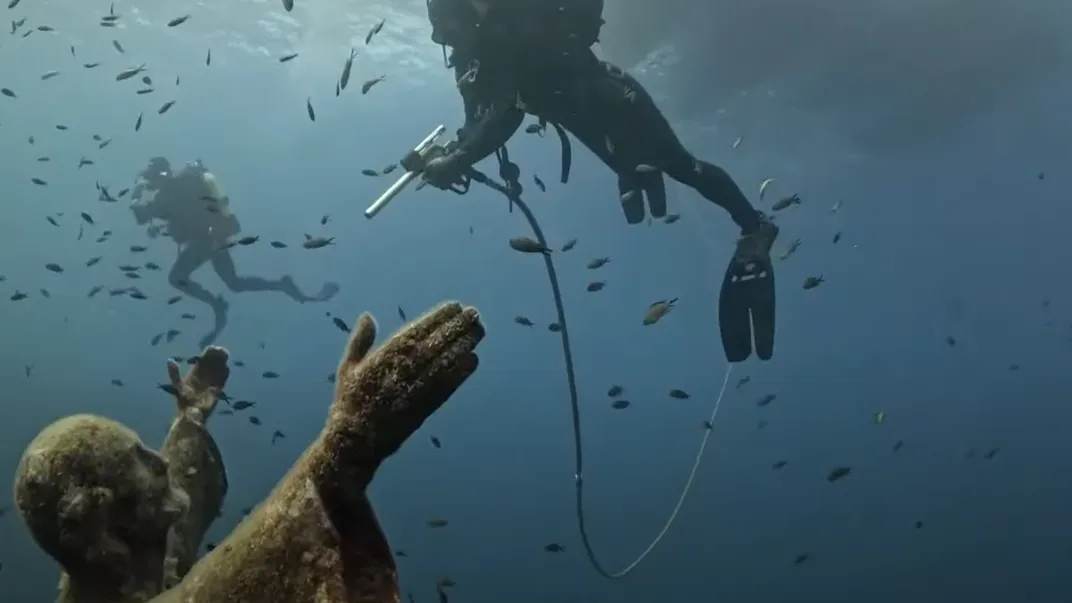
“We no longer use any hard tools,” Alessandra Cabella, an art historian with the Ligurian archaeology superintendent’s office, tells Colombia One’s Abdul Moeed. “Even brushes can cause long-term damage.”
The pressurized water guns clean the statue with seawater, and the method affects neither the bronze nor the surrounding ecosystem.
Quick fact: The statue’s original clay
The clay used to cast the first statue is now held in the collections of Italy’s National Museum of Underwater Activities.
“There are a ton of marvelous fish who come to watch,” Cabella tells the AP. “It’s truly an activity with zero impact on the environment.”
Christ of the Abyss was the brainchild of Italian scuba diver Duilio Marcante, who is known as the father of Italian diving education, according to Italy’s catalog of cultural heritage. The statue was made in honor of Dario Gonzatti, the first Italian to use scuba gear, who had died while testing equipment near Genoa in 1947.
As Time magazine reported in 1954, Marcante was looking into the waters of the Mediterranean one day when he started thinking: “Wouldn’t it be wonderful if there were a statue of Christ down there? Then the dead—all who have lived by the sea and died in it—could have their own secure refuge, a place to pray.”
Galletti sculpted a plaster mold depicting Christ with his face upturned and arms outstretched. He cast the statue in a mixture of melted down metals: fragments of ships, cannons, fallen soldiers’ medals and athletes’ trophies, per the AP and Time. To ensure the statue wouldn’t stray from its place on the seafloor, it was attached to a heavy base, filled with cement and reinforced with iron rods, according to Colombia One.
/https://tf-cmsv2-smithsonianmag-media.s3.amazonaws.com/filer_public/34/e9/34e9dd96-8d25-4de2-a5fc-2ebe714f2450/christ_of_the_abyss_key_largo_fl_-_panoramio.jpeg)
In the decades that followed, two more statues were cast from Galletti’s mold and placed across the Atlantic: One Christ of the Abyss was placed off Key Largo in Florida, while another was installed above water in Grenada.
Italy’s Christ of the Abyss remains the world’s most famous version of the sculpture. Partly because the statue is close to the coast in relatively shallow waters, it’s the most frequented dive spot in the Mediterranean, Italian officials tell the AP. In addition to scuba divers, the statue attracts kayakers and paddleboarders who can see the bronze from above.
When the statue was installed after a Catholic mass in 1954, Marcante and other divers descended to lay flowers at its base, per Time. “There was a lump in my throat so bad I could hardly breathe, and I didn’t think I’d ever manage to get to the bottom with my carnations,” he recalled when he resurfaced. “Then I saw the statue down there. It was truly moving. I shall never forget it.”
/https://tf-cmsv2-smithsonianmag-media.s3.amazonaws.com/accounts/headshot/Sonja_headshot.png)