
Meet Bubbles, a Dolphin in Australia That Chases Fish Until They Barf—Then Eats Their Upchucked Meals
Scientists recorded 11 instances of Bubbles successfully snacking this way. They mark some of the first detailed observations of kleptoparasitism, or food stealing, in cetaceans, the group of marine mammals that includes dolphins, whales and porpoises
/https://tf-cmsv2-smithsonianmag-media.s3.amazonaws.com/accounts/headshot/SarahKuta.png)
/https://tf-cmsv2-smithsonianmag-media.s3.amazonaws.com/filer_public/a8/a5/a8a5e093-276c-42c5-b311-5439a069f9c0/bubbles-lei-tracyolive.jpg)
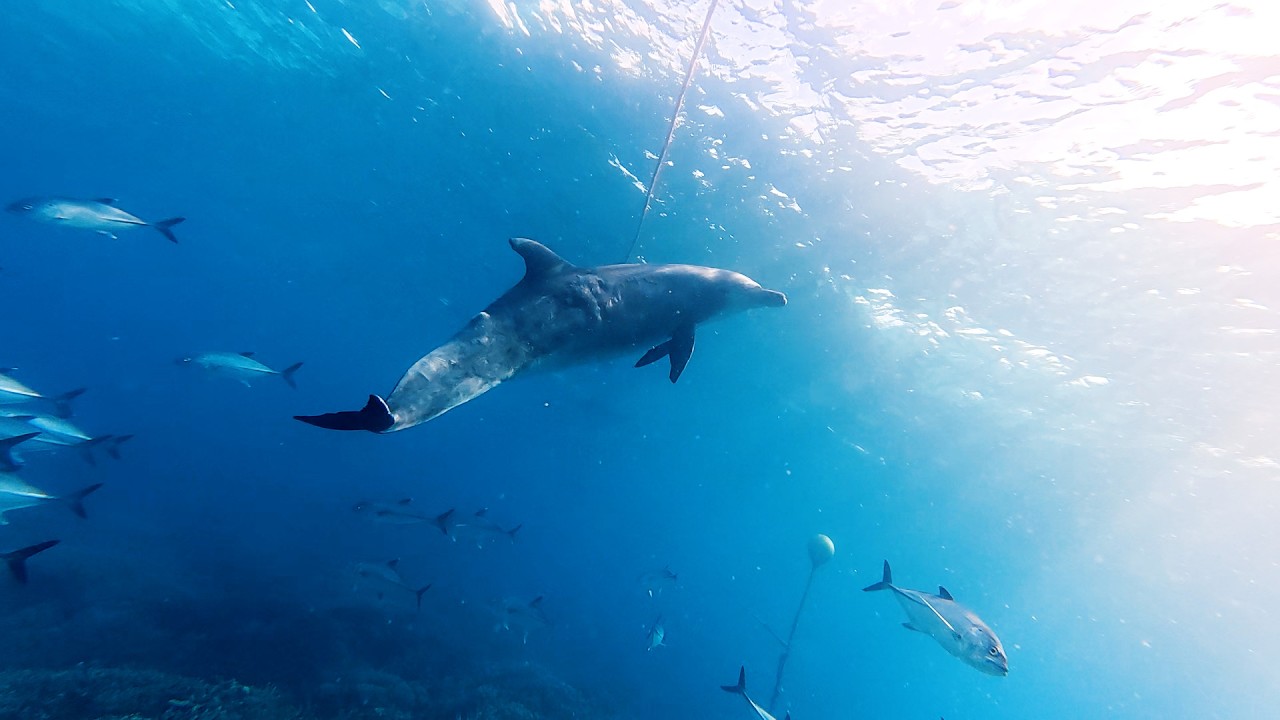
Most dolphins chase fish so they can gobble them up. But not Bubbles, a common bottlenose dolphin that lives off the east coast of Australia. Instead of going after the fish themselves, he hounds them until they throw up, then he swoops in and eats their vomit.
Scientists describe Bubbles’ unusual—and gross—feeding strategy in a study published September 13 in the journal Ecology and Evolution. They say their study represents one of the first detailed descriptions of kleptoparasitism, or food stealing, in cetaceans, the group of marine mammals that includes dolphins, whales and porpoises.
Study co-author Asia Armstrong, a marine scientist at Australia’s University of the Sunshine Coast, first became aware of Bubbles in 2017, when she watched video footage of his unconventional foraging technique. Intrigued, she rounded up some colleagues and decided to investigate.
Between June 2021 and October 2025, the team used GoPro cameras to capture instances of Bubbles feeding off Lady Elliot Island, a coral cay at the southern tip of the Great Barrier Reef east of mainland Queensland.
The recordings show Bubbles, an adult male nicknamed by locals, swimming among schools of bigeye trevally. But rather than chowing down on the fish themselves, he would single one out, pursue it until it regurgitated, then eat its vomit. He repeated this process multiple times during the same foraging session, performing up to ten chases in 30 minutes.
The researchers recorded 20 total foraging attempts. Of those, Bubbles ate food regurgitated by a trevally 11 times.
The footage also revealed that, before approaching the schools of fish, Bubbles made clicking sounds and twisted his head from side to side. The scientists suspect he might have been using echolocation to figure out which trevally had full stomachs.
“Echolocation does allow dolphins to discriminate small differences in their targets’ shape, size and structure, so the dolphin potentially uses echolocation to decide which fish to target to get the best reward,” Armstrong tells Scientific American’s Gennaro Tomma.
Once he started chasing a single fish, Bubbles made repetitive clicking noises and low-frequency sounds. These vocalizations may have scared the pursued animal into throwing up. (It’s also possible, however, that the fish were using puke as a decoy to save themselves from being eaten.)
Did you know? Big fish
Bigeye trevalley can grow up to 33 inches long.Why has Bubbles seemingly developed a taste for barf? Researchers aren’t sure what’s behind the behavior, but they have a few ideas. At first, he might have intended to eat the fish themselves—but after one threw up, he learned to take advantage of upchucked meals.
Another possibility is that the vomit is easier for Bubbles to feast upon than the fish themselves, because bigeye trevally are hefty creatures that can take a lot of time and energy to consume, Vivienne Foroughirad, a marine biologist at Texas A&M University who was not involved with the research, tells Science’s Sahas Mehra.
Whatever the explanation, Bubbles seems pleased with his technique. After eating puke, “he turns his head straight towards me, does this really long click, and it’s almost as if he’s saying, like, ‘Look what I did! I got the food. I’m so smart,’” study co-author Jacinta Shackleton, an independent marine biologist and underwater photographer, tells BBC Wildlife Magazine’s Melissa Hobson.

Still, Jason Bruck, a marine biologist at Stephen F. Austin State University, is skeptical that the footage proves Bubbles is deliberately harassing fish so he can feast on their barf. Recording multiple instances of the behavior is “compelling evidence that this was more than simply opportunistic feeding,” he tells Scientific American, but he’s cautious about “assigning intention” to the behavior.
“We can’t yet say the dolphin is pursuing the fish because it expects it to regurgitate,” says Bruck, who was not involved with the study.
Kleptoparasitism has been observed in numerous species, mainly birds, including frigatebirds, which are sometimes called “pirates of the sky” because they rely heavily on food stolen from other birds.
But it’s been difficult for scientists to document food theft in cetaceans. One of the only other known descriptions of kleptoparasitism among the creatures comes from Janet Mann, a marine biologist at Georgetown University, who described a dolphin stealing fish from cormorants.
The scientists behind the new study suspect, however, that kleptoparasitism and other unconventional foraging tactics are likely underreported in cetaceans.
“The challenge is monitoring the animals underwater over longer time periods to capture their full range of behaviors,” study co-author Romney Edwards-Francis, a marine biologist at the University of the Sunshine Coast, says in a statement. “Combining emerging technologies such as drones with underwater surveys may provide a way to overcome this.”
/https://tf-cmsv2-smithsonianmag-media.s3.amazonaws.com/accounts/headshot/SarahKuta.png)