
A Smithsonian magazine special report
In June 1775, the American Patriots Faced Off With the British at the Battle of Bunker Hill. Archaeologists Are Uncovering Evidence of the Fighting 251 Years Later
Researchers discovered gun parts, musket balls and other artifacts in Boston’s Charlestown neighborhood
/https://tf-cmsv2-smithsonianmag-media.s3.amazonaws.com/accounts/headshot/SarahKuta.png)
/https://tf-cmsv2-smithsonianmag-media.s3.amazonaws.com/filer_public/3b/5a/3b5a3f32-3dc2-42a0-9c9b-b105467d5436/724858384_1407462574760635_2834599002815062206_n.jpg)
The Battle of Bunker Hill was one of the most important battles of the Revolutionary War. Though the British successfully captured Boston’s Charlestown region, they suffered more than 1,000 casualties, nearly twice as many as the American patriots’ inexperienced colonial militia. The June 17, 1775, confrontation made clear that the British would not be able to easily suppress the uprising.
Now, 251 years later, archaeologists are uncovering long-buried artifacts from that pivotal day in American history.
Led by Joe Bagley, the city of Boston’s archaeologist, the dig has turned up an array of Revolution-era objects, including weaponry believed to have been used during the iconic battle. So far, archaeologists have unearthed gun parts and musket balls that appear to have been fired but didn’t strike anyone, reports Michael Casey for the Associated Press.
“It’s crazy. This hasn’t seen the light of day for 250 years,” Bagley told the Boston Globe’s Brian MacQuarrie while holding one of the artifacts discovered during the excavations. “And it’s witnessed hell. The person who had this with him was in the middle of a living nightmare.”

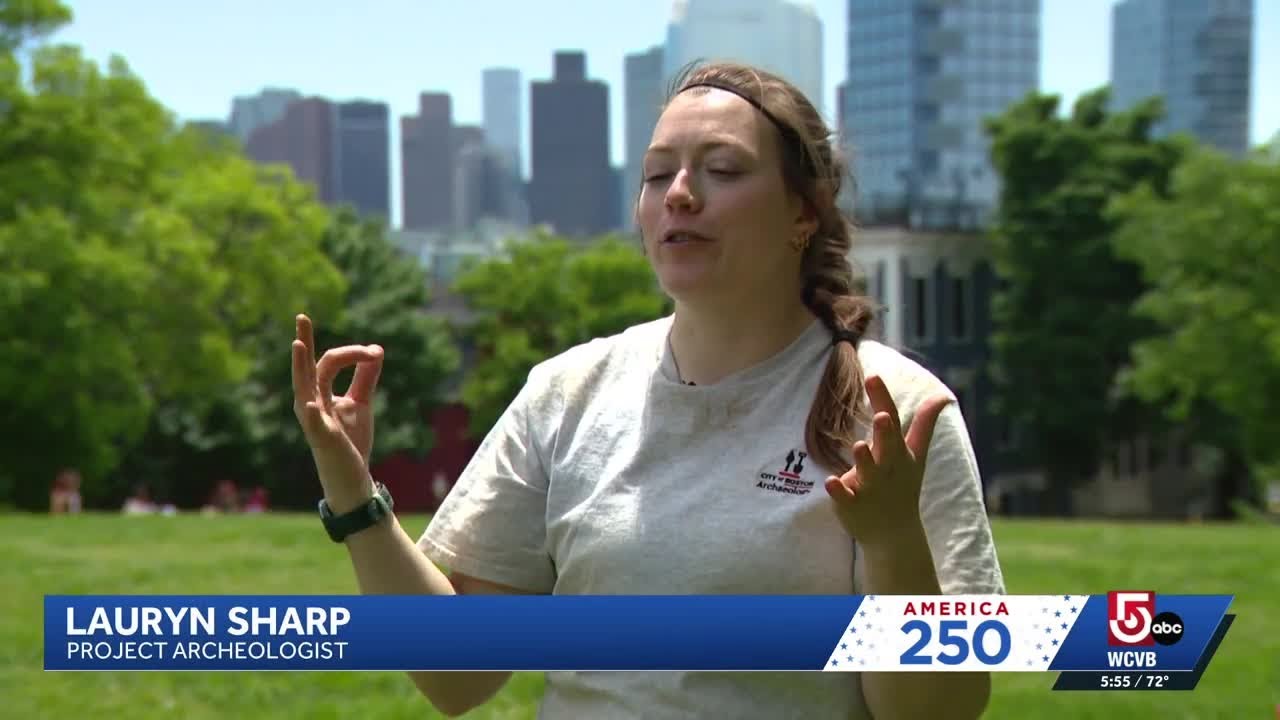
Archaeologists have also unearthed tea cups, tobacco pipes, sleeve buttons and a wig curler, which they suspect were left behind by the British who occupied the area after their victory. They have not yet discovered any human remains, however, a forensic archaeologist is on site should they find any. Some 115 American and 226 British troops were killed in the fighting.
“There were a lot of men who fought and died here from both sides,” Joel Bohy, a historic arms and militaria expert working on the project, tells Fox News’ Kailey Schuyler. “So as much as we get excited about these finds, we need to remember the human side of this also.”
Researchers have been digging near the Bunker Hill Monument, a grassy park surrounding a 221-foot white obelisk located within Boston National Historical Park in the city’s Charlestown neighborhood. They’ve been carefully excavating four-inch-thick sections of soil, then filtering the material through screens to reveal any hidden artifacts.
They believe they’ve located the square redoubt American patriots hastily built before the battle. More than 1,000 individuals shoveled through the night to dig a trench that measured three feet deep by more than six feet wide. As they scooped out the dirt, they used it to build a six-foot-tall, 150-foot-long wall in front of the ditches that made up each side of the square.
Did you know? Battle confusion
The earthen fortification created by the Americans was originally intended for Bunker Hill. But, for some unknown reason, the patriots instead fortified a lower, adjacent site called Breed’s Hill. Though the skirmish is known as the Battle of Bunker Hill, most of the fighting took place at Breed’s Hill.
Researchers knew about the redoubt from a map drawn shortly after the battle. But they hadn’t confirmed its square shape until now.
“Everything about the ditch is from 1775,” Bagley tells the AP. “It’s pretty powerful because these things are being dropped in the middle of the battle.”
Any artifacts recovered from the site will be taken to the city’s archaeology lab for further study and preservation. Longer-term, they’ll be cared for by the National Park Service, which manages the park.
“We have all these historical documents, but this is the evidence, this is the anchor,” Meg Wilkes, an archaeology adviser to Boston National Historical Park, tells the Boston Globe. “Everything we find tells a story.”
The Battle of Bunker Hill excavations are part of a broader, city-wide initiative called Boston 250 Archaeology, launched in honor of America’s 250th anniversary. Archaeologists have been digging throughout the Charlestown neighborhood, including the area behind Christ Church Charlestown and in private backyards, as Cat McQuaid reported for the Boston Globe last year.
In addition to learning more about the battle itself, they also want to understand the lives of the everyday people who lived in Charlestown in 1775, including the neighborhood’s women, children and Black and Indigenous residents.
“This isn’t just the history of the battle. It’s also the history of Boston,” Bagley tells CBS Boston’s Aaron Parseghian. “We’re really excited to actually see so many pieces of history, kind of connecting all of those stories beyond just the battlefield, which is incredibly important.”
/https://tf-cmsv2-smithsonianmag-media.s3.amazonaws.com/accounts/headshot/SarahKuta.png)