
How to Watch the Total Solar Eclipse on a Livestream, Witnessing the Rare View of the Sun’s Corona From Your Own Home
Wednesday’s eclipse will bring dark skies to parts of Russia, Greenland, Iceland, Portugal and Spain. But with these online broadcasts, you can view the spectacle from anywhere
/https://tf-cmsv2-smithsonianmag-media.s3.amazonaws.com/filer_public/72/04/72041dbe-3241-401b-b141-6331bb5ce548/nhq201708210105large.jpg)
The final countdown has begun for the first total solar eclipse to grace our planet in 28 months—on August 12, a fleeting daytime darkness will fall across a narrow portion of Earth, revealing highly coveted views of the ethereal solar corona.
The narrow path of totality will sweep largely over water, but it will also darken skies above parts of Russia, Greenland, Iceland, Portugal and Spain. Wednesday will be mainland Europe’s first experience of totality since 1999, and some locations in Spain will experience the eclipse in the late evening, offering the chance to see totality just before sunset. Meanwhile, a partial eclipse will occur over areas of Europe, Africa, Asia and North America.
Did you know? An eclipse during the season of midnight sun
When the total solar eclipse passes over northern Greenland, it will bring darkness to a place that has not seen the night sky in months. Due to its high latitude, this region does not experience sunset in summer, so the two minutes of totality promise to offer a special glimpse of stars in the midst of around-the-clock daylight.
Totality is somewhat short during this eclipse—its maximum duration will occur over the Atlantic Ocean between Greenland and Iceland, and that will last for just two minutes and 18 seconds. And compared to the North American eclipse of 2024, which brought totality to an estimated 44 million residents across the continent, this spectacle will visit a smaller resident population: About 15.2 million people live in the path of totality for this eclipse. The moon’s shadow will travel some 5,157 miles across Earth’s surface—a mere 0.47 percent of the planet.
If you won’t be in the path of totality this time around, you can still watch its splendor live. Space agencies, museums and other organizations will be streaming and sharing views of the eclipse from sites including Greenland, Iceland and Spain.
Here’s how you can watch the eclipse from your home, no matter where you live.
European Space Agency

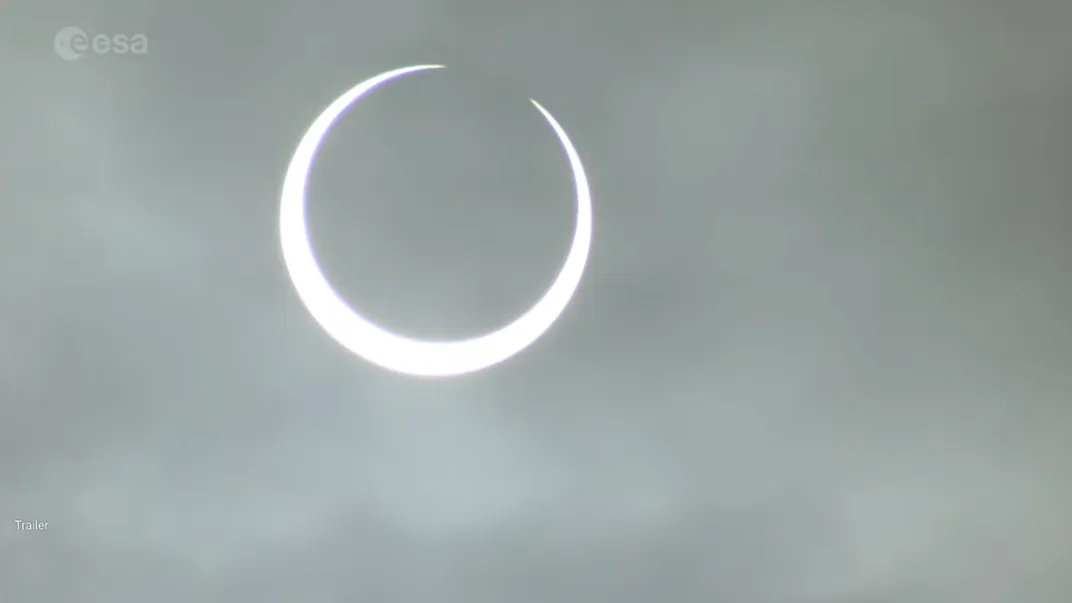
As the eclipse moves over the planet, the European Space Agency (ESA) will stream the event from the Astrophysical Observatory of Javalambre in Teruel, Spain.
Beginning at 1:30 p.m. Eastern time, anyone can tune in via the agency’s broadcast on YouTube, which will feature live telescope views of the eclipse, expert interviews and insights into space weather and solar eclipse science. Space scientist Maggie Aderin will host the coverage, and she will talk with ESA Director of Science Carole Mundell, among other experts. At 2:31 p.m. Eastern time, Javalambre will be plunged into darkness during one minute and 21 seconds of totality.
For a different experience, you can watch ESA’s live telescope feed of uninterrupted solar views.
NASA

The U.S. space agency’s live feed of the eclipse will launch at 1:15 p.m. Eastern time, and 30 minutes later, totality will begin in Iceland. At 2:28 p.m., NASA will air totality from Spain. The broadcast will feature interviews with experts and an overview of some of the science experiments that will help NASA learn more about eclipses, the sun and Earth’s atmosphere.
With support from NASA, the Nationwide Eclipse Ballooning Project will send students to the path of totality to measure how the cold and dark shadow of the moon affects the atmosphere. The researchers will launch 80 scientific balloons in Iceland and six in Spain with various instruments and cameras to collect observations. Another NASA-funded team will chase totality in a WB-57 high-altitude jet, with four cameras on its nose cone snapping images of the corona at least 20 times per second. By moving at 460 miles per hour, the research aircraft will extend its view of totality to almost three minutes.
Exploratorium
On August 12, the Exploratorium, a science and art museum in San Francisco, will be on the road, streaming live views of totality from Villalibado, Spain, beginning at 1:30 p.m. Eastern time. The museum’s feed will also be incorporated into a broadcast from the Virtual Telescope Project, which will air it alongside views of a partial eclipse from Manciano, Italy.
Time and Date

For the time, weather and astronomy site Time and Date, eclipse coverage will kick off at 12 p.m. Eastern. Hosted by journalist Anne Buckle and astrophysicist Graham Jones, the feed will bounce between sites in the path of totality. They hope to show the low-hanging sun near León in northwestern Spain, island views from Mallorca, science education content from Iceland and other celestial sights.
EarthSky
The skywatching website EarthSky will air coverage of the eclipse, featuring EarthSky founder Deborah Byrd and solar scientist C. Alex Young, associate director for science communication at the Heliophysics Science Division at NASA's Goddard Space Flight Center. They will talk through what happens at the sun throughout the celestial event and discuss solar science. The broadcast will go live at 12:30 p.m. Eastern time and feature views from across the path of totality.
Other coverage
Partial eclipse: This week’s spectacle will give the United Kingdom and Ireland their most complete view of an eclipse since 1999, which saw totality over much of Cornwall and Devon in England. On Wednesday, the U.K. and Ireland will see 90 to 96 percent of the sun covered. The Royal Observatory Greenwich will offer a livestream of the partial solar eclipse from one of their telescopes, beginning at 1:10 p.m. Eastern time.
Live updates: Space.com reporters Daisy Dobrijevic and Anthony Wood will post updates from two interesting locations in the path of totality. Wood, who is viewing his first-ever total solar eclipse, will be in northern Spain’s Valoria la Buena, where the eclipsed sun will hover especially low in the sky. Dobrijevic will get views of totality from an HX Expeditions cruise ship in the fjords of eastern Greenland.
The eclipse’s path over Greenland has sparked questions around whether viewers could spot the northern lights when the sky darkens—and experts say it is extremely unlikely but not impossible. Another tantalizingly rare possibility? Spotting a Perseid meteor during totality. “It would have to be a fireball that passed through the darkest portion of the sky,” Robert Lunsford of the American Meteor Society tells Space.com’s Wood. “If anyone does see one, they had better go play the lottery asap!”