
How Colorado’s Wildlife Mitigation Efforts—Including the Largest Animal Crossing Overpass in North America—Are Making Everyone Safer
Animals can now cross a dangerous stretch of Interstate 25 thanks to new infrastructure, including fences, underpasses and a massive overpass, which has led to a 91 percent reduction in wildlife-vehicle collisions

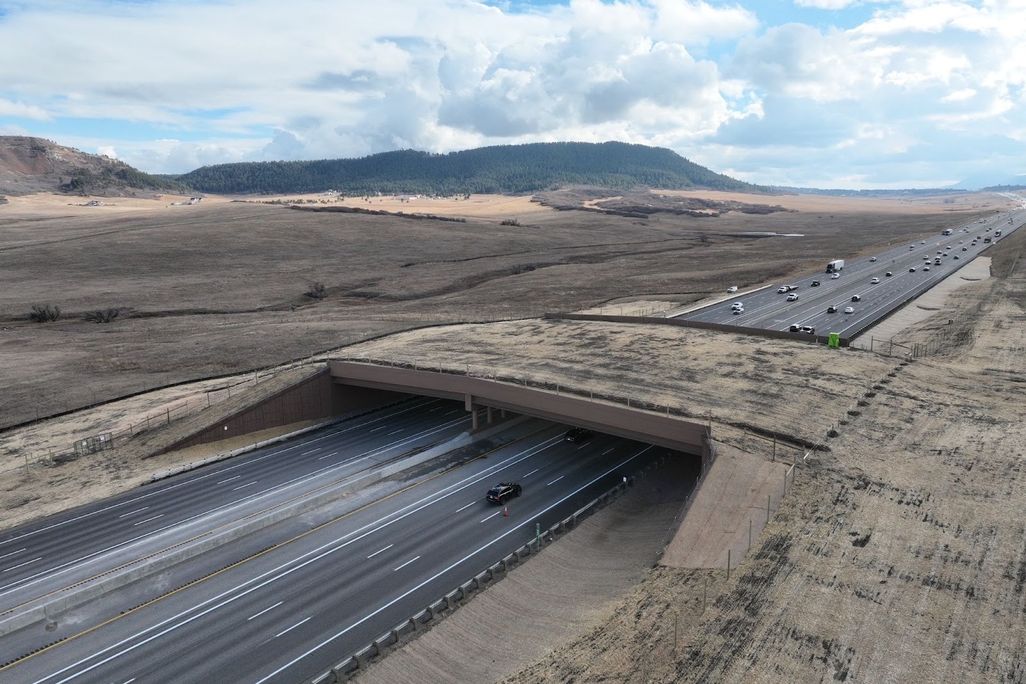
A new wildlife crossing system is making humans and animals safer in Colorado, officials say. Wildlife-vehicle collisions are down more than 90 percent along a busy stretch of freeway in the state, reports Colorado Politics’ Savannah Eller, thanks to new infrastructure that helps animals safely cross over and under the road.
The reduction in crashes comes along 18 miles of Interstate 25, a north-south thoroughfare connecting many of Colorado’s major cities. More than 100,000 vehicles travel this section of the interstate every day, cutting through some 39,000 acres of wildlife habitat. That proximity put elk, pronghorn, mule deer and numerous other species at risk whenever they wanted to cross from one side to the other.
“It was an effective wall that they had to play Frogger and try to get across,” Brandon Marette, a wildlife biologist for Colorado Parks and Wildlife, tells CBS Colorado’s Olivia Young, referencing the popular 1980s video game.
Human drivers faced the threat of dangerous—potentially deadly—collisions, too. So, three decades ago, local, state and federal officials decided to address the problem head-on.
In 1996, they began working on a series of strategically engineered wildlife crossing structures along the interstate between the towns of Castle Rock and Monument. They built 14 miles of eight-foot-tall fences on both sides of the freeway and installed five wildlife underpasses. In December 2025, officials celebrated the completion of the project with the opening of a $15 million wildlife bridge near the town of Monument, roughly 50 miles south of Denver. The bridge, which officials say is the largest of its kind in North America, fills a 3.7-mile gap between the other crossings.
The bridge measures 200 feet wide by 209 feet long, with a surface area of about 41,800 square feet—just shy of an acre. The overpass is designed for large game animals, which tend to prefer wide-open spaces with clear sightlines—and, so far, it appears to be working as intended. Elk have been caught on camera ambling across. And for the first time in years, pronghorn are wandering over to the west side of I-25.
“For decades, pronghorn going from Trinidad to Greenland were looking for a place to cross on I-25,” Chuck Attardo, the I-25 south corridor environmental project manager for the Colorado Department of Transportation, tells CBS Colorado. “And when we open this up, we have pronghorn on video using the overpass, and for the first time in decades they're coming over here to the west side.”
But officials say lots of creatures, big and small, are taking advantage. Surveys and trail cameras have revealed rabbits and northern leopard frogs using the overpass, per the Colorado Sun’s Olivia Prentzel.
Officials have tried to make the overpass, which spans six lanes of traffic, appealing to small mammals like the threatened Preble’s meadow jumping mouse by piling logs into a pathway to provide cover from predators such as coyotes, foxes and hawks. They’re also hoping to get more vegetation to grow on the overpass next year, as this year’s drought affected germination.
This area of Colorado used to be particularly dangerous, with an average of one wildlife-vehicle collision occurring each day during the spring and fall, Marette tells CBS Colorado, when animals like elk, mule deer and pronghorn are on the move. The ungulates spend their winters grazing at lower elevations and their summers in the mountains, with twice-yearly migrations in between those seasonal ranges.
Between 2022 and 2024, after most of the wildlife mitigation measures had been completed but not the overpass, wildlife-vehicle collisions on this section of I-25 declined by about 85 percent per year on average, per Colorado Politics. They dropped by 91 percent during the final year of the study period.
Officials are still collecting data on how the overpass specifically is affecting wildlife-vehicle collisions, per Colorado Politics. However, since the bridge opened ten months ago, just two such accidents have been reported, per the Colorado Sun. The decline in crashes has also led to a roughly 9 percent decrease in travel delays along the heavily trafficked stretch.
“We are thrilled,” Bridget O’Rourke, a spokesperson for Colorado Parks and Wildlife, tells the Colorado Sun. “Wildlife overpasses and underpasses and funneling animals to have a safe path across the roads; it’s been statistically proven that it’s successful.”
Did you know? California’s large wildlife bridge
California is building a massive $114 million wildlife crossing over Highway 101 in Los Angeles County that’s expected to open in December.
Looking ahead, Colorado officials hope to make other roadways safer. They’re developing six additional crossing systems throughout the state, including the first overpass created specifically for Rocky Mountain bighorn sheep, Colorado’s state animal.
“They pay for themselves in about 15 years because of all those accidents that they prevent, and so why wouldn’t you do more of these?” Attardo tells CBS Colorado.
