
For Almost 600 Years, This Enigmatic Jan van Eyck Painting Has Entranced Viewers. Could It Actually Be a Self-Portrait in Disguise?
The new theory about the “Arnolfini Portrait” comes as London’s National Gallery brings together all 10 of the artist’s known portraits for the first time ever

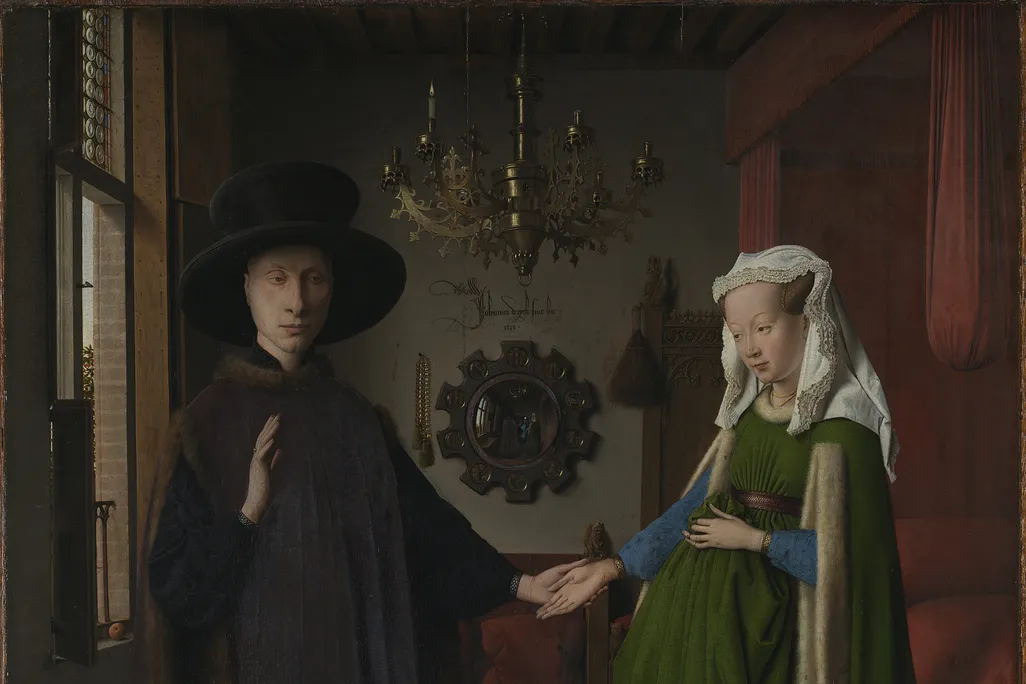
Ahead of a new exhibition celebrating the portraiture of famed Netherlandish painter Jan van Eyck, a new theory has emerged about one of the artist’s most famous—and deeply puzzling—canvases.
At first glance, the scene in van Eyck’s 1434 Arnolfini Portrait seems straightforward: A man, dressed in black, and woman, clad in green, stand at the center of a lavish room where every detail—furniture, a dog, jewelry, oranges—is placed as though to purposefully highlight their wealth. But a closer look at the space’s geometry offers more uncanny observations. There is no fireplace, as would have been expected, and the ceiling is too low to realistically accommodate the chandelier that nonetheless dangles above their heads. Meanwhile, a convex mirror on the far back wall reveals that the pair are not alone; two figures are entering the room. The man in black lifts his hand, apparently in silent greeting, while a large inscription beside his head reads, in Latin: “Jan van Eyck was here 1434.”
Of all the details in the piece, which borders on the surreal, the identity of the man has been speculated upon the most. The leading theory derives from the 16th century, when inventory records labeling the painting as “hernoul le fin” were interpreted to be the French spelling of “Arnoul fin,” or “Arnolfini,” the surname of a wealthy Italian merchant clan who lived and worked in Bruges, Belgium, where van Eyck kept his studio.
For centuries, many art historians have supported this understanding, considering the piece to be a portrait of some members of that family. Some scholars identify the man as Giovanni di Arrigo Arnolfini, while others think it depicts his cousin, Giovanni di Nicolao Arnolfini. But now, as London’s National Gallery prepares to open “Van Eyck: The Portraits,” an exhibition, a new theory put forth about the canvas potentially turns its meaning on its head.


Writing in the exhibition catalogue, Stephan Kemperdick, a curator at the Berlin Gemäldegalerie, posits that the painting is actually a self-portrait of van Eyck and his wife. His evidence is multi-faceted. He points to the Latin inscription as a clear self-reference and suggests that “hernoul le fin” actually translates to mean something like “a deceived cheat.” He argues that the painting, in the early modern period, would have been received as more of a lewd genre piece than a portrait. And he fixates on a statue in bedframe, which has been identified as St. Margaret, to hint that the woman is van Eyck’s wife, whose name was also Margaret.
The reception of this interpretation has thus far been mixed. Maximiliaan Martens, an art historian at the University of Ghent, tells the Art Newspaper’s J.S. Marcus that he “doesn’t see any reason to doubt” that “hernoul le fin” isn’t a reference to the Arnolfini family. Nicholas Flory, the exhibition’s co-curator, tells the outlet that the theory is “interesting” though “speculative.”
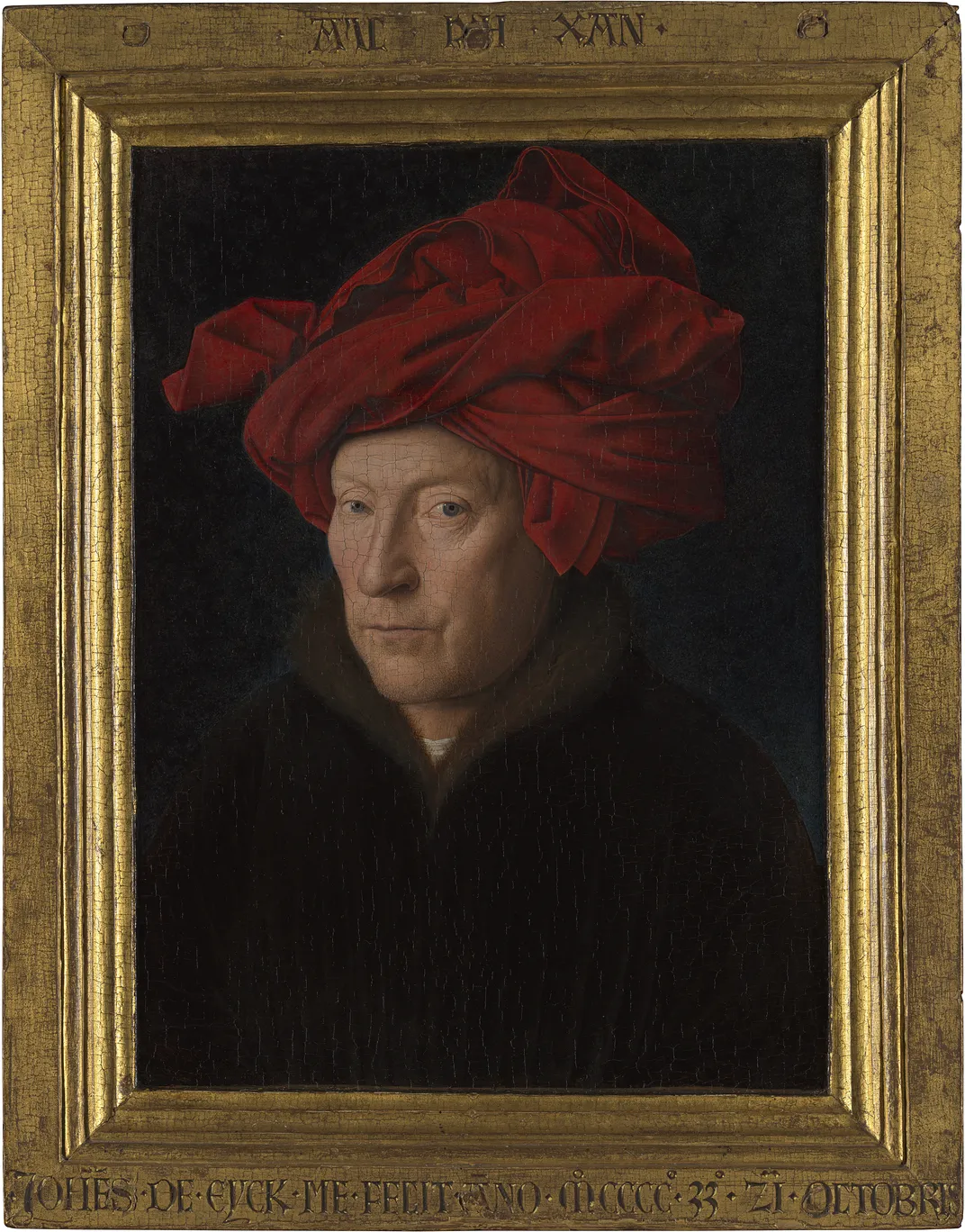
“It’s such a rewarding painting, and also a frustrating one at the same time. Even [after] many years of looking at it, it still allows you to see different things, to see surprising things, and it always sort of keeps you coming back,” Flory tells the “Collector” podcast’s Emily Snow. “There’s something very tantalizing about it that makes you want to look more carefully and harder … I hope that one day we solve all the questions that remain about it.”
The exhibition, which opens later this month and runs through early April, is the first time ever that all 10 of van Eyck’s known portraits have been gathered in the same space. By placing them all together, the show’s curators hope that the artist’s pioneering style, which often included mysterious and misleading details, can be appreciated in full.
Did you know? Van Eyck drawing
Also on view at the National Gallery exhibition is Portrait of an Elderly Man, van Eyck’s only surviving drawing. Created around 1438, it is the earliest existing record of a formal portrait sitting in European art history.
“Some stories do not have a beginning. Portraiture is one of them. It bursts onto the scene fully formed in the 1430s under the brush of Jan van Eyck,” Emma Capron, the exhibition’s co-curator, says in a statement. “These portraits’ ability to baffle by their precision and liveliness is intact today. Yet, just as van Eyck defined the fledgling genre of portraiture, he also subverted it with his cryptic inscriptions and the play of materials of his frames and reverses. These images do not divulge their meaning easily, and they are all the more rewarding for it.”
“Van Eyck: The Portraits” is on view at the National Gallery in London from November 21, 2026, through April 11, 2027.
