
Did Easter Island’s Mysterious Moai Statues Waddle to Their Final Locations? Here’s What That May Have Looked Like
Based on 3D modeling and testing on a moai replica, researchers think that small groups of people may have used ropes to “walk” the large statues across the island
/https://tf-cmsv2-smithsonianmag-media.s3.amazonaws.com/filer_public/53/10/53103a9b-7812-46e2-97c6-0aa414821e20/gettyimages-2183724800.jpg)
How did Easter Island’s famed moai statues get to where they are?
It’s a question that has long fascinated historians, archaeologists, anthropologists and tourists alike. Now, a team of researchers at Binghamton University has a possible answer: They think that the statues were “walked” into place by the Indigenous inhabitants of the Pacific Ocean’s Easter Island (also known as Rapa Nui), now part of modern-day Chile.
The moai statues, large stone figures depicting human faces and forms, were built mostly between roughly 1300 and 1600 C.E. They vary in size but usually stand around 13 feet tall and weigh about ten metric tons. Roughly half of them are at Rano Raraku, the quarry where they were built, but hundreds are scattered across the island. Over the years, researchers have proposed many theories for how they got there—including that they were rolled, dragged or pulled by sled—but “no supportive evidence has backed those claims,” writes Wired’s Ritsuko Kawai.
The Binghamton researchers have gathered evidence for a different method: They think that the people of Rapa Nui tied ropes around the statues, then pulled them from side to side, making them waddle forward in a zig-zagging motion along carefully designed roads. They detail their findings in a paper recently published in the Journal of Archaeological Science.

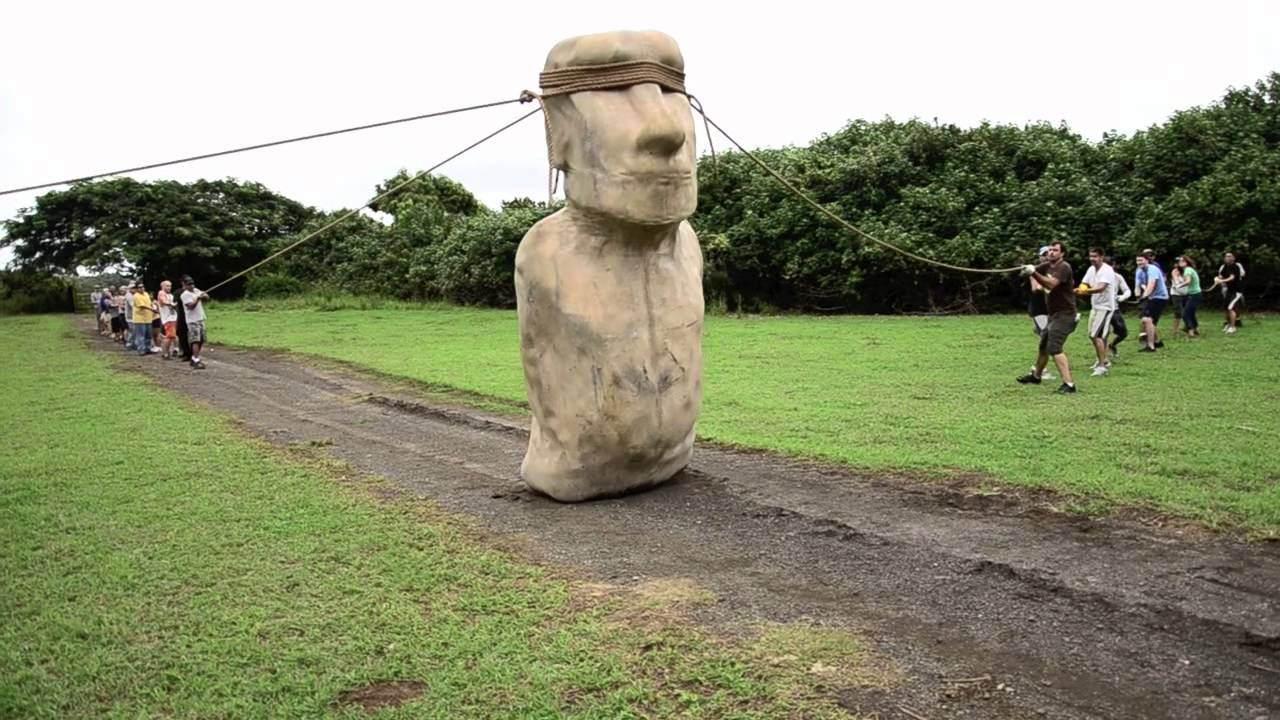
“What we found is the fact that statues were moved with very small numbers of people in an amazingly ingenious way,” co-author Carl Lipo, an anthropologist at Binghamton, tells Live Science’s Sophie Berdugo. “In a way that when you see it happen you’re like, ‘Of course they moved it that way.’”
This conclusion comes from a combination of physics, 3D modeling and real-life testing on a 4.4 metric ton moai replica conducted in 2012, which has been watched millions of times on YouTube.
Quick fact: How many moai statues are on Easter Island?
The island is home to more than 800 historic statues, with roughly 400 located at Rano Raraku.
“Once you get it moving, it isn’t hard at all—people are pulling with one arm. It conserves energy, and it moves really quickly,” Lipo says in a statement. “The hard part is getting it rocking in the first place. The question is, if it’s really large, what would it take? Are the things that we saw experimentally consistent with what we would expect from a physics perspective?”
By analyzing 3D renderings of the moai, the Binghamton team identified distinctive features of the statues that would lend themselves to the zig-zag rocking method, including a low center of mass, a D-shaped base and a forward lean.
They built their replica with its own forward-lean design and gave it a shot. A group of 18 people was able to move the statue 100 meters (328 feet) in 40 minutes.
“The physics makes sense,” Lipo says in a statement. “What we saw experimentally actually works. And as it gets bigger, it still works. All the attributes that we see about moving gigantic ones only get more and more consistent the bigger and bigger they get, because it becomes the only way you could move it.”
Another key piece of evidence for the researchers are Easter Island’s roads. Measuring around 4.5 meters (15 feet) wide, the roads have a concave cross-section, which would have been the perfect terrain for “walking” the moai. The island is also dotted with moai that may have fallen along their journey.
In addition to proposing a potential solution to a centuries-long mystery, the Binghamton research also highlights the ingenuity of the island’s inhabitants.
“It shows that the Rapa Nui people were incredibly smart. They figured this out,” Lipo says in a statement. “They’re doing it the way that’s consistent with the resources they have. So it really gives honor to those people, saying, look at what they were able to achieve, and we have a lot to learn from them in these principles.”
It’s not the only research about the moai statues that has come out this year. A recent paper in the Journal of Cultural Heritage found that rising sea levels caused by climate change will threaten the historic statues in the coming decades.